


Feeding change
As pressure mounts on animal agriculture, pet food has emerged as an unlikely proving ground for alternative proteins – delivering scale, speed, and scientific validation in 2025
For much of the past decade, alternative proteins have been discussed as a future solution still waiting for its commercial moment. The science advanced faster than the markets, the narratives often ran ahead of the infrastructure, and credibility remained fragile. In 2025, that imbalance began to correct itself. The turning point did not arrive first on human plates. It arrived quietly, methodically, and with surprising momentum in pet bowls.
“Pet diets such as those based on plant-based ingredients or cultivated meat could transform the pet food system, lowering adverse impacts for farmed animals and the environment,” said Andrew Knight, Adjunct Professor at Griffith University, after co-leading one of the largest global studies ever conducted on sustainable pet nutrition.
What unfolded over the year was not a single breakthrough, but a convergence. Regulatory pathways clarified. Products reached shelves in real retail environments. Costs moved sharply downward. Palatability trials produced results that were difficult to dismiss. Capital followed companies demonstrating execution rather than aspiration. By the end of 2025, alternative pet food no longer looked speculative. It looked operational.
Demand no longer hypothetical
Before examining what companies built, it is worth understanding what consumers were prepared to accept.
Two large studies published in Animals in November explored attitudes toward sustainable pet diets among more than 4,000 dog and cat guardians worldwide. Among 2,639 dog guardians surveyed, 43% said at least one more sustainable option was acceptable. Cultivated meat emerged as the most favored, selected by 24%, ahead of vegetarian and vegan diets. Among 1,380 cat guardians, acceptance was even higher, with 51% open to alternatives and 33% identifying cultivated meat as acceptable.
Across both studies, priorities were strikingly consistent. Nutritional soundness and good pet health outcomes ranked highest, far ahead of environmental considerations. Sustainability mattered, but only once trust in nutrition and safety was established.
Knight connected these findings to a broader reckoning around pet food’s footprint. “Recent studies have demonstrated our dogs and cats collectively consume a substantial proportion of all farmed animals,” he said. “Pet diets such as those based on plant-based ingredients or cultivated meat could transform the pet food system.”
The implication was clear. The barrier was not curiosity. It was proof.

Plant-based pet food grows up
Plant-based pet food was the first alternative category to demonstrate commercial viability, particularly in dogs. By 2025, it had moved well beyond early adopters.
Munich-based VEGDOG became one of the clearest signals of that maturation. In June, the company raised €9 million in Series A funding to expand across Europe, reporting €10 million in annual sales and 66% year-over-year growth. Investors pointed not to novelty, but to execution.
“Nowadays, no animal has to die to give our dogs the best food,” said CEO and co-founder Tessa Zaune-Figlar. “We have the technological means to develop high-quality, tasty, animal-free recipes.”
VEGDOG’s success rested on a disciplined focus on nutritional completeness, veterinary collaboration, and brand trust. Its dog food range had already demonstrated that plant-based formulations could perform in the real world. In late 2025, the company extended that confidence into more contested territory: cats.

With the launch of VEGCAT Pure Bites, a fermented-protein snack for cats, VEGDOG entered the feline category cautiously but deliberately. The product delivered 60% protein from biomass fermentation, included added taurine at 4,000 mg/kg, and was positioned as a supplemental treat rather than a complete diet.
“From the very beginning, our vision was to replace meat-based products in the pet food sector with healthy plant-based alternatives,” Zaune-Figlar said. “Thanks to new, innovative raw materials and scientific advances, it is now possible to feed cats a balanced plant-based diet.”
The decision to start with snacks reflected regulatory pragmatism and market sense. Treats move faster, build trust, and generate data. VEGDOG was not rushing the category. It was methodically expanding it.

Fermentation proves its appetite appeal
If plant-based pet food established the commercial foundation, fermentation-based proteins began to answer one of the sector’s most persistent questions: will pets actually eat it?
Hamburg-based MicroHarvest provided some of the clearest evidence. In April, the company reported palatability results for its MPX microbial protein across 60 companion animals, including cats. In head-to-head trials against conventional kibble, 68% of cats preferred the MPX formulation, consuming significantly more of it than the control. Among dogs, preference and intake were similarly strong.
“Palatability is a non-negotiable factor,” said Ally Motta, Application Specialist at MicroHarvest. “The fact that both cats and dogs not only preferred MPX but consumed more of it proves that microbial protein can compete on taste, not just sustainability or nutrition.”
These results mattered because they were generated using adapted commercial formulations, not bespoke lab diets. The question shifted from whether fermentation-based proteins could work to how quickly they could be integrated.

That integration was already underway elsewhere. In March, German brand Marsapet launched the first complete dog food containing FeedKind Pet protein, a fermentation-derived protein developed by Calysta. The MicroBell kibble delivered all essential amino acids, was vegan and grain-free, and targeted dogs with allergies or sensitivities.“Marsapet are true innovators in the industry,” said Herman Sloot, Vice President of Global Sales at Calysta. “With MicroBell, they’re introducing both the first pet food to use FeedKind Pet protein and a new choice for pet parents who want to give their dogs high-quality protein that does not impact the planet’s biodiversity.”
Crucially, FeedKind was not constrained by pilot-scale limitations. Calysta’s joint venture had capacity to produce 20,000 tons per year, underscoring that fermentation was no longer a bottlenecked technology.

Mycoprotein and the carbon argument
Alongside microbial proteins, mycoprotein began to establish itself as a compelling environmental alternative.
Finnish company Enifer released a Life Cycle Assessment in February showing that its PEKILO Pet mycoprotein had a cradle-to-gate carbon footprint of 0.93 kg CO₂e per kilogram. That was roughly seven times lower than soy protein concentrate and significantly lower than insect protein or lamb-based ingredients.
“We are incredibly pleased with the results of this CFP study,” said CEO Simo Ellilä. “The findings reinforce our mission to offer sustainable, high-protein solutions to the pet food industry.”
PEKILO Pet’s performance was driven by biomass fermentation that avoided direct land use, resulting in negligible land-use change emissions. While the data was based on projected industrial operations, the direction of travel was unambiguous.
Environmental analysis reinforced what consumer research had already suggested. Pet food was no longer a marginal sustainability issue. It was a meaningful lever.
A broader review published in May went further, concluding that if all pet dogs globally were switched to nutritionally complete vegan diets, the food energy savings could feed an estimated 450 million people, while greenhouse gas reductions would exceed the UK’s annual emissions.
“Sustainable pet food isn’t just a niche trend,” said Billy Nicholles, lead author of the review. “It’s a climate solution hiding in plain sight.”
Precision fermentation enters the science phase
If fermentation proved palatability and mycoprotein quantified climate benefits, precision fermentation delivered something else in 2025: peer-reviewed nutritional validation.
In August, a study published in Frontiers in Animal Science assessed brewed chicken protein produced via precision fermentation and included at up to 40% of adult dog diets over a six-month feeding trial. The results were unambiguous. No adverse health effects were observed. Protein digestibility exceeded 80%. Dogs strongly preferred BCP-coated diets in palatability tests.
“The lack of change to food intake, body weight, serum chemistry, and hematology over six months of feeding suggests that the inclusion of BCP of up to 40% of the diet for adult dogs is safe,” the authors wrote.
Beyond safety, the study documented favorable shifts in gut microbiota, reduced fecal odor compounds, and improved digestibility metrics. Precision fermentation had moved from concept to credible nutritional ingredient.
Cultivated meat reaches the shelf
While fermentation technologies gathered momentum, cultivated meat made the leap from regulatory theory to commercial reality, with pet food as its first proving ground.
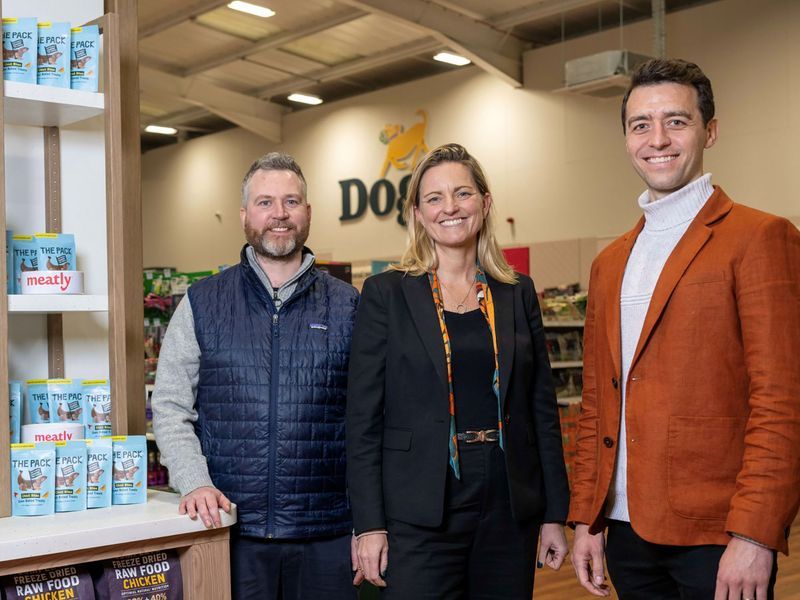
In February, UK startup Meatly and alternative pet brand THE PACK launched Chick Bites at a Pets at Home store in Brentford, London. It was the first cultivated meat product sold commercially in Europe, for pets or humans.
“Cultivated meat can be a game-changer for us, our pets, and the planet,” said Meatly CEO Owen Ensor. “The starting point is today.”
The launch followed UK regulatory approval in 2024 and demonstrated that cultivated meat could move through existing retail infrastructure without drama. For Ensor, the focus on pets was strategic. “Twenty-two percent of the meat consumed in the UK is consumed by pets,” he said earlier in the year. “Scaling Meatly will have an immediate impact.”
That impact extended beyond symbolism. By June, Meatly reported dramatic cost reductions, including a patent-pending bioreactor system 20 times cheaper than conventional models and growth media costs reduced to pennies per liter at scale.
“With just 1% of total global funding in this sector, we’ve created a process that is closing in on price parity,” Ensor said.
-p-800.jpg)
Regulation shifts from obstacle to infrastructure
If cultivated meat was to scale, regulation had to move with it. In 2025, it did.
In March, Vienna-based BioCraft received formal registration to commercialize cell-cultured ingredients for pet food across the European Union. The approval recognized BioCraft as a Feed Business Operator and cleared the use of Category 3 Animal Byproducts, effectively normalizing cultivated ingredients within EU feed law.
“Achieving ABP registration for an animal cell-based ingredient in the EU is a significant milestone,” said BioCraft Founder & CEO Dr Shannon Falconer. “This comprehensive safety analysis goes well beyond regulatory compliance.”
The company voluntarily met the highest dossier standards, validating over 100 nutrients and demonstrating parity with conventional meat slurry. Crucially, BioCraft’s ingredient was designed as a drop-in replacement, requiring no downstream processing changes.
Industry response was immediate. “Pet food producers are following this market space eagerly,” said Patricia Heydtmann of Partner in Pet Food. “There is a need for more ingredients that are supply-chain stable, scalable, safe, and ethical.”
High-inclusion products test the limits
BioCraft’s regulatory progress quickly translated into product ambition.
In April, BioCraft partnered with Romanian manufacturer Prefera Petfood to unveil a wet cat food composed of 99% cell-cultured mouse. The product targeted biological appropriateness rather than compromise.
“Achieving a near 100% inclusion level of an animal cell-cultured ingredient for a final product is a game-changer,” Falconer said. “Low inclusion levels don’t accomplish the objective of reducing our reliance on intensive animal agriculture.”
Prefera General Manager Nicola Magalini emphasized that the product aligned with feline nutrition rather than human sensibilities. “This innovative collaboration marks a significant milestone in functional, sustainable and ancestrally-appropriate pet nutrition,” he said.
Taste trials suggested cats agreed.

Asia moves first, decisively
While Europe built regulatory infrastructure, Asia delivered speed.
In July, Singapore-based Friends & Family Pet Food became the first company in Asia to receive approval for cultivated meat pet food. The company prepared to launch eight freeze-dried SKUs for cats and dogs, all produced locally.
“This is a big step for the cultivated meat industry,” said COO Maurice Yeo. “Singapore soon will be the only place in the world where you can buy your cat or dog a cultivated treat.”
Founder & CEO Joshua Errett saw cultivated meat as a nutritional upgrade, not a substitute. “Part of the mission is to improve the underlying protein cats and dogs eat,” he said. “We want to create a meat that needs no supplementation.”
Singapore’s approval underscored a broader pattern. Pet food allowed regulators to assess cultivated meat under controlled, repeatable conditions, accelerating learning without compromising safety.

Consolidation signals confidence
By mid-2025, alternative pet food was no longer fragmented experimentation. It was consolidating.
In May, Prefera Petfood acquired THE PACK, bringing cultivated chicken dog treats into its European portfolio. The deal followed Prefera’s partnership with BioCraft and reflected a deliberate strategy to integrate next-generation proteins at scale.
“In joining Prefera, THE PACK is going to be able to create the next generation of highly nutritious products,” said THE PACK co-founder Damien Clarkson.
M&A activity signaled that incumbents were no longer waiting on the sidelines. They were buying capability.

Seafood and diversity enter the equation
Protein diversity became another pressure point.
In February, UMAMI Bioworks introduced a cultivated seafood protein platform aimed at reducing reliance on wild-caught fish, which currently accounts for an estimated 2.5 million metric tons annually in pet food.
“Our cultivated seafood protein platform meets the pet industry’s growing need for protein diversity,” said CEO Mihir Pershad.
UMAMI’s selection into Nestlé Purina’s Unleashed accelerator reinforced that cultivated proteins were now firmly on the radar of global players, not just startups.
From experiment to category
By the end of 2025, alternative pet food looked less like an experiment and more like an emerging category with internal logic. Plant-based products demonstrated scale. Fermentation delivered palatability and consistency. Precision fermentation earned scientific validation. Cultivated meat crossed regulatory and retail thresholds. Capital, partnerships, and acquisitions followed.
Perhaps most tellingly, pets ate the food.
“By reaching price parity, it then becomes a simple and easy choice for consumers to buy better meat for their pets,” said Meatly’s Helder Cruz earlier in the year.
That sentiment captures the shift. Alternative pet food in 2025 stopped asking for patience. It started offering performance. And in doing so, it quietly delivered what the broader alternative protein sector had been searching for: proof that innovation, regulation, and consumer trust can move together.
As one founder put it, reflecting on why pet food mattered at all, “We have one food system, and 1.5 billion dogs and cats to feed.”
In 2025, that reality finally began to reshape how protein is made.
If you have any questions or would like to get in touch with us, please email info@futureofproteinproduction.com

More Features

Protein Pioneer: Justin Kolbeck

Deep Dive: Breakout bets

Protein Pioneer: Kesha Stickland


