


Alternative protein funding reached US$881 million in 2025 as consolidation and capital selectivity intensified, GFI said

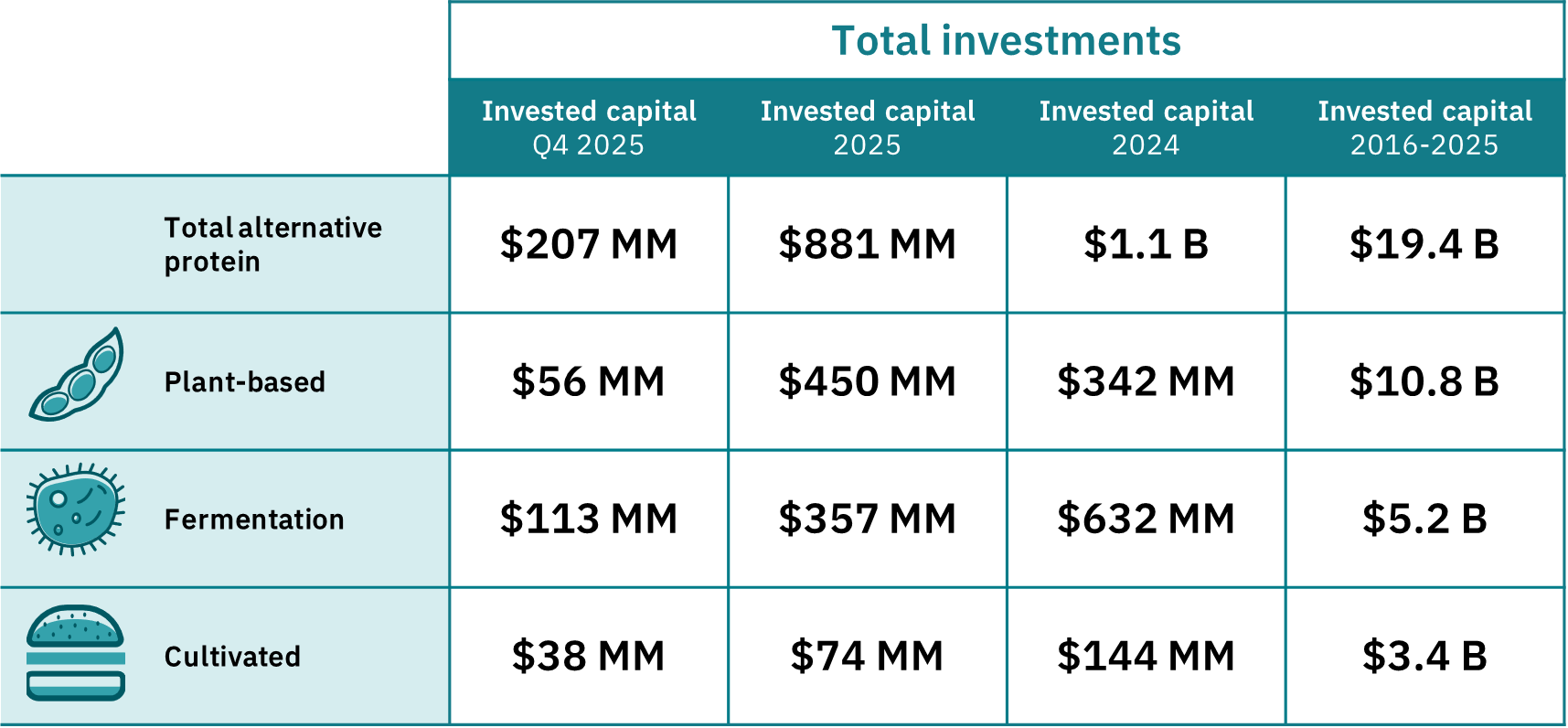
Alternative protein companies raised US$207 million in the fourth quarter of 2025, bringing the full-year total to US$881 million, according to new figures released by The Good Food Institute (GFI).
The year, GFI said, was shaped by a series of structural shifts in the investment landscape that became increasingly visible as 2025 progressed.
• Alternative protein companies raised US$207 million in Q4 2025, bringing full-year funding to US$881 million.
• Europe-headquartered companies secured US$418 million in 2025, ahead of North America’s US$347 million.
• Fermentation companies led Q4 fundraising with US$113 million, followed by plant-based at US$56 million and cultivated at US$38 million.
Daniel Gertner, Lead Economic & Industry Analyst at GFI, said that over the course of 2025 “a set of recurring dynamics came to define the near-term alternative protein investment landscape”.
By year’s end, he said, those forces had largely crystallized.
“A growing share of venture capital shifted toward AI, limiting investor attention and available capital for other sectors, including climate tech and food tech,” Gertner said.
“Tighter funding conditions accelerated consolidation, with restructurings, acquisitions, and portfolio rationalization becoming defining features of the market.”
At the same time, he noted, “public investment, philanthropic capital, and other funding structures increasingly complemented private capital to de-risk key milestones and support scale-up.”
According to GFI’s analysis of Net Zero Insights data, the divergence between companies with sufficient runway and those facing near-term financing constraints widened through the year.
“Amid this evolving funding landscape, the gap widened between companies with sufficient runway to execute against near-term milestones and those facing near-term financing constraints,” Gertner said. “This divergence is likely to persist into 2026, shaping both capital allocation and company strategy.”
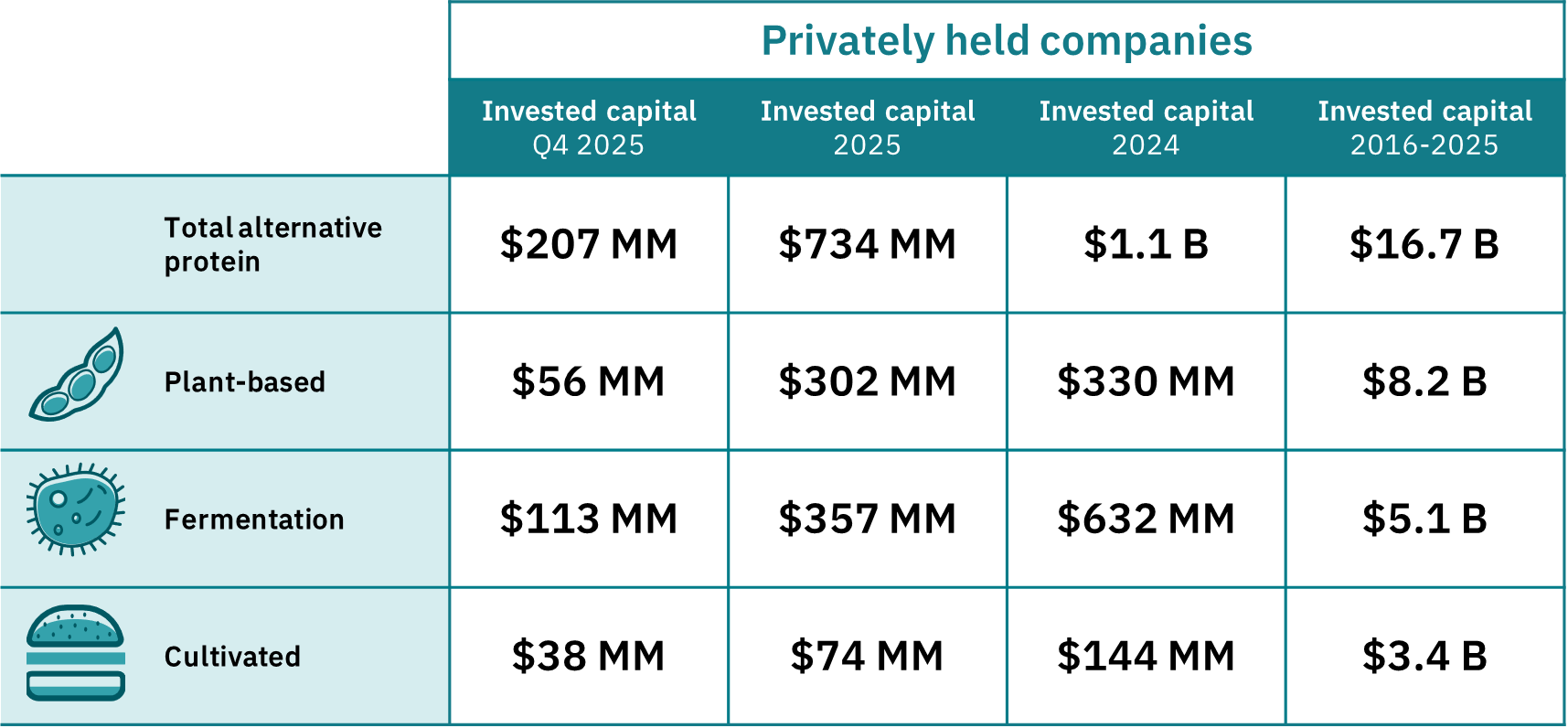
Since 2016, alternative protein companies have raised a cumulative US$19.4 billion, including US$16.7 billion by privately held companies and US$2.7 billion by publicly traded firms.
For 2025 specifically, plant-based companies raised US$450 million, fermentation companies US$357 million and cultivated meat and seafood companies US$74 million. In Q4 alone, plant-based firms secured US$56 million, fermentation companies US$113 million and cultivated meat and seafood companies US$38 million. Overall investment in plant-based companies rose in 2025, while fermentation and cultivated sectors saw declines.
Five disclosed Q4 investments exceeded US$15 million. The EVERY Company raised US$55 million in Series D funding to scale its precision fermentation egg proteins. Denmark’s MATR Foods secured €20 million (approximately US$23.2 million) to expand its fermentation-based meat alternatives. Roebling, formerly Synonym, completed a US$20 million Series A round to support its biomanufacturing financing and implementation platform. Mosa Meat raised €15 million (approximately US$17.6 million) to advance its regulatory approval journey. Ripple Foods closed a US$17 million funding round and appointed a new CEO.
Consolidation activity also accelerated.
“In response, some companies pursued mergers and acquisitions to strengthen core capabilities, consolidate strategic assets, and extend runway,” Gertner said.
Bettani Farms acquired plant-based brands Stockeld Dreamery, NUMU and Hungry Planet. Prosperity Organic Foods, owner of Melt Organic, emerged as the winning bidder for the assets of Miyoko’s Creamery. Gourmey acquired Vital Meat to form PARIMA, combining cultivated duck and chicken capabilities. Fork & Good acquired Orbillion Bio to integrate cultivated pork and beef platforms. Meati Foods was acquired by entrepreneur Yasir Abdul and restructured as Meati Holdings.
Other companies paused or ceased operations. Meatable and Believer Meats closed after failing to secure additional financing, and additional companies across production platforms shut down in early Q1 2026.
Regionally, Europe-headquartered companies raised US$418 million in 2025, outpacing North America’s US$347 million for the second consecutive year.
“Well-performing companies – particularly those operating in supportive regional ecosystems and aligned with clear near-term commercialization pathways – have continued to attract capital,” Gertner said, noting that differences in public funding and ecosystem support may remain relevant in 2026.
He described the market as entering a new phase.
“Taken together, the market appears to be entering a phase defined by leaner operations, more targeted commercialization, and phased scale-up better aligned with near-term demand,” Gertner said.
“In parallel, strategic partners, public capital, and innovative financing structures are increasingly critical to de-risking pathways to scale – a shift we expect to deepen rather than reverse in the year ahead.”
GFI’s annual State of Alternative Proteins reports, containing detailed full-year 2025 investment analysis, are scheduled for release in April.

Join Us At One Of Our Upcoming Events

If you have any questions or would like to get in touch with us, please email info@futureofproteinproduction.com

.jpg)
.jpg)
