

Broccoli side-stream startup UPP secures funding as automation and ingredient platform advance toward commercialization

Upcycled Plant Power (UPP) has secured new investment and reached several technical milestones as it prepares to scale production of plant-based ingredients derived from broccoli side-streams.
• Upcycled Plant Power secured £1.5 million in new investment and converted £1.45 million in loans to equity, bringing total investment to £3.6 million.
• The company completed a pilot plant capable of processing 10 tons of broccoli side-streams per day into fiber and protein ingredients.
• UPP has also achieved ISO 9001 certification for its robotic broccoli harvesting system, designed to automate crop collection and capture side-stream biomass.
The UK-based company is developing a production model that combines automated harvesting with ingredient upcycling, transforming portions of broccoli plants typically left in the field into food-grade protein and fiber ingredients.
UPP said the approach aims to address multiple challenges in the agricultural and food sectors simultaneously, including labor shortages in harvesting, crop waste, and the demand for lower-emissions protein ingredients.
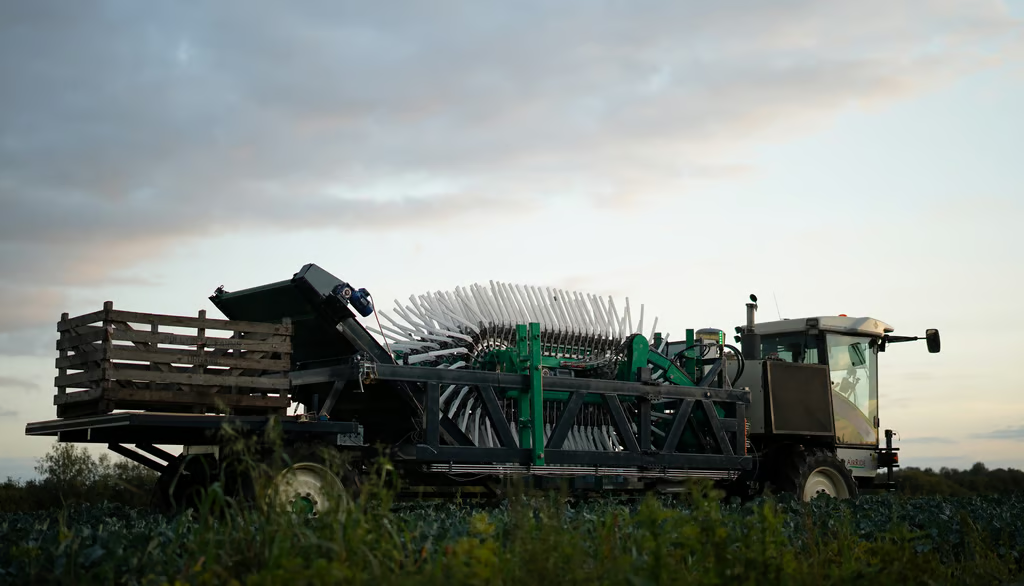
A central element of the company’s system is its Automated Selective Harvester, known as Harvesta, a self-powered robotic platform designed to identify and harvest mature broccoli heads in real time.
UPP recently achieved ISO 9001 certification for Harvesta manufacturing, marking a key step toward commercial deployment.
The latest Harvesta model, trialled in Lincolnshire and Scotland in 2025, can harvest three rows simultaneously and operate at speeds of up to 5 km/h.
By automating a process traditionally carried out by manual labor, the company said the technology could significantly change the economics of broccoli harvesting while enabling large volumes of previously unused plant material to be captured for processing.
Alongside its progress in automation, UPP has also completed construction of a pilot processing facility capable of handling up to 10 tons of broccoli side-streams per day.
The plant produces two primary ingredients: Fiba, a plant fiber ingredient, and Prota, a protein ingredient derived from brassica biomass.
According to the company, the facility can generate up to 4 tons of finished ingredients daily.
The pilot site is currently undergoing the final stage of preparation for Brand Reputation through Compliance Global Standard (BRCGS) certification, an internationally recognized benchmark for food safety and quality.
UPP expected to achieve certification by January 2026, enabling the start of commercial shipments to food manufacturers.
The company reported that 18 major food manufacturers have already trialled its ingredients, with products containing UPP-derived protein and fiber expected to reach supermarket shelves in the first half of 2026.
Looking ahead, the company plans to scale processing capacity to more than 100 tons per day.
UPP said an independent life cycle analysis has also confirmed that its broccoli-derived protein has a lower CO₂ footprint than soy or pea protein and performs significantly better than pork and beef.
Additional environmental analysis is currently underway to quantify methane emissions avoided through the use of broccoli side-streams.
The company has also been building intellectual property around its technology platform.
UPP reported that it has one granted patent family, has filed another patent application, and has submitted three additional filings covering both its harvesting technology and its upcycling processes.
The technology development program has involved collaboration with several research organizations, including the James Hutton Institute, Harper Adams University, and the UK Agri-Tech Centre.
To support its next phase of growth, UPP has expanded its leadership team with the appointment of Dr. Trisha Toop as chief technology officer and Patrick Cohen as chief financial officer, increasing the company’s staff from seven to twelve people.
The strengthened team will focus on scaling UK operations while supporting international expansion plans, including entry into the United States.
UPP said the company has now secured £1.5 million in new investment from Elbow Beach Ventures, alongside the conversion of £1.45 million in existing loans into equity.
Combined with £1.38 million in government grants, including £0.6 million still to be drawn, total investment into the company has reached £3.6 million.
Mark Evans, CEO of UPP, said the company’s approach aims to create value from existing agricultural systems rather than introducing new crops or production inputs.
“UPP is redefining how plant-based ingredients are produced by using the crops we already grow, without the need for additional land, water, or emissions,” Evans said.
“Our technology transforms what was once agricultural waste into cost-effective, nutritious, and hypoallergenic food ingredients. In doing so, we are helping farmers improve profitability, supporting manufacturers in meeting sustainability goals, and contributing to a healthier planet.”
Helen Brookes, Engagement Director at the UK Agri-Tech Centre, said the company’s work highlights the potential of combining agricultural automation with circular bioeconomy principles.
“UPP is a good example of the innovation and collaboration that define the future of UK agriculture and food production,” Brookes said.
“By combining advanced automation with circular bioeconomy principles, they are showing how cutting-edge agri-tech can deliver meaningful impact.”
Professor Stewart from the James Hutton Institute, who is Co-director of the National Alternative Protein Innovation Centre (NAPIC) and an advisor to UPP, said the company’s progress demonstrates the potential of integrating scientific research, automation, and food innovation.
“UPP’s progress is a powerful example of how UK innovation can accelerate the transition to a more sustainable and resilient food system,” Stewart said.
“As one of NAPIC’s founding industrial partners, UPP has shown how cutting-edge science, automation, and circular thinking can be combined to deliver real-world impact, reducing waste, lowering emissions, and creating new sources of clean, nutritious protein.”

Join Us At One Of Our Upcoming Events

If you have any questions or would like to get in touch with us, please email info@futureofproteinproduction.com


