

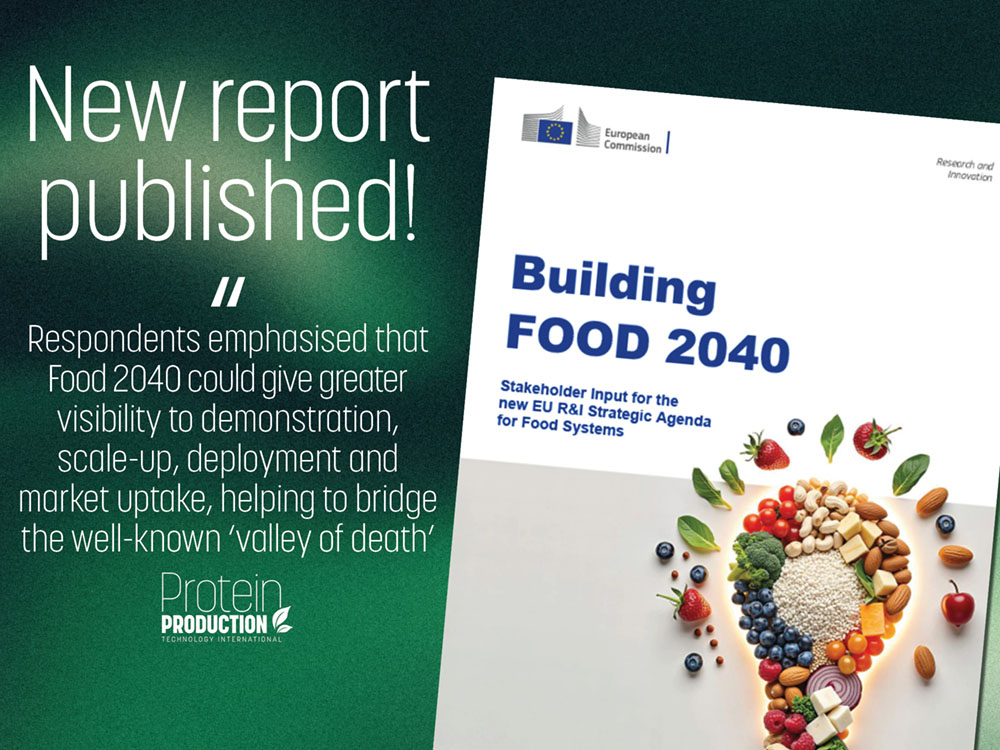
EU Food 2040 consultation puts protein diversification and scale-up at heart of future food innovation strategy

The European Commission's consultation on its forthcoming Food 2040 research and innovation strategy has identified protein diversification, commercialization, and food manufacturing scale-up as key priorities, with stakeholders calling for greater investment in pilot infrastructure, faster regulation and stronger support for bringing food technologies to market.
• The European Commission analyzed feedback from 631 stakeholders and 63 written submissions to inform its new Food 2040 research and innovation agenda for food systems.
• Respondents identified protein diversification, strategic autonomy, commercialization, and scale-up as priorities for future EU food innovation funding.
• Stakeholders also called for greater investment in pilot plants, demonstration facilities, manufacturing infrastructure and faster regulatory pathways to help innovations reach the market.
The report, Building Food 2040: Stakeholder Input for the New EU R&I Strategic Agenda for Food Systems, summarized responses from an EU-wide consultation involving 631 survey participants alongside 63 supplementary submissions from industry associations, academic networks, NGOs and other organizations. The findings will help shape the Commission's next long-term research and innovation agenda for Europe's food system.
While respondents broadly endorsed the systems-thinking approach introduced under the existing Food 2030 strategy, they also argued that its successor should place much greater emphasis on turning research into commercial products and industrial deployment. The report stated that "the results underline the need to bridge the 'valley of death' between basic and conceptual research... helping promising solutions progress towards deployment, commercialisation and wider uptake."
Among the strongest messages to emerge was support for protein diversification. Respondents identified healthier diets as one of the highest priorities for Food 2040, with the report noting that qualitative submissions called for greater strategic attention to protein diversification, including plant-based proteins and other alternatives to animal-derived sources.
Open-ended responses reinforced that message. According to the report, respondents called for "greater attention to protein diversification and the scale-up of plant-based protein production," alongside updated research and innovation priorities around nutrition and sustainable diets.
Commercialization featured prominently throughout the consultation. Stakeholders argued that Food 2040 should extend beyond supporting early-stage science by strengthening demonstration projects, deployment and market uptake.
The report stated that respondents emphasized Food 2040 "could give greater visibility to demonstration, scale-up, deployment and market uptake, helping to bridge the well-known 'valley of death' between promising research results and their practical application at scale."
Infrastructure emerged as another recurring theme. Several submissions called for closer links between research funding and pilot plants, demonstration facilities, biomanufacturing capacity, circular waste valorization infrastructure and shared public-private facilities to help companies commercialize new technologies.
The consultation also highlighted strategic autonomy as an increasingly important driver of future food innovation policy. Respondents argued that Europe should strengthen domestic production capacity in areas where it remains dependent on imports, including plant proteins, aquaculture, food ingredients and micronutrients. The report said enhanced processing capacity for plant-based proteins was identified as relevant to food security, strategic autonomy and economic competitiveness.
Beyond protein production, respondents highlighted environmental sustainability, resilience, circularity and shorter supply chains as priorities that deserved greater prominence within the future strategy. They also called for faster regulatory procedures, greater investment in technology and infrastructure deployment, and stronger integration of primary producers with downstream food manufacturing and processing.
The report suggested that future consultation and implementation activities should involve more food manufacturers, processors, retailers, logistics providers and other downstream businesses to ensure research priorities translate into practical industrial applications and market uptake.
Rather than replacing Food 2030, the consultation concluded that Food 2040 should build on its systems-based approach while making objectives, expected impacts and implementation pathways more operational. Stakeholders also supported stronger monitoring and clearer links between research funding, technology transfer, commercialization and measurable outcomes.
The report concluded that the future strategy should strengthen connections between research, industry, policy and citizens while improving Europe's ability to deploy food-system innovation at scale and support competitive, resilient and sustainable food systems.
If you liked this, check these out...
• Protein Diversification Academy sets out a new vision for protein
• Europe protein diversification could cut feed imports and lower agricultural emissions, EEA says
• CAP 2028-2034: Diversification on the table, ambition under pressure

Join Us At One Of Our Upcoming Events

If you have any questions or would like to get in touch with us, please email info@futureofproteinproduction.com

.jpg)
.jpg)
