FaBA-backed QUT BioPilot opens precision fermentation scale-up route in Australia

Australian food-tech companies have gained access to a new pilot-scale precision fermentation facility designed to close the gap between laboratory development and commercial manufacturing.
• The QUT Pioneer BioPilot in Mackay has become Australia’s first food-grade, PC2-compliant pilot-scale precision fermentation facility following regulatory approval.
• Fermentation capacity ranges from 100L to 2,400L, alongside downstream processing, purification, drying, filtration, centrifugation and analytical capabilities.
• FaBA says the facility will give companies a domestic route for testing and validating processes before committing to larger-scale commercial production.
The QUT Pioneer BioPilot, located in Mackay’s Pioneer Valley in Queensland, has received approval from Australia’s Office of the Gene Technology Regulator, allowing companies to work with recombinant organisms in certified containment facilities.
The facility forms part of an infrastructure network being developed through Australia’s Food and Beverage Accelerator, or FaBA, alongside Queensland University of Technology and government partners.
Its role is to give companies developing products through precision fermentation and synthetic biology access to equipment at volumes that sit between laboratory work and full commercial manufacture.
“The QUT Pioneer BioPilot provides industry with access to the infrastructure, expertise and scale-up capability needed to translate promising research into commercially relevant outcomes,” said Dr Leon Scott, Director Research Infrastructure Operations at QUT.
“By supporting product development at pilot scale, we can help companies de-risk innovation and accelerate their pathway towards commercial production.”
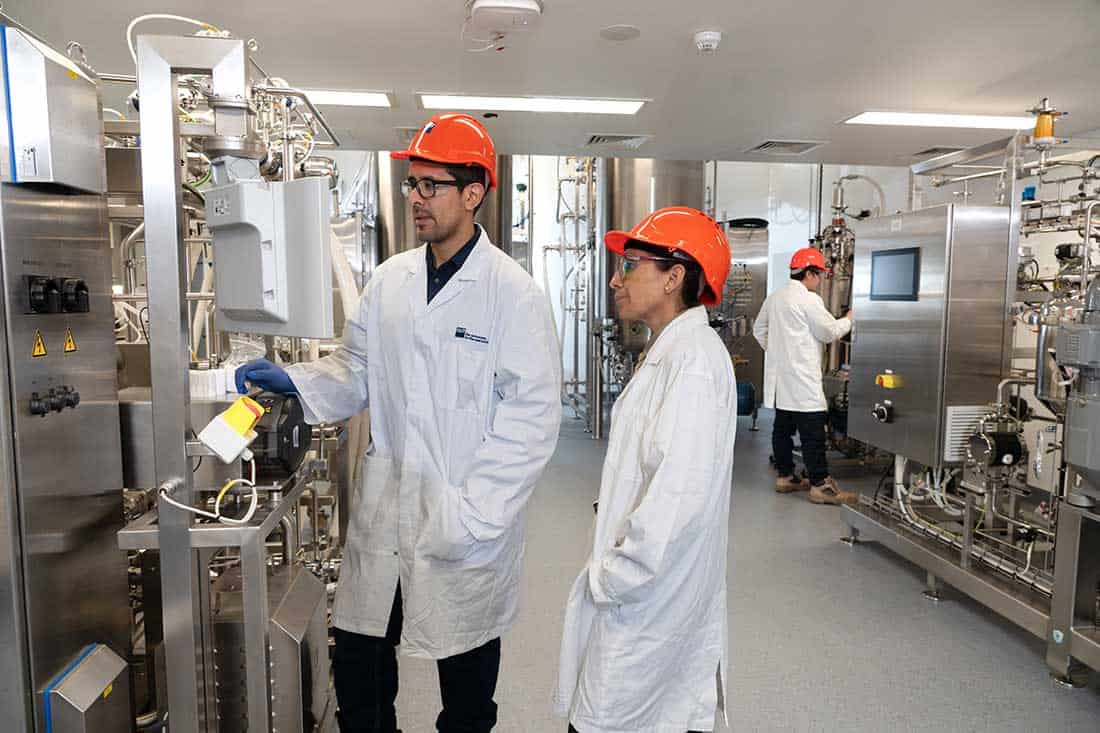
Fermentation systems at the BioPilot range from 100L to 2,400L and can support production of proteins, enzymes, whole-cell products and industrial chemicals.
The site also includes downstream processing and purification capabilities, as well as product drying and in-process quality control. Companies can access industrial-scale centrifugation, filtration and homogenization equipment, together with analytical support.
Alternative feedstocks are another area of focus, with the facility able to support development using sucrose and biomass-derived materials.
Pilot-scale infrastructure has become an important issue for precision fermentation developers as processes move beyond benchtop bioreactors. Companies need sufficient volume to generate representative process data, produce material for application development and validate downstream operations without immediately moving into commercial-scale manufacturing.
FaBA Director Dr Chris Downs said access to suitable scale-up equipment remained a significant constraint for emerging companies.
“One of the most significant barriers facing emerging food technology companies is access to scale-up infrastructure,” Downs said.
“This end-to-end Australian capability enables companies to move more efficiently through the development pipeline, reducing scale-up risks and helping promising technologies reach market faster.”
FaBA said its wider infrastructure network now provides access to bioreactors and fermentation equipment from laboratory scale through to 2,400L pilot manufacturing.
That gives developers the option to progress through several stages of process development within Australia rather than seeking overseas pilot capacity as projects increase in scale.
The BioPilot also adds food-grade capability to Australia’s growing biomanufacturing infrastructure. For food and ingredient developers, this is particularly important when material produced during pilot runs is intended for formulation work, sensory testing, customer evaluation or other activities connected with eventual commercialization.
Its PC2 certification also expands the type of fermentation work that can be undertaken at the site, including processes involving genetically modified microorganisms used to produce specific proteins or other target molecules.
The Mackay facility was recently presented to industry during a webinar hosted by QUT and FaBA, outlining its fermentation, downstream processing and scale-up capabilities.
If you liked this, check these out...
• Joanne Tunna: Australia cannot afford to lose food biomanufacturing at the scale-up stage
• Green Choice Proteins targets US market with Australian-made plant protein range
• PARIMA clears key Australia-New Zealand regulatory hurdle for cultivated meat

Join Us At One Of Our Upcoming Events

If you have any questions or would like to get in touch with us, please email info@futureofproteinproduction.com