Leaft Foods teams up with Foodstuffs South Island to put leaf protein to the test in baking

Leaft Foods had entered a new phase of commercialization in December after securing a partnership with Foodstuffs South Island to explore the use of its leaf-derived protein as an egg replacement in baked goods. The collaboration marked an important step for the New Zealand company as it moved from ingredient development into real-world retail trials within one of the country’s largest grocery cooperatives.
Under the agreement, Leaft Foods and Foodstuffs South Island bakery teams planned to trial the use of Leaf Rubisco Protein across a range of baking applications, including cakes and muffins. The ingredient would be tested as a direct substitute for egg protein, with a focus on maintaining taste, texture, and quality without requiring complex reformulation.
The partnership followed the start of commercial production of Leaf Rubisco Protein, which Leaft Foods extracted from Canterbury-grown alfalfa. The company described the ingredient as non-GMO and non-allergenic, positioning it as a functional protein designed to address both supply chain pressure and sustainability concerns associated with conventional egg use in baking.
Foodstuffs South Island, a 100% New Zealand-owned cooperative with more than 200 stores across the South Island, said the collaboration aligned with its interest in local innovation and ingredient diversification. Daniel Te Raki, Bakery Operations Manager at Foodstuffs South Island, said the potential of the ingredient stood out early in discussions.
“This really grabbed our attention. It’s great local innovation with the potential to change how some baked goods are made here,” Te Raki said. “We wanted to get involved because it could help diversify where our ingredients come from and ultimately give more choice to our customers across the South Island. This partnership ticks those boxes and also presents the potential to strengthen the overall sustainability of baking and bakery products.”
According to Leaft Foods, Leaf Rubisco Protein offered functional performance comparable to eggs, particularly in emulsification and gelling, two properties that are critical in many baked goods. The company said this allowed the ingredient to be used as a like-for-like replacement in certain recipes, rather than as a partial substitute that required additional stabilizers or texturizers.
Chief executive Ross Milne said the Foodstuffs South Island collaboration helped reinforce the commercial case for Rubisco protein following earlier support from the New Zealand government aimed at advancing sustainable food production.
“This agreement validates what we’ve known about Rubisco’s potential and represents the kind of innovation-driven and community-focused solutions that New Zealanders deserve,” Milne said. “Its emulsion stability and gelling capability make it perform exactly like eggs in baked goods. This is South Island innovation at its purest – local ingenuity and expertise tackling local and global challenges.”
Leaft Foods positioned its technology around the extraction of protein directly from green leaves, tapping into what it described as the planet’s most abundant protein source. By processing leafy biomass rather than relying on animal agriculture or highly refined crops, the company said it could deliver protein with a significantly lower carbon footprint than conventional dairy or egg proteins.
The company also emphasized the agricultural implications of its model. By sourcing alfalfa and other leafy crops from local farmers, Leaft Foods said its approach could help growers diversify land use and create additional value streams without displacing existing farming systems.
The Foodstuffs South Island trials were expected to focus on practical performance in commercial bakery environments, where consistency, scalability, and cost are as important as functionality. While no timeline had been disclosed for potential rollout beyond trials, the companies indicated that successful results could open the door to broader adoption across Foodstuffs South Island’s bakery operations.
Founded in New Zealand, Leaft Foods was backed by a mix of domestic and international investors as it prepared for further expansion. The company said it was increasingly focused on the United States as a key growth market, alongside continued development in its home region.
Leaft Foods was founded by John Penno and Maury Leyland and led by Milne, who brought experience from across the food industry. Its investors included Khosla Ventures, NBA basketball player Steven Adams, indigenous investor Ngāi Tahu, and ACC’s Climate Change Impact Fund.
With egg prices and supply volatility continuing to challenge bakeries globally, Leaft Foods said interest in functional egg alternatives was growing, particularly ingredients that could integrate into existing recipes without compromising product quality. The collaboration with Foodstuffs South Island represented one of the company’s most visible steps yet toward demonstrating that potential at scale.
As trials moved forward, both companies framed the partnership as a test of whether leaf-derived protein could shift from a novel ingredient to a practical solution within mainstream baking. For Leaft Foods, success in commercial bakeries would mark a key milestone in its effort to translate sustainability claims into everyday food products found on supermarket shelves.
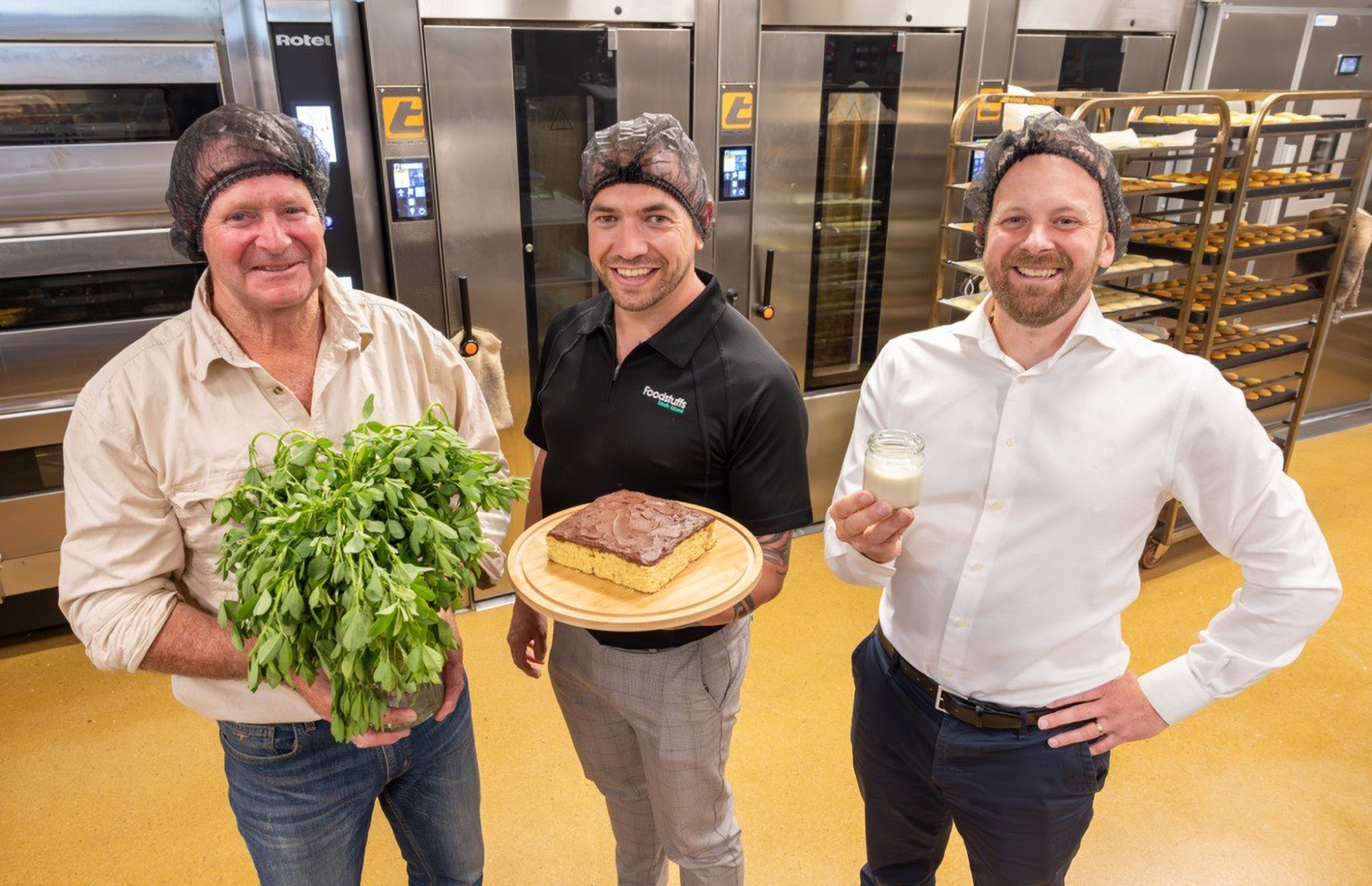
(Main photo shows [from left to right] Tim Ridgen EAL AgriServices, Daniel Te Raki FSSI and Ross Milne)

Join Us At One Of Our Upcoming Events

If you have any questions or would like to get in touch with us, please email info@futureofproteinproduction.com