


Oshi lands seafood industry backing as plant-based fish startup prepares major retail expansion

For years, plant-based seafood has occupied an awkward corner of alternative protein: technically difficult, commercially uncertain, and often overshadowed by the far larger battles playing out in meat and dairy.
Texture is harder. Flavor is less forgiving. Consumers know exactly how fish should flake, smell, and cook. Investors, meanwhile, have remained cautious after watching much of the first wave of plant-based hype collide with operational and economic reality.
That was partly why Oshi’s latest funding announcement carried unusual weight.
The plant-based seafood company secured a US$3 million strategic investment from one of Latin America’s largest conventional seafood manufacturers while simultaneously opening a public community investment round on Wefunder ahead of a planned nationwide US retail expansion.
• Oshi secured a US$3 million strategic investment from a major Latin American seafood manufacturer.
• The company planned a 686-door US retail rollout in 2026 through KeHE and UNFI distribution.
• Oshi also launched a new plant-based whitefish product developed using its proprietary whole-cut manufacturing technology.
The deal represented a notable signal from inside the traditional seafood industry itself — a sector that has historically moved more cautiously toward plant-based alternatives than meat or dairy incumbents.
“The fact that one of the largest traditional seafood players in Latin America is investing in us is a clear signal that plant-based seafood is the future of food security,” said Ofek Ron, Oshi CEO & Co-founder.
The company’s latest raise arrived alongside growing commercial momentum. Oshi reported 4x year-over-year revenue growth and distribution across more than 100 restaurant menus, including Neat Burger, Veggie Grill, and City Roots.
At the same time, the company was preparing for its largest expansion yet: a retail rollout targeting 686 stores across the USA in 2026 through distribution partnerships with KeHE and UNFI. Confirmed placements included Lassens, Mother’s Market, and Earthfare.
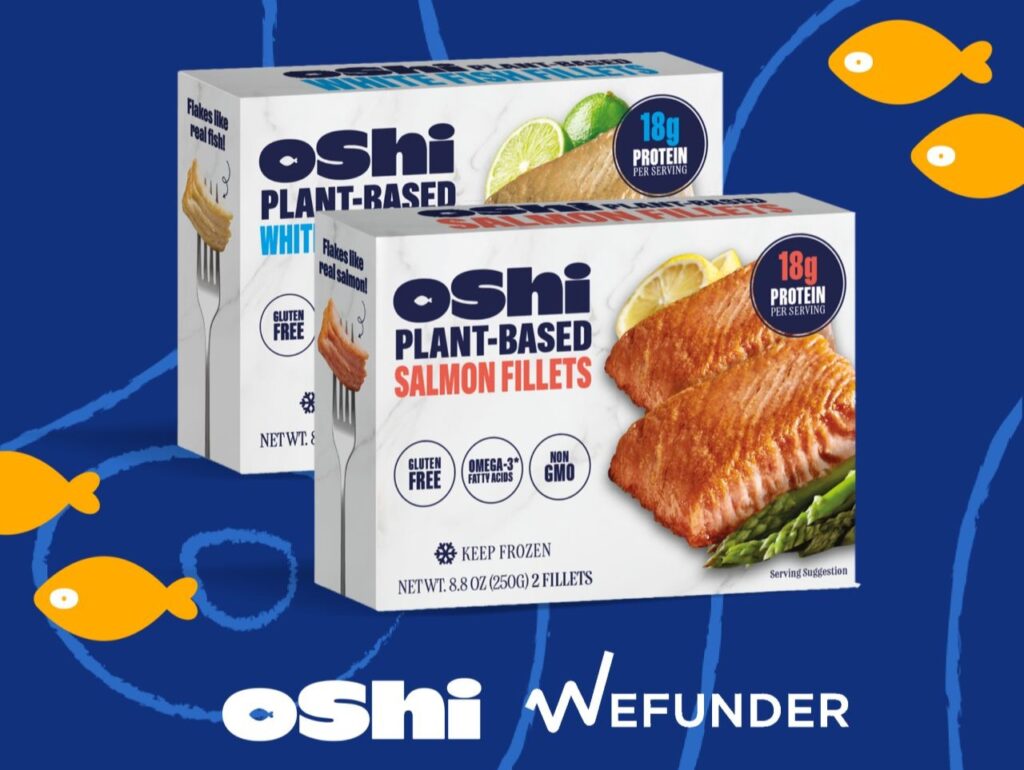
The funding news also coincided with the launch of Oshi’s new Whitefish product line, developed over an 18-month period using the company’s proprietary whole-cut technology platform.
Unlike many earlier plant-based seafood products that leaned heavily on minced or processed formats, Oshi focused on recreating the structure, texture, and cooking behavior associated with conventional fish fillets.
That challenge, Ron admitted, was far harder than many people outside the category realized.
“Back then, we were just a few guys in a lab, trying to do what everyone in the industry told us was impossible,” he wrote in a recent post reflecting on the company’s early years.
“Building a food-tech startup isn't glamorous. It’s years of failed batches. It’s smelling like seaweed for days on end.”
That level of technical difficulty has helped slow the development of plant-based seafood relative to other alternative protein categories. Replicating the layered structure and delicate texture of seafood has proven substantially more complex than building ground-meat analogs, while the category itself has lacked the scale advantages and consumer familiarity enjoyed by plant-based milk or burgers.
But Oshi believed it had begun solving one of the industry’s most persistent problems: manufacturability.
In his post, Ron revealed the company had developed what he described as a proprietary 'plug-and-play' manufacturing model that reduced production costs by 80% — a critical figure at a moment when many food-tech startups were being judged less on concept and more on operational economics.
That shift in investor priorities has reshaped the entire alternative protein landscape over the past two years. Novel ingredients and consumer-facing branding alone are no longer enough. Companies increasingly need to demonstrate scalable production systems, credible distribution, and realistic pathways to profitability.
Oshi appeared keenly aware of that transition.
Rather than positioning itself purely as a mission-driven sustainability startup, the company increasingly emphasized manufacturing efficiency, retail readiness, and category scalability.
The involvement of Unovis Asset Management – one of the earliest institutional backers of Beyond Meat – reinforced that narrative.
“Seafood is one of the last frontiers in the alternative protein revolution,” Unovis stated. “We’ve seen what plant-based can do to meat and dairy. Oshi is bringing that same disruption to salmon, the most consumed seafood in America.”
The company also received public backing from Björn Öste, Co-founder of Oatly and an existing Oshi investor, whose comments reflected both the skepticism and cautious optimism now shaping much of the sector.

“I’ve spent decades building a category-defining company, taking Oatly from a niche idea to a global leader, and that experience has made me very skeptical of how hard this category is to get right,” Öste stated.
“When I first tasted Oshi’s prototypes in 2022, I initially tried to talk Ofek out of it. Plant-based fish is a brutally tough challenge.”
What changed his mind, he said, was execution.
“Oshi hasn’t just developed a compelling product; they’ve built a proprietary production process that gives them a real edge.”
That relationship appeared to have evolved well beyond a standard investor-founder dynamic. Ron described Öste as both a close advisor and frequent sounding board as Oshi prepared for its next phase of growth.
“If you told me five years ago when we started Oshi that one of the founders of Oatly would invest in our company, become a close friend, and speak with me almost every week, I probably would have laughed,” Ron wrote.
The comparison to Oatly was difficult to ignore. Both companies entered categories that many consumers initially viewed with skepticism. Both relied heavily on manufacturing innovation as much as branding. And both attempted to transform a niche alternative product into something capable of operating at mainstream food-system scale.
Whether plant-based seafood can follow a similar trajectory remains an open question.
Consumer adoption across alternative proteins has become more uneven in recent years, particularly as concerns around pricing, processing, and repeat purchases have intensified. Yet seafood occupies a slightly different strategic position from meat.
Wild fisheries remain under mounting environmental pressure. Aquaculture faces growing scrutiny around antibiotics, feed systems, and ecological impact. At the same time, global seafood demand continues to rise.
That combination has left many companies searching for scalable alternatives capable of reproducing seafood’s nutritional and culinary characteristics without relying on ocean harvesting.
For Oshi, the goal appeared increasingly focused on positioning plant-based seafood not as a novelty category, but as a legitimate part of future protein infrastructure.
The company’s latest expansion plans suggested confidence that the category was beginning to move beyond specialty vegan channels and toward broader retail normalization.
Ron also appeared eager to involve consumers directly in that transition through the Wefunder campaign, which opened participation to international investors with minimum investments starting at US$250.
“As many of you know, we recently launched Oshi’s Wefunder campaign, opening a limited community investment opportunity so that our early supporters, friends, customers, and ecosystem can become actual shareholders in Oshi before we scale to mainstream retail,” he wrote.
Within 48 hours of launch, Ron said the campaign had already raised US$125,000.
“What excites me the most right now isn't just the milestones,” he wrote. “It’s the people standing by our side, and the community we are building around this mission.”
The next stage, however, would likely test whether plant-based seafood could finally cross the line from technological curiosity into commercially durable food category.
Oshi’s answer appeared to rest on a combination of product realism, manufacturing efficiency, strategic distribution, and increasingly unusual alliances between food-tech startups and the conventional seafood industry itself.
And perhaps most importantly, unlike much of the first generation of alternative protein companies, the conversation was beginning to sound less about disruption for its own sake and more about operational survival at scale.

Join Us At One Of Our Upcoming Events

If you have any questions or would like to get in touch with us, please email info@futureofproteinproduction.com


