Plantopia raises US$9 million to take animal-free casein into production

Israeli molecular farming company Plantopia has raised US$9 million as it prepares to move its animal-free dairy protein technology from development into commercial production.
• Plantopia raised US$9 million in a round led by Schreiber Foods and Siddhi Capital, taking its total funding since 2018 to more than US$16 million.
• The Israeli startup prepared to open a manufacturing facility at Kibbutz Sdot Yam, with commercial production scheduled to begin during the third quarter of 2026.
• The company developed all four principal casein subtypes using indoor-grown plants and targeted cheese manufacturers seeking lactose-free proteins with conventional dairy functionality.
The funding round was led by global dairy producer Schreiber Foods and food investment firm Siddhi Capital, with participation from additional Israeli investors. It takes Plantopia’s total funding to more than US$16 million since the company was founded in 2018.
Plantopia will use the capital to launch a manufacturing facility at Kibbutz Sdot Yam in Israel. The site is expected to begin operating during the third quarter of 2026 and represents the company’s first step into commercial-scale production.
“Having completed the development stages that have been our focus in recent years, we are now moving into commercial production,” said Tal Lutzky, CEO & Co-founder of Plantopia.
The company uses molecular farming to produce proteins traditionally obtained from animals. Its platform engineers plants to express dairy proteins before the proteins are extracted and purified for use as food ingredients.

Plantopia’s first commercial target is casein, the group of proteins responsible for much of the structure and functionality of milk and cheese. Casein contributes to properties such as stretch, melt, firmness and moisture retention, making it particularly important in mozzarella and other cheese applications.
The company said it had produced all four major casein subtypes found in cow’s milk: alpha S1, alpha S2, beta and kappa casein. It has also demonstrated micellization, the process through which casein proteins organize into structures that influence their behavior in dairy products.
According to Plantopia, its proteins are identical in composition to cow’s milk casein and can provide the functionality needed to make lactose-free dairy products without using livestock.
The involvement of Schreiber Foods gives Plantopia the backing of an established international dairy manufacturer as it begins the transition from scientific development to ingredient production. Schreiber produces dairy products for retail, foodservice and industrial customers across several global markets.
Plantopia has built its production platform around indoor vertical farming rather than open-field cultivation. The controlled environment allows the company to manage light, temperature, humidity and nutrient delivery while reducing exposure to changes in weather, contamination and crop variability.
“A key differentiator in our molecular farming approach is our use of indoor and vertical farming, which provides a level of environmental control that most competitors in this space lack,” Lutzky said in a PPTI interview conducted in early 2025.
“Unlike traditional open-field molecular farming, which is subject to climate variability, contamination risks and inconsistent yields, our controlled growth environments allow us to precisely manage environmental factors like light, temperature, humidity and nutrient delivery.”
He said this approach was intended to deliver consistent protein expression between production batches while allowing facilities to be located close to customers or manufacturing partners.
Plantopia initially used lettuce as its production host before expanding its platform to oats and other fodder crops. The company selected the crops based on their growing speed, yield, input requirements, regulatory profile and suitability for indoor cultivation.

“We started with lettuce but have since evolved to oats and other fodder crops because they are cheap, fit to indoor farming methods, high-yield and scalable,” Lutzky said.
“The core focus is cost efficiency and regulation friendliness. These plants require minimal inputs, grow quickly and integrate into existing agricultural infrastructure.”
Plantopia argues that the choice of crop and production environment is as important as the ability to express the target protein. Molecular farming companies must achieve sufficiently high yields while keeping cultivation, extraction and purification costs within the price range expected by food manufacturers.
Lutzky said the company had designed its platform around commercial pricing rather than treating cost reduction as a later-stage engineering problem.
“While we’ve successfully expressed all four key casein proteins and achieved micellization, none of that matters if production costs are too high or the regulators will block the approach,” he said.
“Our approach ensures we can hit price thresholds in short times that make molecular farming commercially viable at scale.”
The indoor model may also help Plantopia address regulatory questions surrounding genetically engineered crops. Because the plants are grown in contained facilities, the company can limit the risk of gene flow, cross-contamination and unintended environmental exposure.
Plantopia said it had already made progress toward US regulatory approval. The company has been preparing a Generally Recognized as Safe assessment for the Food and Drug Administration and has established protocols for identity and safety testing.
It has also engaged with the US Department of Agriculture over the regulatory status of its engineered oat sprouts. Plantopia said its current oat sprout did not qualify as a regulated article under USDA Animal and Plant Health Inspection Service rules, although the company was still working through the formal confirmation process when Lutzky discussed the matter in early 2025.
The company is positioning molecular farming as a lower-capital alternative to precision fermentation, which uses engineered microorganisms and bioreactors to produce animal proteins.
Precision fermentation has already delivered several dairy proteins at commercial or pre-commercial scale, but companies have faced pressure to improve fermentation yields, secure affordable manufacturing capacity and reduce downstream processing costs.
Plantopia said plants could offer a more direct route to scale because agricultural production systems do not require the same volume of stainless-steel fermentation infrastructure.
“Scalability in molecular farming isn’t just about producing proteins. It’s about doing so cost-effectively and at high yields,” Lutzky said.
“Our platform is designed around indoor and vertical farming, giving us precise control over growth conditions, higher consistency and lower resource dependency. This means we can achieve high yields per square meter while avoiding the land-use constraints of open-field farming.”
He added that Plantopia’s approach could make use of established agricultural systems and suppliers rather than depending entirely on purpose-built biotechnology facilities.
“Unlike precision fermentation, which requires costly bioreactors and has significant infrastructure limitations, our approach leverages existing agricultural supply chains, making it far easier to scale into real-world food production,” he said.
Plantopia is initially focusing on North America, where it sees demand from dairy manufacturers, ingredient suppliers and foodservice companies seeking additional sources of functional proteins.
The company estimates that the casein market in North America is worth approximately US$50 billion, although casein is used across a broad range of products and applications, including cheese, nutritional beverages, cereals, bakery products and sports nutrition.
Plantopia also expects protein demand to benefit from the wider use of GLP-1 weight-management drugs. These treatments can be associated with losses in lean mass, leading physicians, nutritionists and food companies to place greater emphasis on protein consumption.
The startup said dairy protein consumption in the USA had increased sharply over the past two years, while prices for dairy proteins, including whey, had also risen. It believes these supply and demand pressures could create opportunities for additional production methods.
Lactose intolerance provides another potential market. Products made using Plantopia’s purified casein would contain dairy proteins but could be formulated without lactose, allowing manufacturers to create products for consumers who avoid conventional milk because of lactose digestion problems.
The company’s central commercial application is mozzarella. Plant-based cheese manufacturers have often struggled to reproduce the melt, stretch and browning delivered by dairy casein, relying instead on combinations of starches, oils, gums and plant proteins.
Plantopia believes its casein could allow manufacturers to retain the functional behavior of dairy while removing cows from the production process.
“We’re most excited for consumers to taste and feel the difference, to experience nondairy alternatives, such as mozzarella, that aren’t a compromise,” Lutzky said.
“This isn’t a ‘mimic’ or a plant-based alternative that tries to be like cheese. It is cheese, because the casein is real casein.”
He added that casein’s contribution extended beyond protein content.
“The magic of dairy isn’t just in its flavor. It’s in the way it stretches, melts and delivers the full texture and mouthfeel people expect,” he said.
“With Plantopia’s casein, consumers will finally get animal-free dairy that delivers the full experience they love.”
Plantopia has previously worked with Tnuva, Israel’s largest dairy company, through the Fresh Start foodtech incubator. According to Plantopia, Tnuva tested its casein and found that it delivered the stretch, melt and structural properties required for dairy applications.
The company is now seeking further partnerships with food manufacturers, ingredient companies and biotechnology businesses as it develops its US commercial pipeline.
“We’re now in the perfect position to bridge our innovation hub with the leading commercial players in food and biotech,” Lutzky said.
“This is the moment to move from science to scale.”
Plantopia was founded by Lutzky, Amir Tiroler and Professor Alexander Vainstein of the Hebrew University of Jerusalem. The company’s technology originated from research at the university’s Faculty of Agriculture.
It was originally named Pigmentum and explored several plant-made products, including pigments, aroma compounds and high-value proteins, before narrowing its attention to casein.
“When we first started, we were exploring multiple plant-based applications, including pigments, which is why the company was originally named Pigmentum, aroma compounds and several high-value proteins,” Lutzky said.
“But as we refined our vision, we realized that real impact comes from deep expertise, not broad exploration.”
That focus has now carried Plantopia through protein expression, micellization and application testing. The new funding will determine whether the company can reproduce those results at manufacturing scale and supply commercial customers at a price that competes with conventional dairy casein.
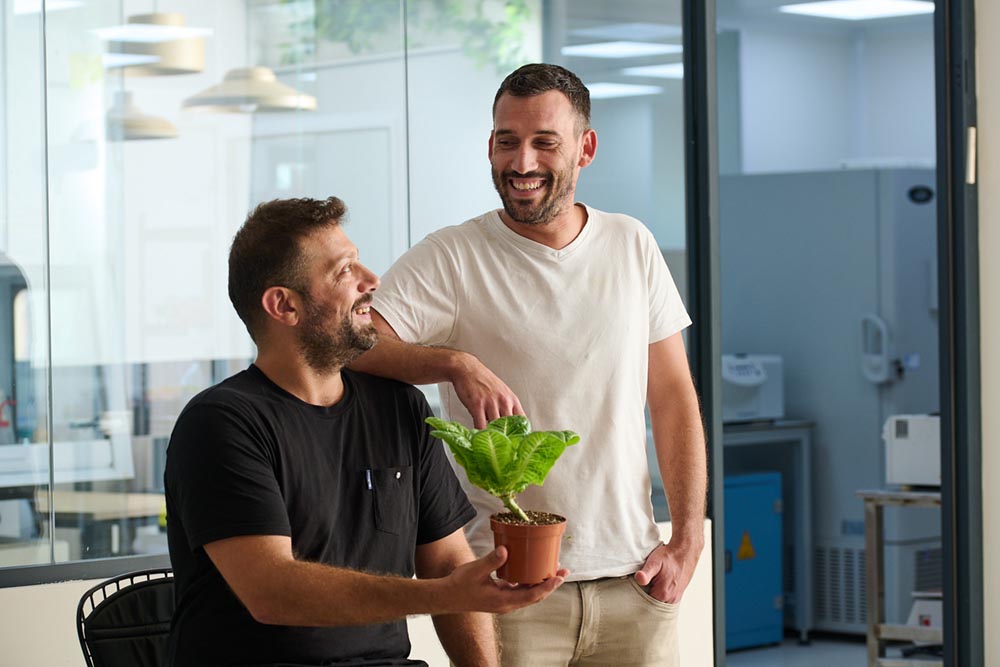
(Main photo shows Plantopia co-founders Tal Lutzky and Amir Tiroler with one of the plants used in the company’s protein production platform)

Join Us At One Of Our Upcoming Events

If you have any questions or would like to get in touch with us, please email info@futureofproteinproduction.com