

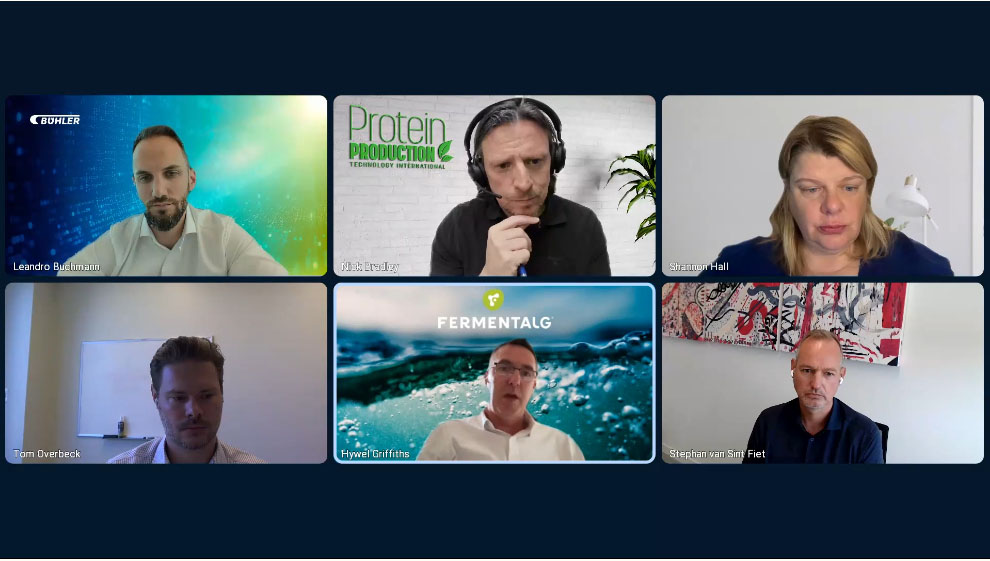
PPTI-Bühler webinar finds manufacturing has overtaken biology as industrial biotechnology's biggest challenge

Industrial biotechnology has reached a pivotal stage in its development, with manufacturing strategy and commercial execution overtaking scientific discovery as the industry's biggest challenges, according to leaders from Bühler, ADM, Vivici, Pow.bio and Fermentalg.
Speaking during a Protein Production Technology International webinar on scaling industrial biotechnology, From Pilot Plant to Profitable Production: What it Takes to Win in Industrial Biotechnology, the panel argued that while advances in synthetic biology, metabolic engineering and strain development continue to unlock new possibilities, the question facing companies has fundamentally changed. Rather than asking whether a molecule can be produced, developers must now demonstrate they can manufacture it reliably, competitively and at a price customers are willing to pay.
• Executives from Bühler, ADM, Vivici, Pow.bio and Fermentalg said commercialization has become the biggest hurdle facing industrial biotechnology after scientific feasibility has been demonstrated.
• Speakers agreed companies should define target cost of goods and customer requirements before optimizing process design, using techno-economic modeling to prioritize investment.
• Panelists also highlighted pilot plants, manufacturing partnerships and continuous process improvement as essential tools for reducing scale-up risk and achieving commercial success.
Leandro Buchmann, Head of Bioprocessing at Bühler Group, said the industry was increasingly encountering what he described as the "scale-up cliff", where promising laboratory results fail to translate into commercially viable manufacturing. "The question is no longer, 'Can you make the molecule?' The question is, 'Can you make it at the right cost?'" he said.
Buchmann argued that companies should begin by understanding what customers are willing to pay before making engineering decisions. Starting with the desired selling price and target cost of goods, he said, allows developers to focus on the technical improvements that have the greatest commercial impact rather than optimizing scientifically interesting aspects of a process.
That philosophy was echoed throughout the discussion. Tom Overbeck, Innovation Commercialization Director, Precision Fermentation at ADM, said techno-economic modeling should be viewed as more than a financial exercise. "There will always be more technical challenges than there are resources to solve them," he said. "The key is identifying which improvements will genuinely move the commercial needle."
Rather than attempting to optimize every aspect of a process, Overbeck said companies should use techno-economic models to identify where investment will create the greatest commercial value.
Stephan van Sint Fiet, CEO at Vivici, said the company had adopted that market-first approach from the outset. "We built Vivici with a very strong focus on the market and on our customers," he said. "We asked ourselves: What is the market actually willing to pay for the proteins we're looking to produce? Then we worked backwards from there."
He said commercial teams should be built alongside technology development so customer requirements help shape product development and investment decisions from the beginning.
The panel also challenged the traditional role of pilot plants.
Rather than simply proving that a process works, speakers described pilot facilities as critical for validating commercial economics, producing material for regulatory submissions, supplying customers with representative samples and identifying operational risks before major capital investments are made.
Hywel Griffiths, Chief Scientific Officer at Fermentalg, said pilot facilities remain valuable throughout a product's lifecycle because they allow companies to test process improvements without disrupting commercial production.
"The pilot plant is the first time you really come into contact with industrial reality," he said.
Shannon Hall, Co-founder & CEO at Pow.bio, said companies should avoid delaying commercialization while pursuing endless process optimization. "What you're really looking for is commercial sufficiency," she said. "Have we built the product our customers are asking for? Are they willing to pay for it? And can we manufacture it within our target cost envelope?"
She added that process improvement should continue long after commercial launch, describing manufacturing facilities as living systems that require continual refinement.
Customer engagement emerged as another recurring theme during the webinar. Overbeck argued that many companies still leave customer conversations too late, spending years refining technologies before confirming whether they solve genuine commercial problems. "Customers don't really care how your process works," he said. "What they care about is whether the product solves their problem, meets their requirements, and creates value for their business."
As precision fermentation companies move closer to commercialization, speakers also identified manufacturing capacity as an emerging bottleneck. Van Sint Fiet said companies that have demonstrated strong market demand can still struggle to secure sufficient production capacity to support industrial-scale volumes, creating a new constraint for the sector as it matures.
Looking ahead, the panel highlighted continuous manufacturing, predictive process control, artificial intelligence and advanced reactor technologies as areas with the greatest potential to improve production economics. However, speakers agreed that technological innovation alone would not determine future winners.
Instead, there was broad consensus that industrial biotechnology has entered a new phase where commercial discipline, manufacturing expertise and customer demand will increasingly determine which technologies succeed.
The webinar, From Pilot Plant to Profitable Production: What It Takes to Win in Industrial Biotechnology, is available to watch on demand via the Protein Production Technology International website. Click here

Join Us At One Of Our Upcoming Events

If you have any questions or would like to get in touch with us, please email info@futureofproteinproduction.com

.jpg)
.jpg)
