

Study has found fermented whey drink could cut land use while increasing water demand

A life cycle assessment has found that a drink made with precision-fermented whey protein could use 60% to 68% less land than conventional UHT cow’s milk while using roughly five to ten times as much water. The researchers modeled a finished drink made with beta-lactoglobulin. Their results changed with the electricity supply, the sugar used in fermentation and the efficiency of the process.
• The researchers modeled a finished drink made with precision-fermented beta-lactoglobulin and compared it with conventional UHT cow’s milk and an oat drink under harmonized European assumptions.
• The modeled drink occupied less land than cow’s milk in every scenario. It used substantially more water by volume, with results also varying according to local water scarcity.
• Under average European electricity, modeled climate impact was 40% below cow’s milk per kilogram of drink. The modeled oat drink had a lower climate impact than both.
Julian Quandt and colleagues published the analysis in The International Journal of Life Cycle Assessment on November 11. They modeled a milk-equivalent recipe in which fermentation supplied the beta-lactoglobulin. Sugar beet sucrose, rapeseed oil and other ingredients supplied additional components in the baseline recipe. The comparison included formulation, packaging, transport and retail. The researchers applied common carton and ambient distribution assumptions to all three drinks to keep those parts of the comparison consistent.
The researchers reported results for the finished beverage and separately for the protein powder used to make it. In the baseline scenario, the stand-alone powder was associated with 8.18kg CO₂e per kilogram of powder at 92% protein. That number describes ingredient production. The beverage results count the smaller amount of powder in each kilogram of drink, along with the other ingredients and the activities needed to get the carton to the consumer.
Under the average European electricity mix, the fermented-protein drink came in at 0.86kg CO₂e per kilogram of product, compared with 1.44kg for cow’s milk and 0.49kg for the oat drink. The estimate fell to 0.64kg with Norwegian electricity or the modeled renewable electricity supply. With the Polish electricity mix used in the paper, it was 1.29kg, about 10% below the cow’s milk comparator. The results are given per kilogram of drink. That unit of comparison matters when readers compare products with different protein contents.
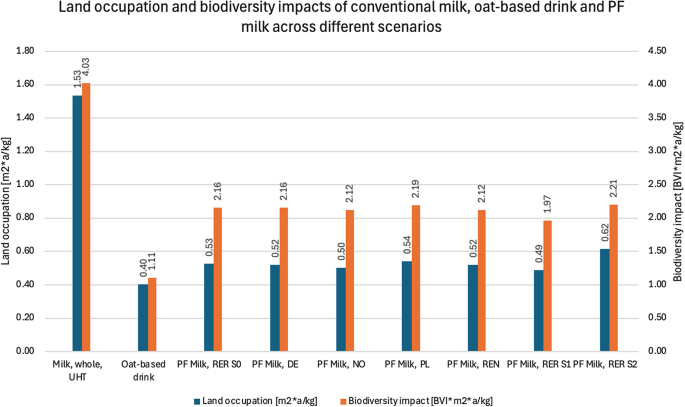
Land occupation for the fermented-protein drink ranged from 0.49 to 0.62 square-meter years per kilogram, compared with 1.53 for cow’s milk and 0.40 for the oat drink. Growing sugar and oil crops still required land, even without the agricultural land associated with raising dairy cattle. The modeled formulation consequently used less land than cow’s milk and more than the oat comparator.
Water produced a different result. The authors distinguished total water volume from water scarcity, which weights use according to the availability of water where it is withdrawn. In two of the modeled European scenarios, switching the sugar source to sugar cane raised the scarcity-weighted estimate from 0.72 to 1.72 cubic meters of world-equivalent water per kilogram. That metric reflects scarcity. It cannot be read as the volume of water used inside a fermentation plant.
The researchers drew the fermentation data from pilot-scale experiments and process models, while established databases supplied much of the information for cow’s milk and oat drinks. That limits how closely the results describe a particular commercial plant. A manufacturer applying the findings would need site data on its own water demand, electricity and raw material suppliers. The study also estimated fossil resource use of 8.09–15.57MJ per kilogram for the fermented-protein drink, compared with 6.94MJ for cow’s milk and 7.52MJ for the oat drink. Even the scenario with the lowest fossil resource use used more fossil resources than either comparator. A plant can therefore improve its modeled greenhouse gas result and still have a reason to examine electricity and heat demand elsewhere in its process.
(Figure 4 from Quandt et al., The International Journal of Life Cycle Assessment, CC BY 4.0)

Join Us At One Of Our Upcoming Events

If you have any questions or would like to get in touch with us, please email info@futureofproteinproduction.com


