Researchers create low-cost cultivated protein snack for children using naturally derived scaffolds

A team of researchers reported a new approach to creating a low-cost cultivated protein snack designed to provide children with a nutritionally complete, shelf-stable alternative to conventional meat. Published in npj Science of Food, the study described how an edible scaffold made from two naturally abundant polysaccharides supported muscle cell growth, produced all essential amino acids, and achieved sensory scores rated highly acceptable by volunteers. The authors also concluded that industrial-scale production could be feasible at less than US$0.065 per snack, with a projected retail price below US$1 by 2030.
The work addressed two intersecting challenges: global protein deficiency among children and the environmental pressures associated with conventional meat production. The authors noted that one in seven school-aged children in the USA failed to consume adequate protein daily, while a significant portion of their caloric intake came from low-nutrient snacks. At the same time, conventional livestock systems faced limitations related to energy use, food safety, and environmental impact. The study framed cultivated meat as a potential solution to both issues and proposed the development of an appealing snack aimed at children.
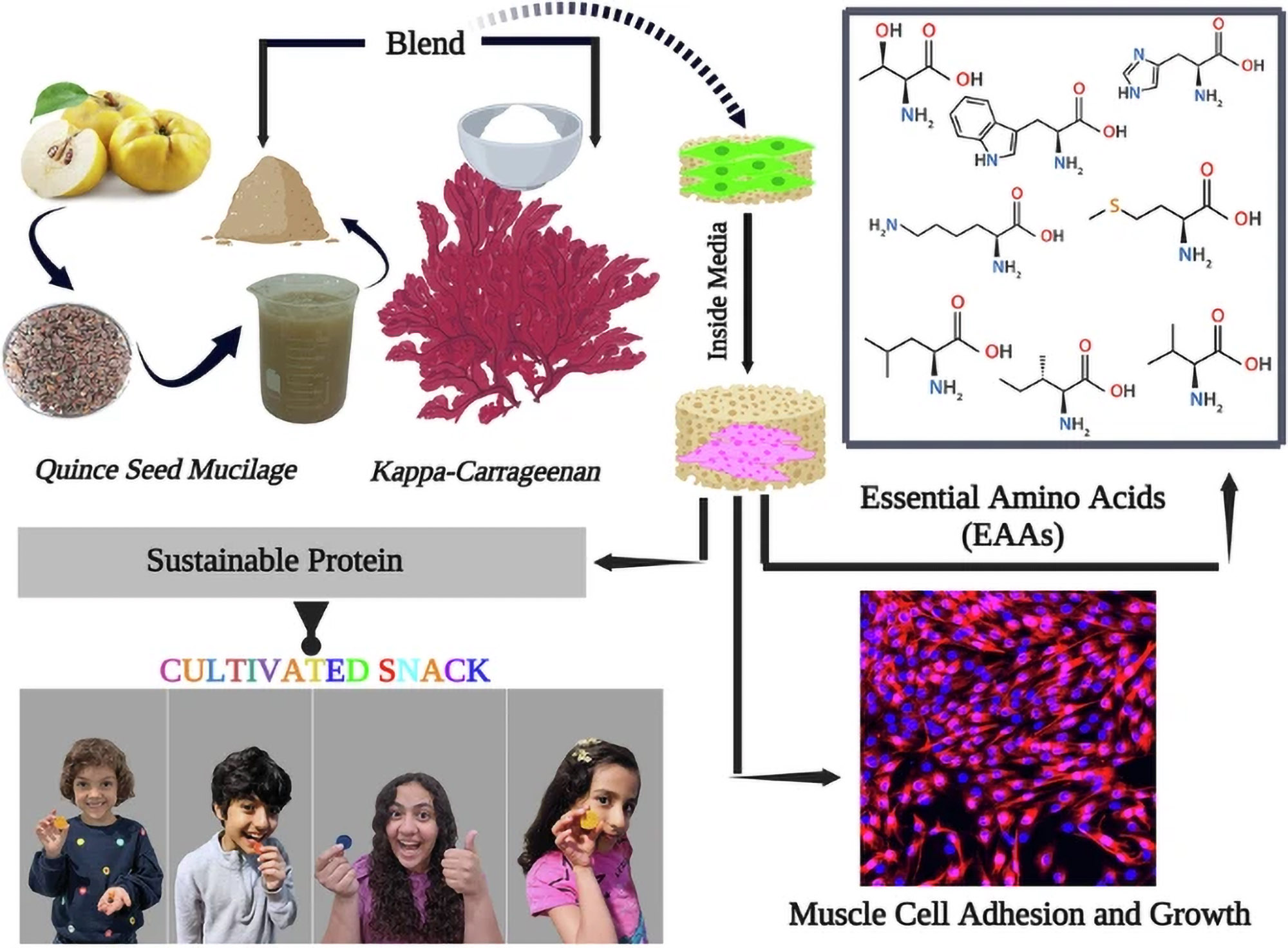
To create the product, the team developed a hybrid scaffold using kappa-carrageenan, a marine-derived hydrocolloid extracted from red seaweed, and quince seed mucilage, a plant-derived hydrocolloid with strong water-retention and gelation properties. The researchers hypothesized that combining the two materials would yield a structurally stable, biocompatible, and edible scaffold capable of supporting muscle cell adhesion, proliferation, and differentiation. They also noted that both materials are inexpensive, widely available, and already used in food applications.
The scaffold, referred to as Carr:QSM, was produced by blending the two polysaccharides in a one-to-one ratio and physically crosslinking them with potassium chloride. The researchers selected this formulation after comparing water uptake, degradation behavior, and mechanical stability across several blends. Carr:QSM showed the highest water absorption and the lowest degradation over 21 days, and swelling tests revealed a tenfold increase compared with carrageenan alone. Scanning electron microscopy confirmed a porous honeycomb structure suitable for supporting muscle cell infiltration.
Mechanical testing also showed that integrating the two polysaccharides significantly increased stiffness and ultimate strength. The authors attributed these improvements to an interlocking network formed during crosslinking, which provided additional reinforcement without covalent bonding.
To assess biological performance, the team seeded the scaffolds with C2C12 murine myoblasts and primary bovine myoblasts. Cell metabolic activity increased significantly by day seven, and seeding efficiency on Carr:QSM exceeded 84%. Live-cell imaging indicated that cell coverage and viability remained high throughout culture, with viability above 95% on both scaffold types. However, Carr:QSM consistently supported greater metabolic activity and higher cell coverage than carrageenan alone.
Differentiation studies showed that C2C12 myoblasts formed elongated, multinucleated myotubes on Carr:QSM, while relatively few differentiated cells were observed on carrageenan. Quantitative PCR confirmed enhanced expression of myogenic genes on Carr:QSM. When primary bovine myoblasts were cultured on the scaffold, the cells penetrated up to 600 micrometers within the first week and more than 1.5 millimeters after two weeks, indicating full infiltration through the scaffold’s thickness. Mechanical testing of cell-containing scaffolds also showed substantial increases in stiffness and ultimate strength compared with empty scaffolds, suggesting that muscle-cell deposition further reinforced the structure.
Chemical analysis confirmed that scaffolds containing differentiated bovine myoblasts exhibited a complete profile of all nine essential amino acids. These amino acid ratios closely matched values associated with tissue protein, maintenance amino acid patterns, and dietary requirements for children aged three to fourteen. The researchers estimated that 100g of Carr:QSM biomass contained approximately 14.45g of essential amino acids, comparable to certain meat products.
To evaluate sensory characteristics, the team produced cultivated snacks in jelly and dried forms and conducted a tasting panel with twenty adult volunteers. Using a nine-point hedonic scale, the dried version received higher scores for taste, aroma, texture, and overall acceptance. Both formats achieved average scores consistent with a “highly acceptable” rating, though the dried snack was preferred. Informal feedback from children aged three to thirteen also suggested a stronger preference for the dried version.
The researchers noted practical considerations for scaling production. Dried products offered longer shelf life and lower transportation costs than jelly products, although freeze-drying times of eight to twelve hours and storage at minus eighty degrees could increase investment costs.
A detailed techno-economic analysis modelled a production facility capable of producing 5,000kg of biomass per day, corresponding to roughly 2.5 million snack units. Using market prices for materials and data from previous cultivated-meat studies, the authors calculated an industrial-scale production cost of under US$0.065 per snack. The analysis projected that a 50-ton pilot facility could support regulatory validation, while a commercial facility producing 1,800 tons annually could meet broader market demand. In the commercial scenario, the authors estimated a cost of goods sold of around US$19.3 per kilogram of dry biomass, with culture medium constituting more than half of the total. A discounted cash-flow analysis suggested a net present value of US$62 million, an internal rate of return of 28%, and a payback period of four years at 85% utilization.
The study identified future cost reductions as likely, citing projections from the Good Food Institute that culture media costs could fall significantly by 2030. Under these assumptions, the cost per snack could drop below US$0.03, comparable to certain whey-based protein crisps. The authors proposed that the product created a new category they termed concentrated cultivated protein snacks, describing it as a bridge between cultivated meat and plant-based alternatives.
The researchers concluded that their edible Carr:QSM scaffold and cultivated-snack model offered a scalable and nutritionally complete approach to producing protein-rich foods tailored to children. They argued that using naturally derived polysaccharides as scaffolding materials showed potential to shift tissue-engineering techniques from therapeutic contexts to nutritional applications. The findings also suggested that the product could achieve mass-market pricing by 2030, provided ongoing improvements in media costs and bioprocessing technologies materialize.

Join Us At One Of Our Upcoming Events

If you have any questions or would like to get in touch with us, please email info@futureofproteinproduction.com