


Teaching biology to search smarter: how Verixus Labs is turning bioprocess optimization into an AI problem

Scaling biological systems remains one of the hardest problems in protein production, and a new generation of AI-driven optimization tools is emerging to navigate complexity that traditional methods can no longer handle
Biomanufacturing has opened an extraordinary new frontier in protein production. From cultivated meat and precision fermentation to advanced cell therapies, researchers are increasingly able to program living systems to produce materials that were once unimaginable. Laboratories around the world continue to demonstrate that biology can be engineered to manufacture everything from food proteins to pharmaceuticals.
Yet one stubborn reality continues to slow the transition from discovery to industry. The scientific breakthrough is rarely the hardest part. Scaling it is. A process that performs well in a small laboratory experiment often behaves very differently when translated into large bioreactors and industrial production environments. Finding the precise combination of conditions that allow a biological system to grow, produce, and remain stable at scale can require hundreds of experimental runs.
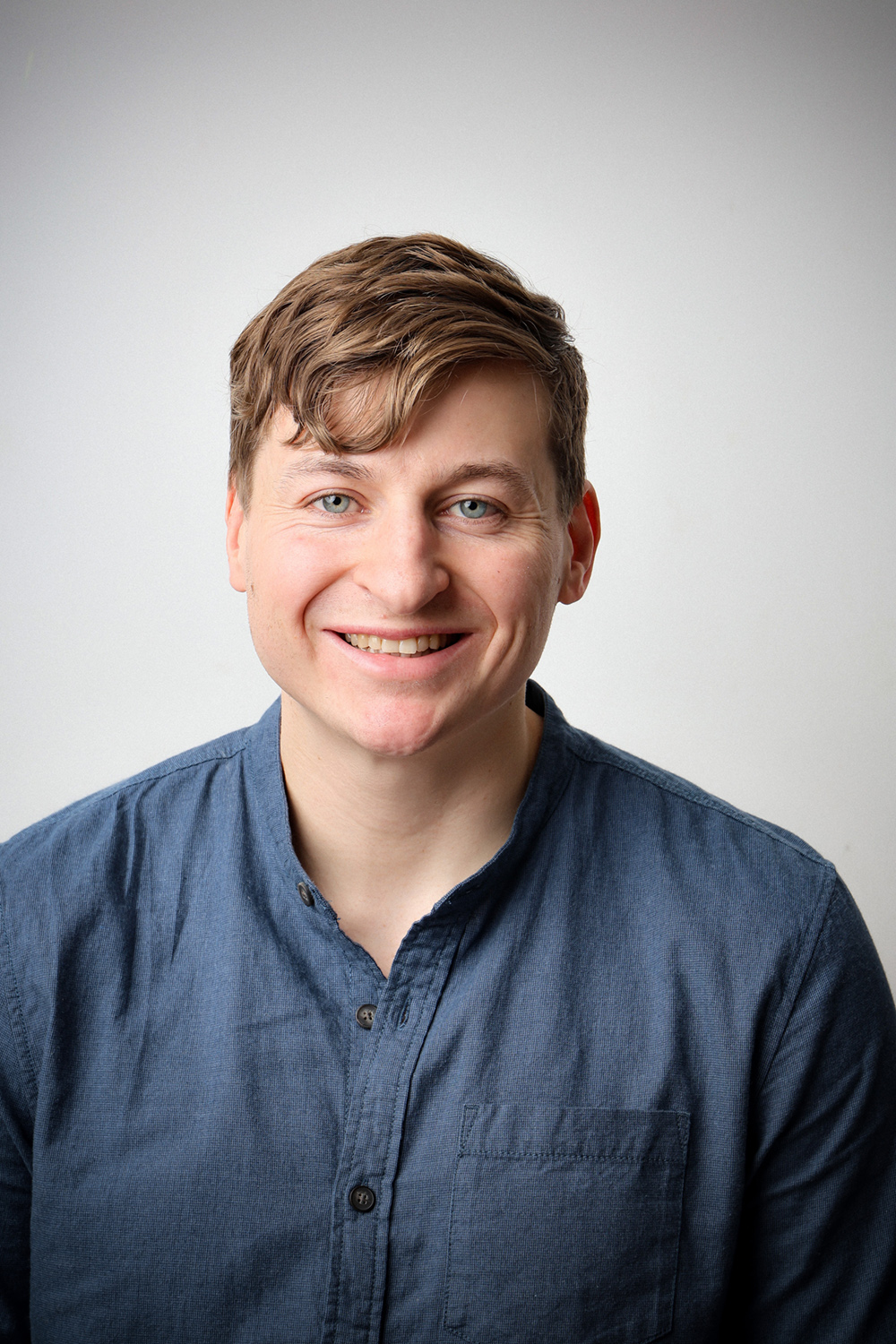
Joel Kosmin, CEO & Co-founder of Verixus Labs, believes the difficulty is not simply biological complexity. It is the way researchers search through that complexity. “After my PhD, I set out to identify the next major unsolved problem in biotechnology,” he begins. “I kept encountering the same bottleneck: cellular agriculture companies were achieving remarkable breakthroughs at bench scale but struggling to scale economically.
“Upon further research, it appeared that a significant portion of the bottleneck was due to inefficient bioprocess optimization. Biomanufacturing systems had become too complex for traditional methods to navigate efficiently. That realization was the seed for Verixus Labs – an AI-powered optimization platform designed to make scaling systematic rather than trial-and-error.”
Kosmin, an Oxford-trained molecular geneticist, founded Verixus Labs with Robin Bernon (CTO & Co-founder), an engineer with nearly a decade of experience building machine learning systems in industries such as logistics and fintech. Together they set out to build a platform capable of guiding experimental optimization in a fundamentally different way.
Instead of treating experiments as isolated events, their system treats optimization as an ongoing learning process.
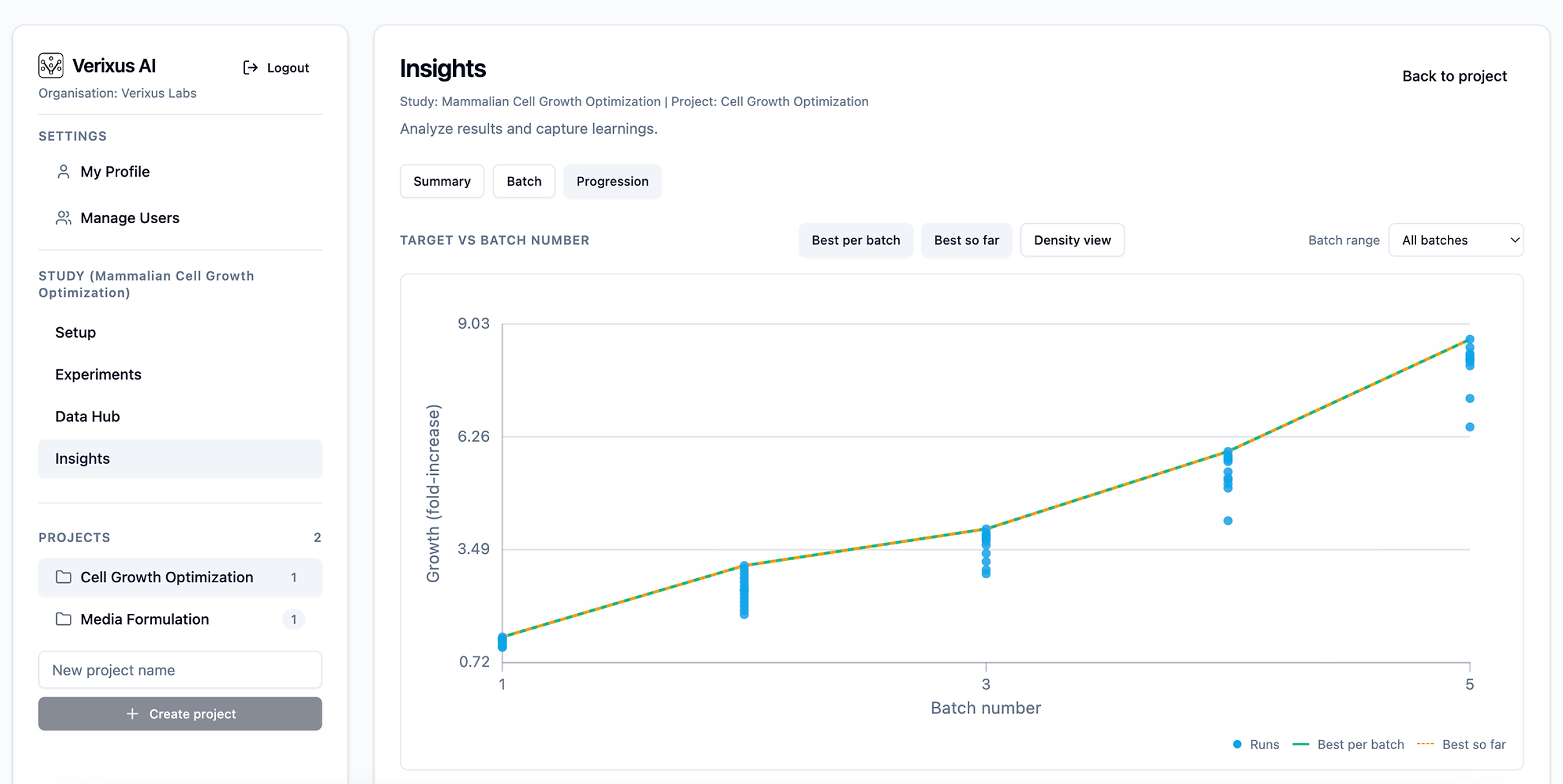
Early validation results have already produced a striking demonstration of that approach: a 61% increase in mammalian cell proliferation achieved in just four experimental iterations over three weeks. For industries where optimization cycles can stretch across months, the implications are difficult to ignore.
When experimentation stops scaling
“Design of Experiments (DoE) was developed decades ago for a very different class of problems,” Kosmin continues. “It emerged in an era where systems were assumed to be relatively low-dimensional, effects could be approximated as linear or near-linear, and interaction terms were limited and explicitly specified. In that context, DoE was powerful.”
Even now, DoE remains one of the most widely used statistical frameworks for experimental planning. The methodology has guided industrial research for decades, helping scientists identify relationships between variables and process outcomes. But biological manufacturing systems have grown dramatically more complex.
“Biomanufacturing systems had become too complex for traditional methods to navigate efficiently”
Modern cell culture and fermentation processes routinely involve dozens of interacting variables. Media composition alone can include many nutrients, salts, amino acids, and growth factors. Add in process conditions such as temperature, oxygen concentration, agitation rates, and feeding strategies, and the parameter space expands rapidly.
“The issue is not just combinatorial explosion, although that is certainly part of it,” Kosmin says. “The deeper issue is structural. DoE is fundamentally a static, grid-based sampling strategy. It requires decisions about the search structure to be made in advance, and it does not adapt meaningfully based on emerging results.”
The limitations become more pronounced as complexity grows. “As dimensionality increases, DoE becomes exponentially expensive. As nonlinearity increases, its assumptions weaken. As noise increases, its efficiency collapses.”
What modern bioprocess development increasingly requires is not simply more experiments, but a smarter way of selecting them. “What it requires is not better grids, but adaptive, uncertainty-aware search,” Kosmin confirms.

Optimization as a decision process
“When we say AI-powered optimization, we are not referring to a single fixed algorithm,” Kosmin stresses. “We use an adaptive, sequential optimization framework that explicitly models uncertainty and updates its internal representation of the search space after every experiment.
“The system does not simply predict outcomes; it makes decisions about what experiment to run next based on both expected performance and confidence.”
The distinction may seem subtle, but it shifts the role of computation from passive analysis to active guidance.
Rather than analyzing results once an experiment has finished, the platform continuously learns from incoming data and adjusts the next experimental step accordingly.
“Biology is noisy, nonlinear, partially observable and often data-scarce,” Kosmin suggests. “Conventional machine learning models tend to optimize predictions without adequately accounting for uncertainty, which can lead to overconfidence when extrapolating beyond known regions of the search space. In experimental settings, that overconfidence can be extremely costly.”
The system instead treats optimization as a structured decision-making process. “Our approach treats optimization as a structured decision process under uncertainty,” he says. “It balances exploration and exploitation, adapts to different data regimes, handles mixed parameter types and constraints, and remains robust in complex environments.”
Importantly, the platform is not built around a single modeling technique. “We do not view optimization as one fixed model class. Different experimental setups benefit from different strategies depending on dimensionality, batch size, objective structure and noise level.”

The logistics of biology
Across industries, the mathematical structure of complex optimization problems often looks remarkably similar.
“In logistics, you’re balancing routing constraints, stochastic demand, cost surfaces and nonlinear trade-offs,” Bernon explains. “In fintech, you’re modeling risk under uncertainty with sparse and noisy signals.”
Biological systems share many of the same characteristics. “Biology is a high-dimensional system with hidden interactions and imperfect observability. Data is expensive to generate, and variables interact in ways that are rarely intuitive or additive.”
When stripped of its domain-specific terminology, the challenge becomes easier to recognize.
“What modern bioprocess optimization requires is not better grids, but adaptive, uncertainty-aware search”
“When you strip away the domain-specific language, most complex systems compress into the same structural challenges: high-dimensional parameter spaces, expensive experiments, noisy outputs, nonlinear interactions, and the need to make sequential decisions under uncertainty while balancing exploration and exploitation.”
From that perspective, optimizing a fermentation process may not be so different from optimizing a transportation network.
“AI excels in these environments not simply because they are complex but because it provides a disciplined framework for navigating uncertainty efficiently,” Bernon says.
“The real parallel across logistics, fintech and biological optimization is that the challenge is not prediction alone – it’s intelligent decision-making under uncertainty.”
Learning from scarce biological data
“In biological R&D, data is not abundant; it has to be manufactured through costly and lengthy experiments,” Kosmin says.
That constraint has historically limited the usefulness of many machine learning approaches, which often rely on large datasets.
Verixus Labs designed its platform specifically around the realities of experimental biology.
“Our proprietary algorithms are designed to account for sparse and noisy data, in order to extract as much meaningful learning from the data as possible.”
Careful experimental design also helps reduce uncertainty. “A key method for mitigating noise is to plan optimization experiments containing multiple technical and/or biological replicates.”
The system then updates its internal models as new results arrive. “Yes, our system suggests experiments, learns from each iteration and builds a predictive model on the complex, non-linear interactions between all of the variables within a biomanufacturing pipeline.”
Automation is possible but not required. “In theory, this process could be completely autonomous if an end-user has an autonomous lab. However, these experiments can also be performed manually by hand.”

A 61% improvement in three weeks
“In one of our growth media optimization studies, our system achieved a 61% increase in mammalian cell growth within four optimization iterations,” Kosmin says.
The improvement was measured against a formulation already optimized using traditional Design of Experiments.
The difference lay in how the search unfolded. “As dimensionality increases, human intuition becomes less reliable. Even highly experienced teams tend to explore around familiar operating regions, adjust one or two variables at a time, and implicitly assume relatively smooth behavior.”
That approach works in relatively simple systems. It becomes far less effective as interactions multiply. “The key difference was not brute-force search, but efficiency of navigation,” Kosmin says. “Because the optimizer models uncertainty and updates sequentially, it can move away from local optima early, allocate experiments strategically rather than evenly, and explore counterintuitive parameter interactions.”
What might otherwise require months of iterative adjustment can compress into a handful of carefully chosen experimental cycles.
Implications for alternative protein
“One of the largest pain points that cultivated meat and precision fermentation companies suffer from is bridging the gap or ‘valley of death’ from benchtop scale to large scale manufacture,” Kosmin says.
Process optimization sits at the heart of that challenge. “If our platform scales successfully, it will be transformative for the alternative protein industry,” he says. “It has the potential to significantly reduce the media and capital expenditure while substantially increasing product yields.”
The downstream impact could ripple through the entire commercialization timeline.
“One of the largest pain points that cultivated meat and precision fermentation companies suffer from is bridging the gap or ‘valley of death’ from benchtop scale to large scale manufacture”
“In turn, this will reduce time to regulatory submission and market launch, thereby increasing product revenues.”
Kosmin also notes that optimization is only one piece of the puzzle.
“AI-led optimization can certainly materially shift the unit economics of cultivated protein,” he says. “But to achieve price parity with conventional meat, AI-led optimization needs to be combined with cell line engineering and considerably cheaper growth factors or growth factor substitutes.”
Optimization as infrastructure
“AI-for-bio is indeed crowded,” Kosmin says. “But most approaches either apply generic machine learning models to biological datasets or provide tools that assist with isolated stages of the R&D pipeline.”
Verixus Labs is approaching the challenge differently. “We are not building one predictive model; we are building an adaptive optimization layer that sits on top of experimental systems.”
Each deployment helps refine how the platform approaches new optimization problems.
“Every engagement improves our understanding of how different optimization strategies behave under varying levels of dimensionality, noise, constraints and batch sizes.”
“Scientists will not become validators. They will become designers of objectives, interpreters of trade-offs and architects of new experimental directions”
Strict data boundaries remain essential.
“Each client’s experimental data is strictly siloed, and we do not pool raw data across organizations.”
Instead, the learning takes place at the algorithmic level.
“We learn about the structure of optimization problems rather than about any one client’s proprietary biology.”
The future of AI-led process development
“The most likely future is hybrid, but with a clear shift in what humans focus on,” Kosmin says.
AI systems will increasingly handle the structured task of navigating complex parameter spaces. Scientists will spend more time defining objectives, interpreting trade-offs, and designing new experimental directions.
“Determining optimal parameter configurations in high-dimensional systems is precisely the type of task that benefits from structured, uncertainty-aware optimization.”
Rather than replacing researchers, the technology could expand what they are able to accomplish.
“Scientists will not become validators,” Kosmin says. “They will become designers of objectives, interpreters of trade-offs and architects of new experimental directions.”
The result is not automation for its own sake, but a shift in where human creativity is applied.
“The outcome is not replacement, but leverage,” he says. “As optimization becomes faster and more reliable, scientists gain more freedom to think strategically and push boundaries.”

Join Us At One Of Our Upcoming Events

If you have any questions or would like to get in touch with us, please email info@futureofproteinproduction.com

.jpg)
.jpg)
