VTT project targets the missing value in plant protein production

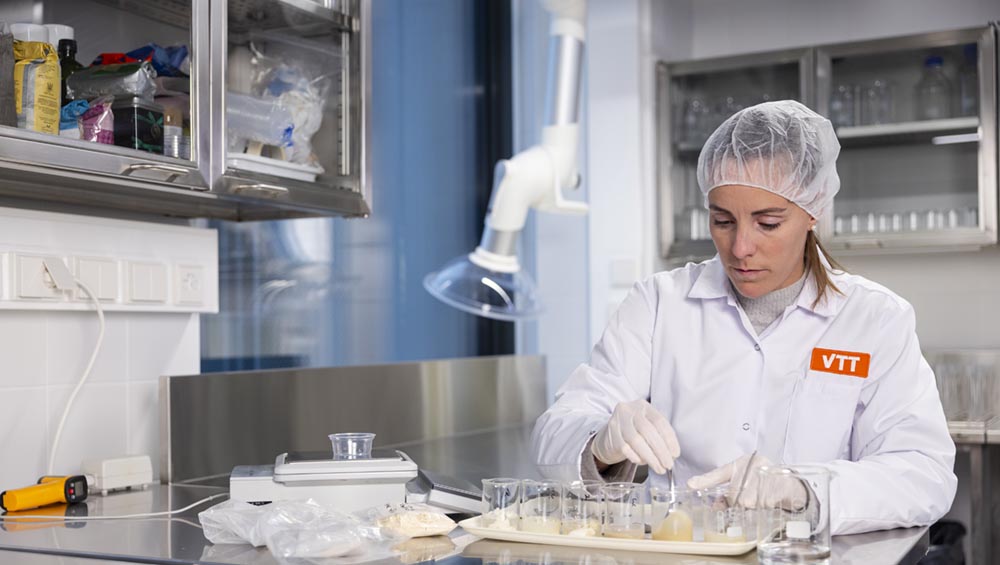
Finland’s VTT Technical Research Centre and a group of food companies have completed a three-year project aimed at tackling one of the persistent challenges facing plant-based ingredient production: how to extract enough value from the entire raw material to build a profitable business.
• VTT and seven Finnish food companies have completed the €3 million (US$3.5 million) RETHINK project, exploring how plant-based ingredient production can become more profitable.
• Researchers developed technologies for oat beta-glucan, legume protein processing and enzyme-assisted production, alongside a new faba bean protein granule from Valio and Viking Malt.
• The project found that profitability depends on generating greater value from carbohydrates, fiber and other fractions, rather than concentrating primarily on plant protein.
The Business Finland-funded RETHINK project brought VTT together with Anora, Apetit, Fazer, Helsingin Mylly, Raisio, Valio and Viking Malt. Running from June 2023 to August 2026, the €3 million (US$3.5 million) initiative explored new processing technologies, ingredients and business models based around crops including oats and faba beans.
Its central finding is that focusing predominantly on protein leaves considerable value on the table. Instead, the project argues that producers need viable markets for every fraction generated during processing, while designing ingredients more closely around their eventual applications.
“Globally, food production is shifting towards more local and distributed production models, as companies and societies strive to strengthen their resilience,” said Emilia Nordlund, Portfolio Lead at VTT and responsible leader of the project. “Finland is in a great position to create new plant-based production chains and profitable business, leading to growth in the industry. We have plenty of active farmers and capacity for regional raw material production, as well as growing interest in plant-based products from the food industry and retail sector.”
One particular challenge is finding higher-value applications for carbohydrate-rich fractions. When peas are processed for protein, for example, these fractions can represent a large proportion of the original crop but may ultimately be sold into relatively low-value animal feed markets.
“It is especially critical to find the high value use cases for carbohydrate-rich fractions, as they often comprise the largest share of the raw material,” Nordlund said. “We should be boldly looking for uses beyond the food sector too. In cosmetics, for example.”
RETHINK also examined how companies at different points in the supply chain could work together earlier, covering raw material availability and quality, processing, applications and commercial routes rather than treating them as separate problems.
One result is a new ingredient developed jointly by Viking Malt and Valio. The companies used germination expertise and food commercialization capabilities to create a faba bean protein granule intended for plant-based and hybrid meat products.
“Our collaboration is based on a shared goal: to maximise the value of Finnish plant-based raw materials by drawing on Finnish expertise and our best practices,” said Susanna Kallio, Vice President, Plant-Based Business at Valio, and Xin Huang, Group R&D Manager at Viking Malt. “Viking Malt’s experience with germination and Valio’s commercialisation know-how made it possible to create an entirely new kind of food product.”
Several processing technologies also emerged from VTT’s research.
Among them is a patented method for concentrating and using oat beta-glucan dietary fiber. According to VTT, the process allows beta-glucan to be incorporated into liquid products while keeping the fiber intact and maintaining a pourable consistency rather than producing a paste-like texture.
“In RETHINK, we patented an entirely new way to concentrate and apply oat dietary fibre, beta-glucan,” Nordlund said. “This invention makes it possible to add fibre to liquid products so that the fibre stays intact while the liquid remains pourable and without a paste-like texture.”
Researchers also developed a pretreatment technique for protein separation intended to prevent the off-flavors commonly associated with legume ingredients. The aim is to broaden the range of foods in which legume-derived proteins can be used without requiring more complex processing.
Enzyme-assisted processing was another area of development, with VTT investigating methods that could reduce chemical use while improving ingredient functionality.
The project has also contributed to the commercialization of technology developed by VTT spin-off Happy Plant Protein. Its process separates protein from carbohydrates and texturizes the resulting protein in a single processing step, rather than treating separation and texturization as separate stages.
The technology has moved from research toward industrial deployment and is now being used in production projects in Latvia and the Netherlands.
“Happy Plant Protein is reshaping the market with its production process,” Nordlund said. “It's also an excellent example of a company with international ambitions making use of existing food industry infrastructure and local raw materials.”
For VTT, the commercial argument emerging from RETHINK is that plant protein economics cannot be solved simply by improving the protein fraction. Building viable production will also depend on finding customers and applications for carbohydrates, fiber and other outputs, while linking farmers, processors, ingredient companies and end users more closely from the outset.
The project was supported through Business Finland’s co-innovation model and included five parallel industry projects alongside VTT’s research program.
If you liked this, check these out...
• What does ‘plant-based’ actually mean? US study finds generational divide
• Pea protein processing method shapes gut microbiota response, University of Parma study finds
• Alfa Laval breaks ground on food innovation center focused on next-generation protein processing

Join Us At One Of Our Upcoming Events

If you have any questions or would like to get in touch with us, please email info@futureofproteinproduction.com