
Smaller appetites, higher expectations: why every ingredient now has to do more

GLP-1 therapies are reshaping food design, and companies like Meala, led by CEO Hadar Ekhoiz Razmovich, are developing multifunctional protein systems to deliver more nutrition, satiety, and performance in every bite
As GLP-1 weight management therapies continue to gain traction globally, they are reshaping not only how much consumers eat, but what they expect from every bite. Smaller portions, higher nutritional density, and stronger satiety are emerging as defining requirements, prompting food manufacturers to reassess food formulation for GLP-1 users.
“GLP-1 is pushing the industry to rethink food design from a volume-based model to a value-per-bite model,” says Hadar Ekhoiz Razmovich, CEO & Co-founder of Meala. “When people eat less, every bite has to work harder: nutritionally, sensorially, and functionally.”
Recent research from Kantar suggests this shift is set to accelerate across all major markets, with adoption expanding beyond injectable formats into more accessible oral treatments.[1] GLP-1 therapies are projected to grow across every market studied, driven by improving accessibility, falling costs, and expanding use cases.
From volume to value per bite
The implications are already visible in consumer behavior. GLP-1 users are increasingly preparing meals at home and reducing restaurant visits, while placing greater emphasis on portion control, nutrient density, and protein intake. As appetite is suppressed, the expectation placed on each meal has shifted: food must deliver more value in less volume.
That shift is also changing how consumers evaluate products. As GLP-1 adoption grows, users are becoming more selective, placing greater emphasis on ingredient transparency, nutritional quality, and functional outcomes. Demand is moving toward foods that are not only high in protein or fiber, but also clearly formulated and easy to understand.
For food manufacturers, this evolving landscape introduces a new formulation challenge. Historically, product development has focused on scaling volume, managing cost, and achieving acceptable sensory performance at scale. In a GLP-1-driven environment, however, the emphasis has shifted toward optimizing performance per bite. Nutritional density, satiety, and sensory satisfaction must now be delivered within smaller formats, without compromising consumer expectations or overall product appeal.
Where traditional formulation systems fall short
“The biggest gap is that many current systems are still built around trade-offs,” Ekhoiz Razmovich says. “When manufacturers increase protein, they often lose texture or create dryness. To fix that, they add stabilizers, hydrocolloids, or multiple functional ingredients, which increases complexity and often weakens the clean-label proposition.”
This requirement exposes the limitations of many legacy formulation systems. In protein-forward categories in particular, manufacturers have long relied on multi-component ingredient systems combining stabilizers, binders, and texturizers to achieve the desired functionality. While effective at scale, these systems often increase formulation complexity, extend ingredient lists, and make it more difficult to improve nutritional profiles without affecting texture or taste.
When people eat less, every bite has to work harder: nutritionally, sensorially, and functionally
Against this backdrop, ingredient-level innovation becomes critical, with companies developing multifunctional protein systems emerging as key enablers of this shift. Meala is among those advancing solutions in this space, with a focus on delivering clean-label functionality alongside strong sensory performance.
“Traditional systems often rely on several different ingredients to achieve texture, binding, stability, and nutritional targets,” Ekhoiz Razmovich says. “Our approach is different because we integrate multiple functionalities into one clean-label solution.”
Satiety is also taking on a more prominent role in GLP-1-driven product reformulation, extending beyond nutritional composition to include sensory experience. Texture, chew, and mouthfeel are increasingly important in determining how satisfying a product feels, particularly as portion sizes shrink.

“Satiety is not only about protein content or fiber; it is also strongly influenced by texture and mouthfeel,” Ekhoiz Razmovich says. “Foods that feel substantial, structured, juicy, or satisfying can contribute much more to the overall eating experience than foods that are nutritionally strong on paper but feel thin, dry, or unsatisfying.”
Label simplicity is emerging alongside this as a functional requirement rather than a marketing preference. As consumers become more selective, long ingredient lists increasingly create friction, especially in categories already under scrutiny. The challenge for manufacturers has therefore become twofold: improving product performance while simultaneously simplifying formulations through more advanced functional food ingredients.
From product concept to market reality
The industry is already beginning to respond. In May 2024, Nestlé introduced its Vital Pursuit range,[2] a portfolio of portion-aligned, high-protein meals designed specifically for consumers using GLP-1 medications or managing their weight. The products were developed to deliver essential nutrients and satiety within smaller portions, reflecting a broader shift in how food is being designed.
By September, the range had reached nationwide distribution across major US retailers including Walmart, Target, and Kroger, underscoring the speed at which GLP-1-driven product concepts have moved from strategy to shelf. Industry projections suggest that GLP-1 users in the USA alone could reach 30 million by 2030, reinforcing the scale of the opportunity.
The response extends beyond product innovation into broader portfolio strategy and investment. In March 2026, Danone agreed to acquire meal replacement brand
Huel in a deal worth approximately €1 billion,[3] expanding its presence in functional and complete nutrition. The move reflects a wider push toward high-protein, nutritionally dense products aligned with evolving consumer needs.
At the same time, demand for protein-rich products continues to accelerate across categories, with higher protein content becoming an increasingly standard expectation rather than a point of differentiation. As a result, product developers face growing pressure to deliver nutritional value, functionality, and sensory quality within increasingly constrained formats.
Meala has developed its approach around this convergence of needs. Its protein texturizing solution, commercially available through dsm-firmenich as Vertis PB, delivers binding, gelling, emulsification, and water retention functionality – roles typically handled by multiple ingredients – within a single ingredient labeled simply as pea protein.
By consolidating functions into one component, it reduces reliance on complex additive systems while increasing protein content. This approach aligns with GLP-1-driven product design. As portion sizes shrink, every ingredient must contribute more to structure, stability, nutritional value, and sensory experience.
The ingredient supports texture, chew, and mouthfeel without off-notes, removing the need for masking agents that complicate ingredient lists. This enables shorter labels while giving manufacturers greater flexibility across applications.
Although initially applied in meat alternatives, the technology enables new product formats. Examples include a tofu schnitzel with just four recognizable ingredients and more than 20g of protein, or vegetable-forward products combining strong texture with high protein content. These applications show how simplified ingredient systems support innovation and improved nutritional performance.
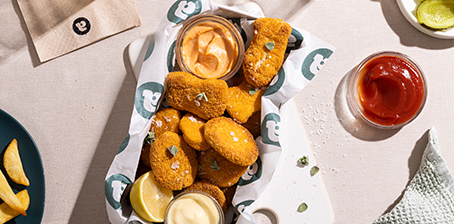
in coated fish-style products
“We are seeing a stronger focus on nutritional density, protein enrichment, and product simplicity,” Ekhoiz Razmovich says. “Manufacturers are asking how to increase protein without compromising texture, how to maintain a satisfying eating experience in smaller portions, and avoid building products around long and complex ingredient lists.”
Designing for more with less
As GLP-1 adoption continues to influence eating habits, the pressure on manufacturers to deliver more from less is unlikely to ease. Consumers are eating less, but expecting more – more nutrition, more satisfaction, and greater transparency from the foods they choose.
The emerging formulation paradigm reflects that shift. It is defined not by increasing complexity, but by efficiency, where fewer ingredients are expected to deliver greater functionality.
“We expect products to become more nutrient-dense, more portion-efficient, and more focused on quality of intake rather than quantity,” Ekhoiz Razmovich says. “The winners will be solutions that combine clean-label positioning with real sensory performance and industrial practicality.”
Within this context, solutions that simplify formulations while enhancing performance, such as multifunctional protein systems, are likely to play a central role in shaping the future of food formulation.
[1] https://www.kantar.com/inspiration/research-services/global-glp1-adoption-for-consumers-and-brands
[2] https://www.nestle.com/media/news/vital-pursuit-brand-glp-1-weight-support
[3] https://www.danone.com/newsroom/press-releases/acquisition-huel.html
If you have any questions or would like to get in touch with us, please email info@futureofproteinproduction.com