
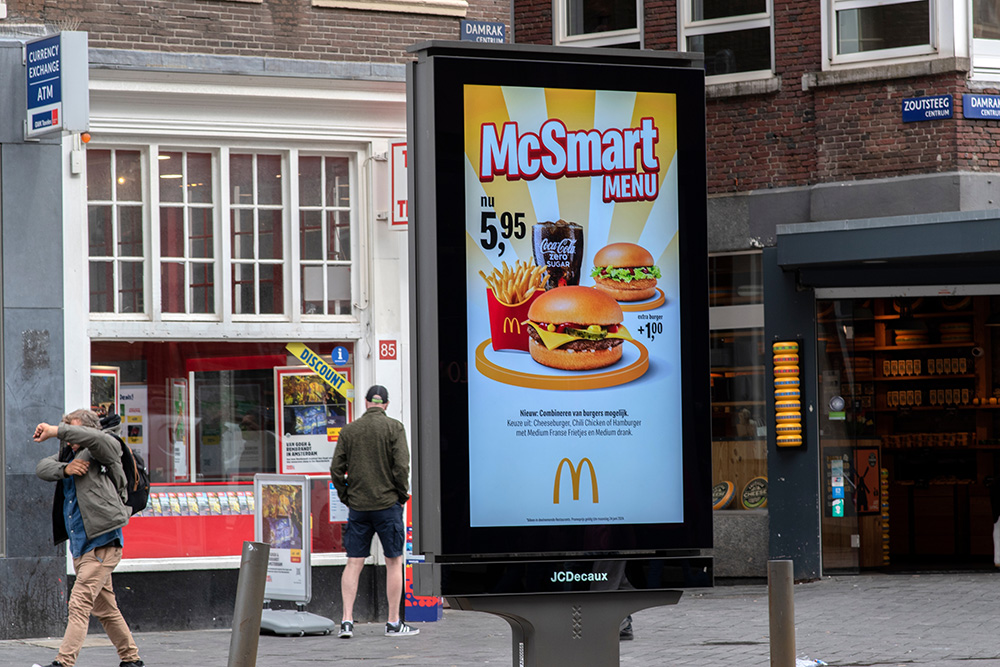
Amsterdam moves to curb meat advertising as capital targets plant-forward diets

Amsterdam has become the first capital city in the world to ban the advertising of meat in public spaces after its municipal council approved a measure designed to support healthier diets and lower greenhouse gas emissions.
• Amsterdam’s municipal council approved a ban on meat advertising in public spaces, set to take effect from 1 May 2026, following a vote supported by a majority of council members.
• The policy was introduced by the Party for the Animals and the Green/Left party and aligned with the city’s goal of achieving diets that are 50% plant-based by 2050.
• Advocacy group ProVeg International welcomed the move, citing climate, health, and animal welfare benefits associated with reduced meat consumption.
The ban was approved by 27 of the 45 seats on Amsterdam’s municipal council and was introduced under a bill jointly tabled by the Party for the Animals and the Green/Left party. The restriction will apply to meat advertising across public spaces within the city and is scheduled to come into force on 1 May.
ProVeg International welcomed the decision, describing it as a logical step in addressing food system emissions and supporting dietary change. Joey Cramer, Director of ProVeg Netherlands, said the measure reflected the climate impact of meat production and the role of advertising in shaping consumption patterns.
“We know that most of the carbon emissions in the food system comes from meat production so it makes sense for Amsterdam to restrict the advertising of meat as part of its strategy to promote food system change,” Cramer said.
The policy aligned with Amsterdam’s longer-term dietary objectives. The city has previously set a goal of ensuring that its citizens’ diets are 50% plant-based by 2050, a target that local policymakers have linked to both public health and climate objectives.
“This policy supports Amsterdam’s existing goal of ensuring their citizens’ diets are 50% plant-based by 2050. Such a shift is not only good for the climate, it’s good for people’s health and, of course, for animals,” Cramer said.
Amsterdam’s decision built on earlier action taken elsewhere in the Netherlands. In 2022, the town of Haarlem became the first non-capital city in the world to restrict meat advertising in public spaces. Following Haarlem’s move, seven other Dutch cities began work on similar measures, with Amsterdam becoming the third municipality to actually implement a ban.
Supporters of the policy have pointed to growing public backing for dietary change in the Netherlands. Research cited by ProVeg Netherlands indicated that a majority of Dutch consumers were in favor of shifting toward a more plant-based way of eating, even as animal protein continued to dominate national consumption patterns.
Protein intake in the Netherlands currently consisted of around 60% animal protein, according to the figures referenced by ProVeg. This remained well above the balance recommended by the Dutch Health Council, which advised a dietary split of 40% animal protein and 60% plant-based protein.
ProVeg Netherlands has sought to accelerate this transition through a national platform highlighting the plant-based ambitions of 190 Dutch organizations, spanning businesses, institutions, and civil society groups. The organization framed the Amsterdam advertising ban as one of several tools available to local governments seeking to influence dietary norms and consumption behavior.
Environmental considerations were central to the rationale behind the policy. Animal-based foods were cited as emitting roughly twice as much greenhouse gas as plant-based foods, reinforcing arguments that reducing meat consumption could play a meaningful role in lowering food system emissions.
While the ban focused specifically on advertising rather than consumption itself, supporters argued that limiting promotional visibility in public spaces could help normalize alternative dietary choices and support existing policy goals without imposing direct restrictions on individual behavior.
Amsterdam’s move placed it at the center of a growing debate across Europe about the role of advertising regulation in climate and health policy. Unlike national bans on products such as tobacco, restrictions on food advertising have typically been implemented at the municipal level, often as part of broader sustainability strategies.
With the policy now approved, attention will turn to its implementation from May and whether similar measures are adopted by other capital cities seeking to align food policy with climate and public health objectives.

Join Us At One Of Our Upcoming Events

If you have any questions or would like to get in touch with us, please email info@futureofproteinproduction.com