


Brevel and Wave Group plan US$10-15 million illuminated fermentation plant in India

Brevel’s planned manufacturing venture with India’s The Wave Group could produce roughly 900 tons of chlorella a year, CEO and Co-founder Yonatan Golan has told Protein Production Technology International. The company is also negotiating production capacity with plant cell culture businesses, with one prospective nutraceutical deal expected to begin at its existing Israeli factory before expanding into India.
The US$10-15 million project follows months of commercial operation at Brevel’s first plant, which opened in Israel in 2025. Golan said that experience had helped establish the case for a larger factory, although the product leading the expansion will be chlorella biomass rather than the food protein ingredients that initially brought Brevel to wider attention.
• The Wave Group will fund the planned 300,000-liter facility, with construction due to begin later in 2026.
• Production will start with Brevel’s Purallis chlorella, with scope to manufacture other light-dependent ingredients.
• The partners are testing sugar mill side streams as fermentation inputs to reduce production costs.
Wave will fund the facility, with construction scheduled to begin later in 2026 and full-scale production expected in 18 months. Its first product will be Purallis, Brevel’s clean-label chlorella biomass. The partners also intend to manufacture ingredients for other companies using Brevel’s illuminated fermentation technology.
The agreement was signed in New Delhi at a ceremony attended by representatives of the Embassy of Israel, Israel’s Economic and Trade Mission, and Invest India.
Brevel’s Israeli factory currently operates at a 5,000-liter reactor scale. Since opening it, the company has been testing whether its process delivers consistently, whether the resulting ingredients meet customer requirements and whether there is sufficient demand to justify expansion.
“Since opening the first commercial plant in 2025 we managed to fully validate our illuminated fermentation technology over many months and could also validate the resulting product quality and market demand,” Golan said.

Work with external developers added another reason to build. Brevel began taking on process improvement and scale-up projects, mostly with plant cell culture companies, and found that its available manufacturing capacity would not be enough.
“These companies (mostly plant cell culture) are in need of larger capacities than we can currently provide in the existing factory and thus we understood that we have to expand capacity to meet the growing market demands,” Golan said.
Those customers could eventually occupy part of the Indian plant, alongside Brevel’s own chlorella production. Golan said discussions were taking place with companies already operating commercially in plant cell culture, although he did not disclose how much capacity was covered by purchase commitments.
“Based on market demand for Purallis, we strongly believe we can fill the whole capacity with ease,” he said. “In parallel, we are in discussions with companies already commercial in the PCC space about securing part of the capacity for their needs.”
How much ingredient comes out of the factory will depend on what goes into its production schedule. A facility devoted to Purallis could produce roughly 900 tons annually, according to Golan. For plant cell culture products, which generally grow more slowly, his current estimate is around 200–400 tons annually.
These are alternative uses of the planned 300,000-liter capacity. The eventual mix of chlorella and external customer products has not been announced.
For now, Purallis offers Brevel an established market in which to sell the output. Golan was direct about its commercial advantages over food protein.
“Purallis (chlorella) is actually more profitable than protein, does not require any regulation or process development and is entering an existing market where it can compete on quality and price,” he said.
That assessment explains why nutraceutical chlorella will be the first product manufactured in India. It gives Brevel a way to expand production infrastructure and pursue profitability while continuing the longer development work needed for its protein business.
“Protein will take more time to get into the market, but once it does, is a much larger market opportunity,” Golan said. “Thus, it remains a priority for Brevel, but a more long-term one.”
He sees Purallis helping to pay for the facilities and process improvements that will support that work.
“Purallis can enable the next major scale-out stage, construction of large-scale infrastructure, arriving at profitability and securing a solid path for further development and improvement,” he said.
Brevel has secured US$30 million in funding to date. The Wave agreement brings a manufacturing partner willing to finance the next factory, as well as access to sugar processing materials that could feed its fermenters.
Wave’s businesses span sugar manufacturing, beverages, industrial manufacturing, real estate and infrastructure. For its investment in Brevel’s technology, Golan said the group wanted evidence of an operating industrial process and a credible market.
“Wave are investing in an industrial factory and not in a high-risk high-reward startup,” he said. “Therefore, they wanted to be sure that the technology and market are de-risked as much as possible before investing.”
The Israeli plant gave Wave an operation to assess. Golan said customer sales and market analysis supported the commercial case, while the relationship between the partners also contributed to the agreement.
“Operating a fully commercial FOAK facility provided vital operational credibility, while active customer sales and rigorous market analysis delivered definitive commercial validation,” he said. “These, alongside the long personal relationship we have been building, were enough for them to make this significant decision.”
The companies now have different jobs to complete before production starts. Wave will provide the financing and establish the factory. Brevel must deliver the technology and find customers for the planned output.
“The next step would be for Wave to deliver on financing and setting up the factory, while Brevel will deliver on a fully efficient and productive technology and securing all planned capacity to customers,” Golan said.
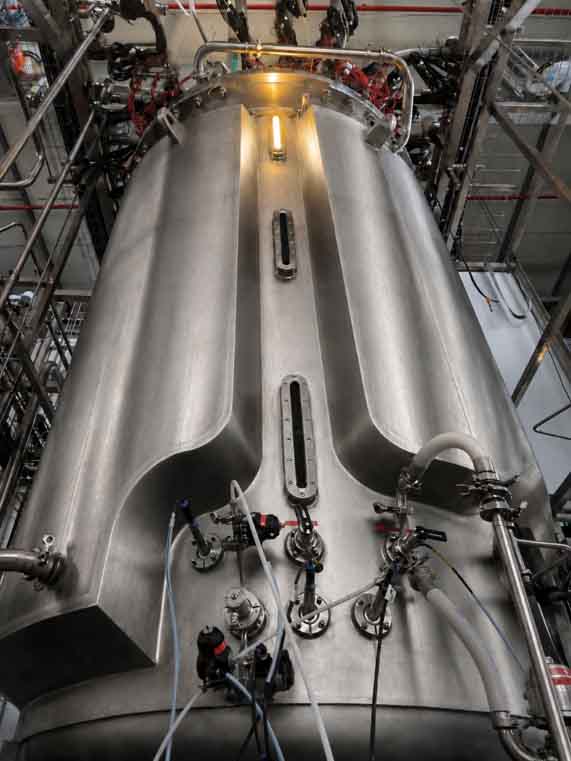
The factory will use 30,000-liter illuminated fermenters, a sixfold increase from the individual reactor scale Brevel currently operates. Its 300,000-liter total capacity will therefore be spread across multiple vessels.
Introducing light into larger fermentation equipment brings engineering problems that conventional fermentation does not have to address. Illumination must reach the culture while the system remains clean and practical to operate.
“Yes, getting enough light inside the fermenter while preventing contamination and operational issues is the difficult part,” Golan said.
Nevertheless, he said the move from 5,000 to 30,000 liters would not require new technology development, and the design would remain substantially the same. Larger individual vessels could require further changes.
“Beyond 30,000L some technology solutions may be needed, and our team is already working on some of them,” he said.
Brevel’s process combines sugar-fed fermentation with controlled light inside a closed system. Sugar supplies the energy and nutrients needed for growth, while illumination affects the compounds an organism produces. The company said its technology is protected by four patents.
Golan said the value of light varies by ingredient. In some cases, it enables production of a compound that would otherwise be absent. In others, it increases yield.
“Many valuable ingredients in microalgae and in plant cell cultures either demand light to be produced in the first place or are produced in much higher yields,” he said.
He cited RuBisCo protein, lutein and zeaxanthin as examples of compounds whose production requires light in the microalgae processes he described.
“This is a binary zero or one situation,” Golan said. “In other cases, for example in plant cell culture, light triggers the production of secondary metabolites and can increase yields by 200-300%.”
Illumination could also change how a culture is run. Golan said using light as an elicitor, a stimulus that triggers a biological response, can enable continuous cultivation and reduce production time by up to 90%.
“This is a potential major cost reduction which can open new market opportunities and increase profitability,” he said.
The figures describe potential gains in particular applications, rather than a performance claim for every ingredient the Indian plant might manufacture. Golan did not provide a product-level comparison of those gains against the additional equipment and electricity costs of illumination.
The partners are also working on the cost of supplying sugar to the process. Trials with materials from Wave’s mills have gone further than the broad reference to sugar side streams in the joint venture announcement.
“We have been testing different sugarcane refinery by-products and process intermediates,” Golan said. “These include molasses, raw sugar and sucrose rich intermediates.”
Some preparation is required before those materials can be used. Golan described the preprocessing as mostly hydrolysis-based and said the trials were already showing savings, although he was not ready to give a figure.
“This is still work in progress, but current results demonstrate a meaningful cost reduction,” he said. “I cannot provide specific numbers at the moment.”
Locating the factory close to Wave’s sugar mills should also reduce the expense of transporting those materials. The partners expect lower associated emissions, but have not published calculations for the transport savings or environmental reductions.
Beyond chlorella, Brevel has been working with customers on cocoa, coffee, saffron and marigold. Several companies are involved in its cocoa work. Golan could not disclose the complete range of products under development, citing customer confidentiality.
The company’s external projects include its previously announced collaboration with US plant cell technology business Ayana Bio. The partners secured US$1.25 million from the Israel-US Binational Industrial Research and Development Foundation earlier in 2026 to develop plant-derived bioactives using illuminated fermentation.
The Indian venture is intended to give such developers a route from process development into larger production. Brevel’s own products would occupy some of the factory, with other capacity available to companies whose organisms or cell cultures benefit from light.
Golan said products aimed at nutraceutical markets were closest to manufacturing readiness. One prospective customer could begin production before the Indian plant is built, using Brevel’s existing capacity in Israel.
“In fact, we are now about to close a production deal which we will begin supplying from the current facility in Israel and then ramp-up production once the India JV facility will be up and running,” he said.
The customer and ingredient remain undisclosed, and the agreement had not been confirmed as signed at the time of the interview.
If you liked this, check these out...
• Brevel bets on light to unlock the next chapter of plant cell culture
• Ayana Bio and Brevel secure US$1.25 million BIRD grant to scale plant cell bioactives through illuminated fermentation
• NXW Nutrition from Water deepens PhycoFerm partnership with strategic strain investment

Join Us At One Of Our Upcoming Events

If you have any questions or would like to get in touch with us, please email info@futureofproteinproduction.com


