Brevel bets on light to unlock the next chapter of plant cell culture

As plant cell-culture companies search for viable routes to scale, Brevel CEO Yonatan Golan argues that light may be the industry's missing variable. In this exclusive interview, he discusses how illuminated fermentation could reshape economics, quality, and production efficiency across a new generation of biological products
A coffee cell growing inside a bioreactor has never seen a sunrise. Brevel believes that matters. The Israeli biotechnology company has spent years developing a manufacturing platform built around a simple idea: many biological systems evolved in the presence of light, yet industrial fermentation largely removes it from the equation. By introducing carefully controlled illumination into closed fermentation systems, Brevel believes it can improve productivity, unlock valuable compounds, and help solve some of the economic challenges that have long constrained plant cell culture.
That conviction is now being tested through a collaboration with Coffeesai, a company developing coffee through plant cell culture. Together, the companies are exploring how light can influence both production efficiency and flavor development, offering a glimpse into what a future generation of plant cell-culture manufacturing could look like.
For Yonatan Golan, Brevel CEO & Co-founder, coffee is only the beginning. “Light is a critical component in fermentation in two cases,” he begins. “The first is for ingredients, strains, or metabolites that are dependent on light to be produced and cannot be produced otherwise. These include, for example, RuBisCo protein, specific carotenoids and other photosynthesis-related components, as well as some strains which simply cannot grow in dark conditions.”
The second opportunity could prove even more transformative from a commercial perspective. “Light acts as a strong elicitor, like in nature, and can increase production by 200-300%,” Golan says. “This is true for secondary metabolites like polyphenols, flavonoids and other flavor compounds, as well as high-value ingredients like Paclitaxel, resveratrol, anthocyanins and others.”

Those kinds of gains have attracted growing attention from developers working in plant cell culture, a sector that has consistently demonstrated scientific promise but has often struggled to establish viable production economics at scale.
Brevel's efforts have also received external backing. The Israel Innovation Authority awarded the company US$1 million specifically to expand its illuminated fermentation platform into plant cell culture and adjacent industries, supporting a broader strategy to make the technology available to companies working with light-driven biological systems.
An unexpected opportunity
Brevel did not originally envision itself as a platform provider for the plant cell-culture industry. The company initially developed illuminated fermentation to support its own microalgae production activities. The goal was to combine the advantages of fermentation with the biological benefits of light exposure, creating a system capable of producing photosynthetic ingredients efficiently at industrial scale.
Then the phone started ringing. “The turning point came when companies started knocking on our door, asking if they could apply our technology to the strains and cell lines they had already developed to enhance yields and accelerate scale-up,” Golan continues.
The requests came from organizations working on different organisms, products, and production systems, but they shared a common question: could light improve what they were already building?
“Initially we set up our commercial production line for our own microalgae products, but we now realized that the potential is far greater than what we initially imagined.”
That realization has gradually reshaped Brevel's strategy. Alongside its own commercial microalgae products, the company is increasingly opening its infrastructure to external partners looking to explore the role of light in biological manufacturing.
The collaboration with Coffeesai represents one of the first public examples of that approach.

Why coffee matters
Coffee presents a fascinating test case because it highlights both the promise and complexity of plant cell culture. Conventional coffee production faces mounting challenges. Arabica coffee, in particular, is highly sensitive to temperature fluctuations and changing environmental conditions. As climate pressures intensify, concerns have grown about the long-term suitability of traditional coffee-growing regions.
Plant cell culture offers an alternative approach. Rather than cultivating entire plants, individual coffee cells can be grown in controlled bioreactor environments, reducing dependence on land, water, weather, and seasonal conditions.
Yet producing coffee cells is only part of the challenge. “In some PCC targets, the end product is not the plant cell itself, but a target molecule,” Golan explains. “In coffee, the cell is the final product.”
That distinction fundamentally changes the manufacturing objective. When companies produce a single compound, they only need to optimize production of that specific molecule. Coffee requires something far more sophisticated. The entire sensory experience must be recreated, including the complex combinations of compounds responsible for flavor, aroma, and overall quality.
“In our collaboration with Coffeesai, we found out that light is an essential lever to get to certain flavors which haven't been possible before,” Golan says. “We demonstrated a very strong correlation between the light intensity and the flavor profile.”
The trials focused on evaluating how different light conditions influence the resulting biomass. According to Brevel, manipulating specific light profiles allowed the company to influence the expression of desirable compounds while maintaining stable, high-density cultivation.
Coffeesai CEO Ami Herman described the early findings as encouraging and said the company continues to assess the platform's capabilities as it advances development and evaluates future production pathways.
Bringing nature back into the bioreactor
The relationship between light and plants is hardly a scientific revelation. Plants evolved to interpret light as a source of information, using it to regulate growth, metabolism, and the production of countless compounds.
What makes illuminated fermentation noteworthy is the attempt to bring that biological language into an industrial setting.
Traditional fermentation systems generally operate in darkness. That approach works perfectly well for many microorganisms and production processes. However, Brevel argues that removing light from photosynthetic and plant-based systems may limit what those cells are capable of producing.
The company's platform introduces controlled light exposure directly into the fermentation process, allowing operators to influence cellular behavior without sacrificing the consistency and control associated with industrial manufacturing.
The objective is not necessarily to create entirely new flavors or products. At least initially, the goal is more pragmatic.
“In the near term, consumers are likely to expect the same flavor profile they know from traditionally grown crops, and only at a later stage will be open to variations,” Golan says.
“To get there, you will need a combination of levers which mimics the exact same conditions the plant receives in nature. Naturally light is an essential part of it.”
That philosophy reflects a broader trend across food biotechnology. Increasingly, companies are looking beyond simple productivity metrics and focusing on how biological systems can reproduce the complexity consumers expect from agricultural products.

The scale-up challenge
Generating impressive laboratory results is one thing. Reproducing them consistently at industrial scale is something else entirely.
Scale-up remains one of the most significant hurdles facing plant cell culture and cellular agriculture. Processes that perform well in small reactors often behave very differently once transferred into larger systems.
Golan believes part of the problem lies in the mismatch between development equipment and commercial production infrastructure.
“One of the biggest challenges in scaling up is that due to engineering constraints, many times the larger systems are very different from the lab-scale ones,” he says.
Brevel has attempted to address this issue by creating a scale-up pathway built around consistency.
“When we work on scale-up projects, we always start with 50L, which is pretty much identical in design to our 500L and 5,000L systems, and can quite reliably extrapolate the results from it to our larger ones.”
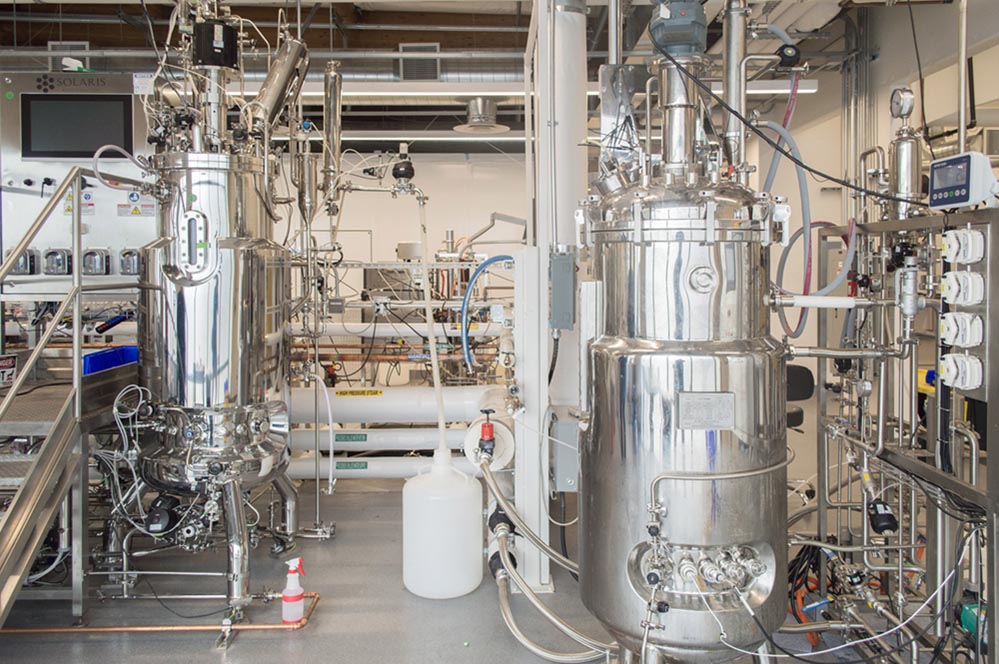
The company's manufacturing facility currently operates illuminated fermenters at 50L, 500L, and 5,000L scales under food-quality certifications including FSSC 22000 and HACCP.
That progression forms the backbone of Brevel's three-stage business model. Companies begin with feasibility and proof-of-concept work, advance into pilot-scale production, and eventually move toward commercial manufacturing through Brevel facilities, partnerships, or joint ventures.
The model is designed to shorten the journey from laboratory concept to industrial production while reducing some of the risks associated with scale-up.
The economics of light
Plant cell culture's long-term success will depend on economics as much as biology.
Many companies have demonstrated remarkable technical achievements. The challenge has often been translating those achievements into production systems capable of competing with conventional agriculture.
Golan believes illuminated fermentation addresses one of the most important economic drivers.
“The biggest factor is yields of the target molecules,” he says. “If, by using light, you can achieve 200-300% higher yields of secondary metabolites, at a negligible additional cost, then you cut the cost by more than 67% due to further simplified DSP costs.”
The potential impact extends beyond yields alone.
“If by using light we can achieve continuous harvesting, rather than batch growth, that means we can cut production times by at least 50-70% and even further reduce costs.”
Higher yields, shorter production cycles, and reduced downstream processing requirements all contribute to a more attractive cost structure.
“Overall, I am very optimistic that PCC won't face the same cost constraints that cultivated meat has faced.”
That optimism is notable at a time when many alternative protein and cellular agriculture companies are under increasing pressure to demonstrate clear commercial pathways.
Brevel's response has been to monetize the platform itself rather than rely exclusively on bringing new products to market.
“We developed a technology which we can already monetize, without the need to further develop, go through regulation and market penetration with a product produced by it.”
The decision became increasingly obvious as more companies approached the business looking for access to its technology.
“This also made it very clear to us that our main asset, our illuminated fermentation platform, is the core of the company strategy.”
Discovering a wider biological world
As Brevel has expanded beyond microalgae into plant cell culture and other biological systems, Golan says one realization has stood out.
“One thing that surprises me most is the sheer breadth of plant-based systems that are affected by light, which is something I never imagined.”
The company has encountered organisms and metabolic pathways far removed from its original focus.
He points to purple and green bacteria that use hydrogen sulfide rather than carbon dioxide in photosynthesis-like processes, generating compounds with significant pharmaceutical value.
“This is a complete parallel process to photosynthesis that I had no idea about and we can also play a dramatic role in.”
The experience has also revealed a more practical challenge.
“The industry is very non-standardized,” Golan says. “Each company uses different metrics and different ways to measure productivity.”
Dry weight, wet weight, optical density, cell counts, and numerous other measurements can all be used to describe biological performance.
“It's as if we speak different languages. Now that we have opened our gates to others to work with us, we are becoming aware of this Tower of Babel.”
As the industry matures, greater standardization may prove just as important as technological innovation in accelerating commercialization.
Looking beyond the horizon
Coffee may be the first public case study, but Brevel's ambitions extend well beyond any single crop.
The company sees illuminated fermentation as a platform capable of supporting a broad range of products, from plant cell-culture ingredients to photosynthetic microorganisms and high-value metabolites.
The Israel Innovation Authority funding is helping expand that capacity through additional systems, improved software infrastructure, and enhanced support for multiple partners working simultaneously.
“The milestones are on one hand our actual capacity and capabilities and on the other hand the number of successful collaborations we can achieve,” Golan says.
Ultimately, he views the technology through a long-term lens.
“PCC of any product, and coffee included, will become more viable than traditional agriculture,” he says. “This is not dependent on climate change, and coffee prices going up, but simply because PCC will be affordable as processes and technologies improve, and production capacity scales. It is only a matter of time.”
That future remains some distance away. Plant cell culture is still an emerging industry, and many technical, regulatory, and commercial questions remain unresolved.
Yet Brevel is betting that as companies continue searching for ways to improve yields, reduce costs, and replicate the complexity of agricultural products, they will increasingly discover that one of biology's most powerful tools was there all along. Light.
(Main photo: Brevel and Coffeesai are exploring how illuminated fermentation can influence flavor development in coffee cell cultures while supporting future commercial-scale production)

Join Us At One Of Our Upcoming Events

If you have any questions or would like to get in touch with us, please email info@futureofproteinproduction.com