

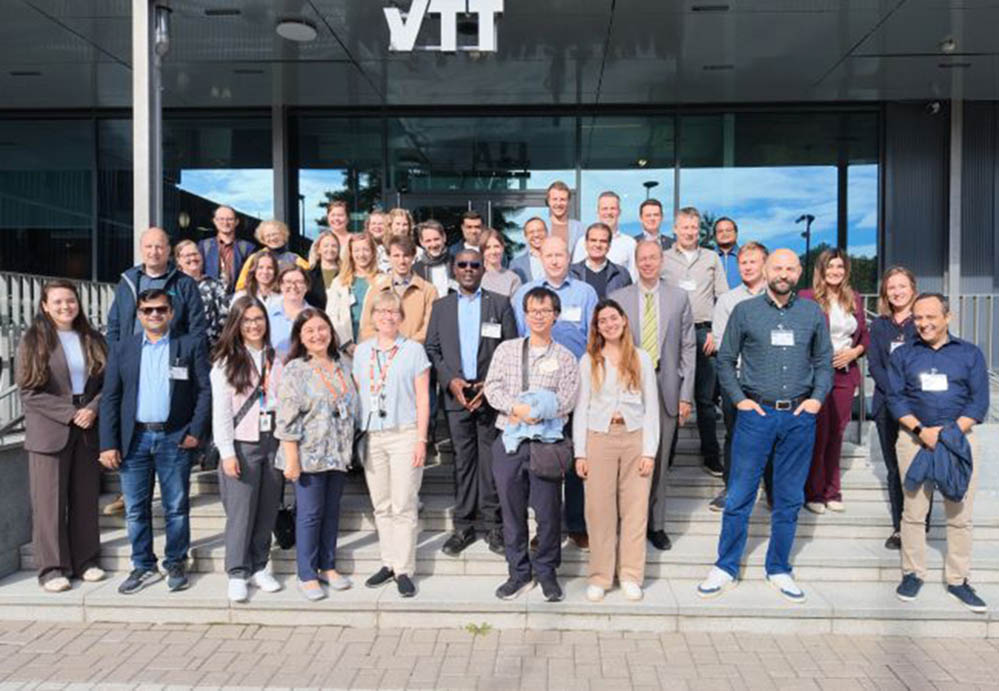
Duynie targets fermentation feedstocks in PROSCALE microbial protein project

Duynie has outlined its role in PROSCALE, a European research and demonstration project using food industry co-products to produce microbial protein ingredients, with responsibility for improving the composition, availability and quality of the materials supplied for fermentation.
• Duynie joined 16 partners across 11 countries in PROSCALE, contributing expertise in food industry co-products to support their conversion into microbial biomass for food applications.
• The four-year project began in September 2026 and targeted the scale-up of fungal, yeast and bacterial protein production through three continuous fermentation processes.
• PROSCALE received approximately €7 million (US$8 million) from the Circular Bio-based Europe Joint Undertaking, with work spanning feedstock preparation, ingredient production and food application testing.
Coordinated by VTT Technical Research Centre of Finland, PROSCALE runs until August 2030. The project brings together feedstock suppliers, fermentation specialists, equipment manufacturers, researchers and food producers to develop ingredients containing at least 50% protein on a dry matter basis.
Duynie’s involvement addresses the supply of suitable raw materials for those processes. Food industry co-products can retain valuable carbon sources and nutrients, but their availability alone does not establish whether they can support reliable, economical fermentation.
The company will work on optimizing their composition and quality to improve conversion into microbial biomass. It describes the work as creating higher-value food applications alongside the existing use of co-products in animal feed.
The project’s feedstock options include residues from potato, wheat and vegetable processing, together with byproducts from baking and pasta production. Preparing these materials for fermentation is part of a program covering characterization, pretreatment, cultivation and downstream processing.
According to the project’s published objectives, this preparation work includes developing methods to remove or detoxify substances that inhibit microbial growth, deal with non-fermentable suspended solids and improve substrate formulations.
These tasks are intended to make food industry sidestreams more useful as fermentation inputs. They also address feedstock cost and suitability, which Duynie identifies as constraints on the wider adoption of microbial proteins, alongside the difficulty of transferring promising pilot results to larger production systems.
PROSCALE will advance three production routes: mycoprotein from filamentous fungi, yeast protein, and bacterial protein produced through gas fermentation using methanotrophic bacteria. The partners will use continuous fermentation as they move the processes from pilot to demonstration scale.
The intended output is a set of nutritious, functional ingredients for food manufacturers. Potential applications identified in the project documentation include meat and dairy alternatives, sports nutrition, health-focused products and everyday foods such as bread and pasta.
Food industry partners will test the ingredients in relevant product categories, examining nutritional quality, taste, texture and processability under realistic conditions. Quality and safety assessments will accompany that development work.
The focus on finished applications means the consortium will assess how the ingredients perform in formulations as well as how efficiently they can be produced. Downstream processing will form part of that work, with the project seeking to preserve useful functionality while meeting safety requirements.
Partners include Enifer, Circe Biotech, Tetra Pak, Barilla, Pınar Süt, Sinonin Biotech and Wageningen Research. The consortium also includes DIL Deutsches Institut für Lebensmitteltechnik, the University of Vaasa, EIT Food, EFFoST, Institut Lyfe’s research center and The American College of Greece.
Digital tools, including a digital twin platform, will support process optimization and help the partners transfer results between scales. Techno-economic and environmental assessments will examine the production routes, while consumer research and regulatory work will inform potential market entry and investment decisions.
The consortium will also investigate further uses for materials generated during production. Its plans include recycling water and spent culture medium, developing pet food palatants and finding technical applications for co-products that are not directed into human food.
That work is intended to improve resource use across the production chain, with safety measures addressing the potential reintroduction of contaminants or pathogens when materials are reused.
PROSCALE’s published targets include a tenfold increase in fermenter capacity and improvements in resource efficiency. These are project objectives to be tested during the demonstration program, rather than results reported from completed operations.
PPTI first reported the project’s funding in May 2026, ahead of its September start. Duynie’s update provides more detail on its contribution to feedstock preparation and supply, with the company working alongside the other partners through the development of fermentation processes, ingredient recovery and food prototypes.
PROSCALE receives funding from the Circular Bio-based Europe Joint Undertaking under Horizon Europe, through grant agreement 101288362. Its scheduled completion date is August 31, 2030.
If you liked this, check these out...
• PROSCALE secures €7 million EU backing to scale single-cell proteins from food industry sidestreams
• Revyve raises €24 million to scale egg-replacing yeast proteins
• Angel Yeast adds dual certifications to Angeopro yeast protein

Join Us At One Of Our Upcoming Events

If you have any questions or would like to get in touch with us, please email info@futureofproteinproduction.com


