
Engineered yeast turns plastic waste into protein-rich food

Researchers at Southern Illinois University Carbondale have engineered yeasts to convert compounds derived from plastic and agricultural waste into proteins and other food ingredients, advancing a NASA-backed technology that has already been used to produce 3D-printed cookies.
• SIU researchers engineered yeasts to convert compounds obtained from PET plastic and agricultural biomass into edible proteins, fats, acids, vitamins and flavor molecules.
• The team used oxidative hydrothermal dissolution to break waste into microbe-accessible carbon compounds before feeding them to yeasts and producing protein-rich µBites.
• The latest work expanded a technology first reported in 2024, adding yeast strains capable of producing vanilla flavoring and beta-carotene from waste-derived feedstocks.
The latest results were presented at ACS Fall 2026 in Chicago on August 24 by graduate researcher Sandhya Jayasekara as part of a project led by Associate Professor Lahiru Jayakody. The presentation focused on engineered yeast consortia capable of converting plastic- and biomass-derived compounds into food additives.
The approach starts with polyethylene terephthalate (PET), the plastic commonly used in drinks bottles, alongside discarded corn stalks, leaves and other biomass.
Rather than incorporating plastic directly into food, the researchers first break down the waste using oxidative hydrothermal dissolution (OHD), a process developed by SIU geology professor Ken Anderson.
OHD uses water and oxygen at high temperature and pressure to transform resistant materials into smaller, water-soluble carbon compounds that microorganisms can access. Those compounds are subsequently fed to engineered yeasts, which convert the carbon into new food ingredients.
“We were trying to develop technologies for plastic upcycling to make more valuable products. We thought, why not focus on making food? Because plastic is carbon and food is carbon,” Jayakody said.
The microbial stage has now been used to generate proteins, fats and acids, while the team has also engineered organisms to produce specific nutritional and flavor compounds.
Baker’s yeast was modified to produce vanilla flavoring from plant biomass, while another yeast strain converted ethylene glycol derived from PET into beta-carotene, a precursor that the human body can convert into vitamin A.
“We’re using microbes to develop the cookie into a more attractive, consumer-friendly product,” Jayasekara said.
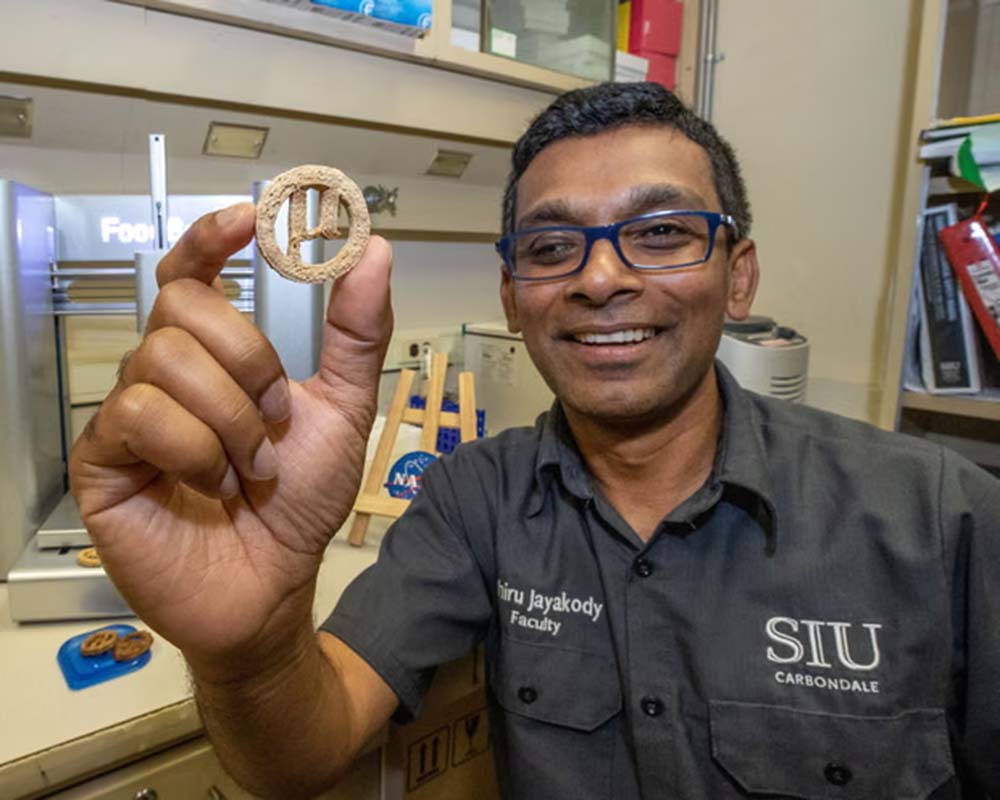
The resulting ingredients have been incorporated into µBites, a protein-rich food prototype produced by adding fiber, starch and sweetener before shaping the mixture using a 3D printer.
The project predates the latest ACS presentation. In May 2024, Jayakody and colleagues described the concept in Trends in Biotechnology, outlining a thermo-biological approach capable of using the carbon locked inside plastic waste and biomass as a feedstock for food production.
SIU said at the time that the researchers had demonstrated the concept by producing 3D-printed cookies from material processed through the µBites system. The work originated through NASA’s Deep Space Food Challenge, which sought technologies capable of producing food in environments where conventional agricultural supply chains would be impractical.
The latest work therefore represents a development of an existing platform rather than the first demonstration of food made from waste-derived carbon. By engineering additional yeast strains, the researchers are attempting to expand the range of compounds the system can produce and reduce its dependence on conventionally sourced ingredients.
Fiber, starch and sweetener are still added separately to the current µBites formulation. Jayakody said the longer-term objective was to produce these components through microbial processes as well, moving toward a system in which most of the food's principal ingredients could originate from microbial conversion.
According to ACS, the researchers' data indicated the µBites were safe to eat, although the team was awaiting institutional approval for further taste testing. The group hopes the technology could eventually be used not only in space exploration but in submarines, remote communities and regions where conventional food production or resupply is constrained.
The underlying plastic-upcycling research has also continued outside the food project. In 2024, Jayakody received a five-year National Science Foundation CAREER award worth up to US$624,500 to develop microorganisms capable of breaking down different plastics and funneling the resulting compounds into higher-value products.
For food production, however, considerable development remains before waste-derived microbial ingredients move anywhere near mainstream manufacturing. Consumer acceptance, regulatory requirements, process integration and the economics of converting heterogeneous waste streams into food-grade feedstocks all remain substantial questions.
For Jayakody, the attraction lies in treating carbon currently regarded as waste as a potential biological raw material.
“Microbes are very clever,” he said. “So, we are using their traits to solve the problems we created.”
If you liked this, check these out...
• World Economic Forum calls for cellular agriculture and bioreactors to become part of integrated space food systems
• NASA extends BioNutrients research on space-fermented food for astronaut health
• Finnish food tech takes a giant leap: Solar Foods wins international category in NASA's Deep Space Food Challenge

Join Us At One Of Our Upcoming Events

If you have any questions or would like to get in touch with us, please email info@futureofproteinproduction.com


