


Journal of Food Science review explores multi-organ systems to improve cultivated meat quality, Texas A&M researchers say

A review published in the Journal of Food Science has argued that cultivated meat production may need to move beyond simplified single-cell systems to better match the quality of conventional meat.
• A Journal of Food Science review examined how co-cultures, liver-cell modules, and rumen fermentation products could be combined in cultivated meat production systems.
• The authors found that multi-organ approaches could improve flavor and tissue quality while reducing reliance on costly media components such as growth factors.
• The paper identified key challenges including contamination control, process complexity, regulatory uncertainty, and standardization of microbial inputs.
The paper, titled Multi-Organ Approaches to Cultivated Meat Biomanufacturing: Conceptual Applications of Ruminal Fermentation and Co-Cultures, was authored by Morgan Rease, Wasitha Praveen de Wass Thilakarathna, Chandni Praveen, Suresh Pillai, and Reza Ovissipour.
It set out a case for introducing greater biological complexity into cultivated meat systems, moving beyond monocultures that have dominated development to date.
Current production models have largely focused on growing muscle or fat cells in isolation, reflecting the need for simplicity, cost control, and scalability in early-stage development. The review argued that this simplification came with trade-offs, particularly in replicating the interactions that shape flavor and tissue structure in conventional meat.
“The main quality gaps in monoculture systems are flavor and tissue maturation,” said Reza Ovissipour, Assistant Professor at Texas A&M University. “In animals, flavor develops through interactions among the gut microbiome, liver, fat, and muscle. A multi-organ approach could better recreate this cross-talk, improving flavor-related metabolism and tissue development while reducing reliance on costly added growth factors.”

One area explored in the review was co-culture systems, where multiple cell types are grown together rather than in isolation. These approaches are well established in regenerative medicine and have shown the ability to influence cell behavior through the exchange of nutrients, cytokines, and signaling molecules.
“In cultivated meat, adoption of co-culture and multi-organ approaches has been limited because the field has focused first on more immediate priorities such as cell line development, media optimization, bioprocess scale-up, and cost reduction,” Ovissipour said. “To enable wider uptake, the field now needs more targeted research showing that these approaches can deliver clear benefits in product quality, functionality, and cost-effectiveness.”
The role of supporting cell types formed a central part of the review’s argument. Morgan Rease, Graduate Assistant at Texas A&M University and co-author of the study, pointed to fibroblasts as a key example.
“Fibroblasts can have a significant practical impact on texture because they produce and organize extracellular matrix components that help define tissue structure and mechanical integrity,” Rease said. “In cultivated meat, where texture remains a major challenge, the contributions of support cells like fibroblasts may be underappreciated, while muscle cells and fat cells get more focus. Products derived from multiple cell types, including cells like fibroblasts, could lead to more realistic meat texture.”
The review also examined the potential role of liver cells as a metabolic support system within cultivated meat production.
“In the near term, liver cells are most realistically useful for metabolic support, including nutrient processing, lipid metabolism, and production of bioactive factors,” Ovissipour said. “The most practical approach is likely liver organoids or small liver-cell modules integrated into co-culture systems, rather than as a major structural part of the final product.”
Another layer of complexity explored in the paper was the potential use of rumen-derived metabolites. In ruminant animals, microbial fermentation in the rumen produces compounds such as B-vitamins, short-chain fatty acids, and other metabolites linked to flavor and nutritional characteristics.
“Rumen-derived metabolites may offer advantages over conventional media supplementation because they could provide a more biologically relevant mixture of nutrients, fermentation products, and signaling compounds,” Rease said. “These metabolites could better support cell growth, differentiation, and flavor-related metabolism while potentially reducing reliance on expensive purified media components.”
The review proposed introducing these compounds through a separate fermentation module, physically isolated from mammalian cell cultures to reduce contamination risk. Microbial metabolites would be harvested, filtered, and used to condition media.
“It would be difficult to fully standardize the native rumenmicrobial consortium for industrial use because of its complexity and natural variability,” Rease said. “However, the goal does not need to be to replicate the exact rumen community. A more feasible approach is to develop a simplified, stable microbial consortium for controlled cultivation with the ability to convert lignocellulosic substrates into metabolites that are relevant to cellular flavor, nutritional qualities, and function.”
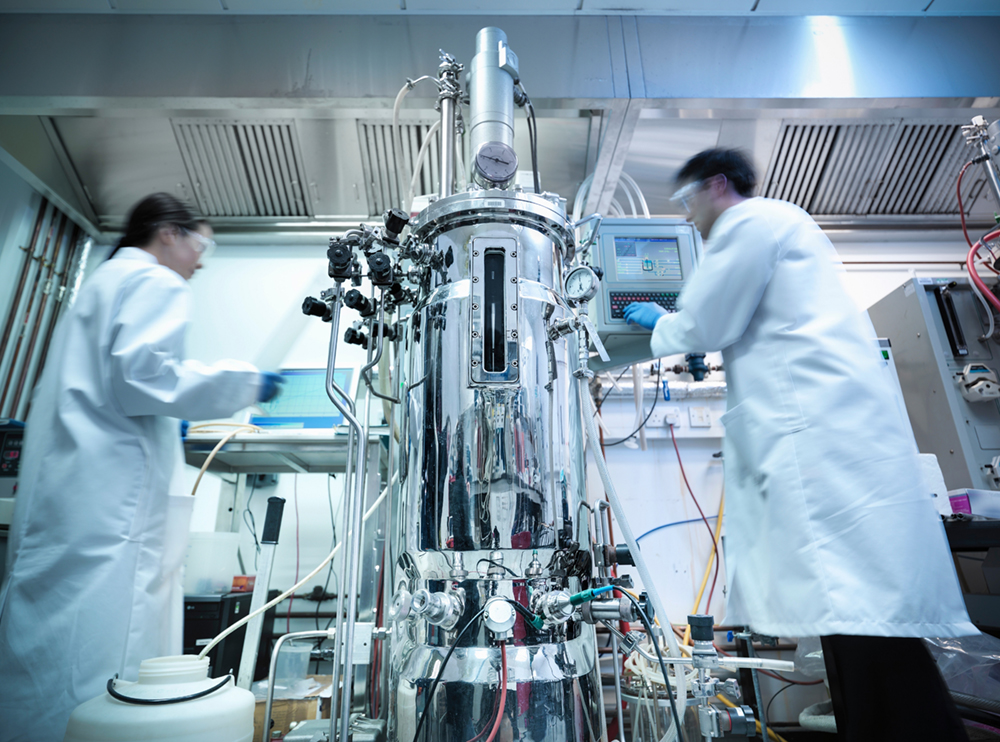
To integrate these different biological systems, the authors outlined a conceptual multi-organ bioreactor design made up of separate but connected modules. Distinct units for rumen fermentation, liver cells, fibroblasts, and target tissue cells would operate under optimized conditions, linked through controlled media exchange.
“It would be challenging, especially at commercial scale, because each biological module has different environmental and operational requirements,” Ovissipour said. “However, a modular bioreactor system may still be feasible if each unit is optimized separately and connected through controlled metabolite or media exchange. This stepwise design can reduce biological interference, improve process control, and make scale-up more practical than trying to combine all systems in a single reactor.”

Alongside technical challenges, the review highlighted regulatory considerations as a key barrier to adoption.
“The main hurdles are safety, consistency, and regulatory approval,” Ovissipour said. “Rumen-derived inputs are complex and variable, so regulators will expect clear characterization, safe manufacturing, and consistent performance. In the near term, standardized metabolite fractions are more realistic than undefined rumen mixtures.”
While the paper outlined a more complex biological model, it also acknowledged that near-term industry priorities would remain focused on cost and scalability.
“In the near term, simplicity and scalability will continue to dominate, as the industry remains focused on cost, media, and bioprocess scale-up,” Ovissipour said. “Over time, greater biological complexity may be adopted selectively where it provides clear benefits in flavor, texture, and product quality.”

Join Us At One Of Our Upcoming Events

If you have any questions or would like to get in touch with us, please email info@futureofproteinproduction.com


.jpg)
.jpg)
