

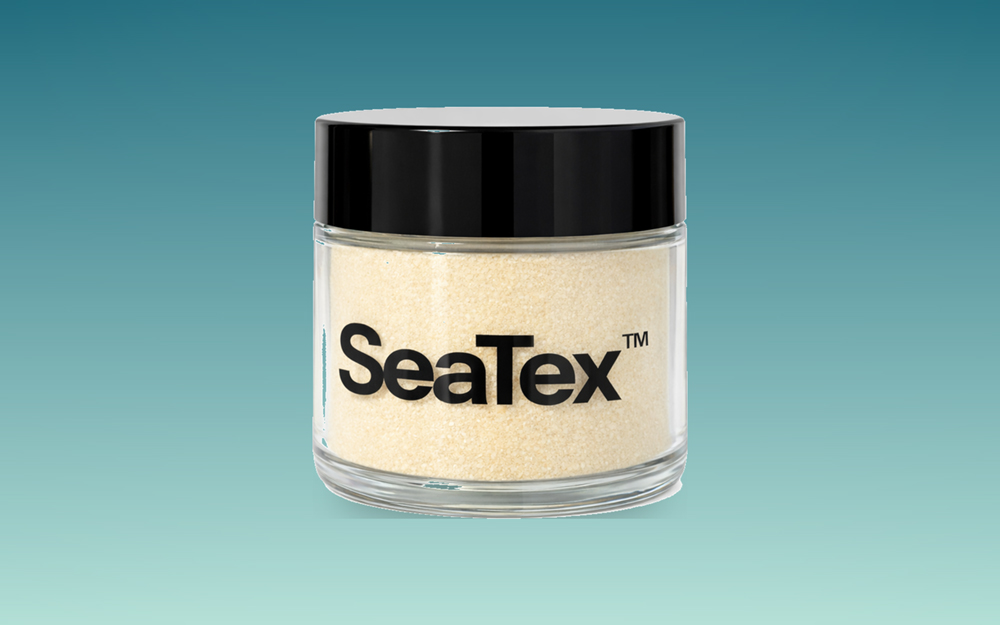
Marine Biologics introduces SeaTex seaweed powder to simplify clean-label food formulation

Marine Biologics has unveiled SeaTex, a seaweed-derived powder designed to stabilize proteins and other functional ingredients in food and beverage formulations while helping manufacturers reduce the number of additives on product labels.
The Berkeley-based company reported that the patent-pending ingredient was developed as a single-component stabilization system intended to replace complex formulation stacks often used in modern food products.
• Marine Biologics has introduced SeaTex, a single-ingredient seaweed powder designed to stabilize proteins, fibers, minerals, and bioactives in food and beverage formulations.
• The ingredient is sourced from ocean-harvested brown seaweed and contains no additives, synthetic ingredients, or carrageenan.
• The company developed the product using its MacroLink AI engine to accelerate clean-label ingredient discovery and development.
SeaTex was designed to suspend and stabilize a wide range of nutritional components, including fibers, minerals, and bioactive compounds. The powder can also bind and structure fats and lipids, enabling food manufacturers to streamline formulations while maintaining product stability.
According to Marine Biologics, the ingredient functions effectively at very low application rates, allowing developers to replace multi-component stabilization and buffering systems with a single clean-label ingredient. The company reported that the approach can simplify formulations while improving consistency and scalability in production.
Patrick Griffin, CEO of Marine Biologics, said the development addressed long-standing challenges associated with seaweed-based ingredients. “Seaweed has long offered the promise of an abundant and renewable alternative ingredient, but a narrow understanding of its chemical composition and outdated production methods have led to highly refined ingredients that consumers are no longer interested in seeing on their ingredient labels,” he said. “With our breakthrough processing capabilities, we provide product developers and brand teams with new tools to meet consumer demands for cleaner labels.”
The company reported that SeaTex has been engineered to work across a wide range of pH levels and temperature conditions, allowing it to be incorporated into multiple food and beverage formats. Because it is derived from brown seaweed harvested from the ocean, the ingredient is vegan and contains no added synthetic components.
Manufacturers using the ingredient can remove gums, buffers, and bulking agents from their ingredient lists, the company reported, offering a simplified approach to product formulation.
Marine Biologics described SeaTex as part of a broader effort to address the growing global demand for clean-label functional ingredients. The company estimated the market for these ingredients at US$121 billion, noting that developers have historically faced challenges including inconsistent ingredient composition, difficulties scaling production, and lengthy research and development cycles.
To accelerate the discovery and design of new ingredients, Marine Biologics uses its MacroLink platform, which it described as the first artificial intelligence system purpose-built for ingredient design. The system applies predictive modeling to analyze natural raw materials and identify functional compounds that can be developed into food ingredients.
According to the company, this approach enables the discovery process to be compressed from several years to a matter of months, helping manufacturers develop ingredients that can be produced consistently and integrated into global supply chains.
Griffin said SeaTex represented the first commercial example of the company’s AI-driven ingredient development strategy.
“Our vision is to create a limitless pipeline of clean-label food ingredients,” he said. “SeaTex is the first manifestation of that and a powerful example of how technology can help unlock the full spectrum of natural, raw material-derived ingredients for the food industry.”
Marine Biologics is currently focusing its efforts on seaweed-derived functional ingredients produced as standardized bulk materials. The company reported that these ingredients are digitized and benchmarked to support their use as reliable manufacturing inputs across multiple industries.
In addition to SeaTex, Marine Biologics said it is exploring other product categories derived from seaweed and related biomass sources. These include clean-label egg replacements, baking texturants, bioactive ingredients, and biopolymers intended for use in sustainable packaging.
The company reported that its broader strategy centers on combining artificial intelligence with standardized seaweed inputs to convert abundant marine biomass into scalable ingredients for food, cosmetics, and materials applications.
By applying digital tools to ingredient discovery and development, Marine Biologics aims to shorten innovation timelines and reduce the cost of bringing new ingredients to market while expanding the range of natural materials available to product developers.
SeaTex marks the first commercial product to emerge from this approach, with the company presenting it as a platform ingredient designed to simplify formulation challenges in nutritional products and other food applications.

Join Us At One Of Our Upcoming Events

If you have any questions or would like to get in touch with us, please email info@futureofproteinproduction.com


.jpg)
.jpg)
