McMaster’s plant protein scaffold tackles a structural challenge for cultivated meat

Researchers at McMaster University in Canada have developed edible, plant-based scaffolds capable of supporting the growth of bovine muscle cells, addressing one of the technical challenges involved in producing structured cultivated meat.
• McMaster researchers have developed edible soy and pea protein scaffolds that support bovine muscle cell growth.
• Low-dose genipin and heat treatment created flexible, stable structures with a meat-like pink color.
• The team will next add fat cells, pursue marbling and address the challenges of scaling larger tissues.
The work, led by PhD candidate Pegah Saraf in the laboratory of Engineering Professor Ravi Selvaganapathy, uses soy and pea protein isolates to create three-dimensional structures that provide animal cells with a surface on which to attach, multiply and grow.
Scaffolds are particularly important when attempting to move cultivated meat beyond unstructured products. Animal cells require a suitable physical environment that can support their growth while ultimately becoming part of the food itself.
“It’s a place where they can attach to, grow and multiply,” Saraf said, describing the scaffold as a “kind of home for the cells.”
Plant proteins offer several potential advantages as scaffold materials because they are edible, widely available and relatively inexpensive. However, producing mechanically stable three-dimensional structures entirely from plant proteins has proved difficult.
Previous approaches have often combined plant proteins with additional structural materials such as polysaccharides. While these can improve mechanical properties, Saraf noted that they provide fewer sites for animal cells to bind unless they are modified or coated.
The McMaster approach instead uses protein-rich scaffolds made from soy protein isolate or pea protein isolate. Proteins can provide biologically relevant binding sites for cells, with soy, for example, containing peptides that naturally support cell attachment.
The researchers then had to find a way of strengthening the material sufficiently without compromising its suitability as food.
Saraf combined genipin, a naturally derived compound that can cross-link proteins, with dehydrothermal treatment, or DHT. The latter uses heat and vacuum to stabilize the structure.
Together, the treatments produced scaffolds capable of bending without breaking while remaining edible and able to support animal cell growth.
There was another problem to solve, however. At higher concentrations, genipin reacts with protein and causes the scaffold to turn blue, an obvious drawback for a material intended to form part of a cultivated meat product.
By optimizing the process around a lower concentration of genipin and combining it with DHT, Saraf was able to produce a much milder pink color more closely associated with conventional meat.
The proof-of-concept work used bovine muscle-derived cells obtained from domestic cattle. The next stage will add another important component of meat: fat.
“For this study, I exclusively focused on muscle cells to prove that this type of scaffold could be effective,” Saraf said. “Next, I want to grow fat cells on the scaffold as well so we can get that marbling effect you find in store-bought meat.”
Successfully co-culturing muscle and fat cells could allow the scaffold to support more complex structures and reproduce some of the marbling associated with conventional beef.
Size presents another hurdle. The scaffolds produced so far are approximately two-centimeter squares, meaning considerable development will be required before the approach can produce substantially larger pieces of cultivated tissue.
Increasing thickness and scale introduces challenges that extend well beyond simply making a larger scaffold. The researchers will need to generate greater numbers of cells while maintaining sufficient oxygen and nutrient transport throughout the tissue.
Metabolic waste must also be removed, while cells need to remain uniformly distributed and differentiate consistently across the structure. These requirements become increasingly difficult as cultivated tissues become thicker.
Any eventual production process would also need to operate at a scale and cost suitable for food manufacturing, using food-grade materials and serum-free cultivation conditions.
For Saraf, the current study is therefore an early demonstration of what plant proteins could contribute to the structural side of cultivated meat production rather than a finished route to commercial products.
“People already care about recycling and reducing plastic waste because they know today’s choices shape their future,” Saraf said. “Because the world’s population continues to grow, food production needs to be viewed in a similar way.”
Saraf stressed that she sees cultivated meat as an additional option alongside conventional meat rather than an attempt to remove it from diets.
“This work is not telling people to stop eating meat,” she said. “It’s offering an alternative choice that is more ethical and more sustainable.”
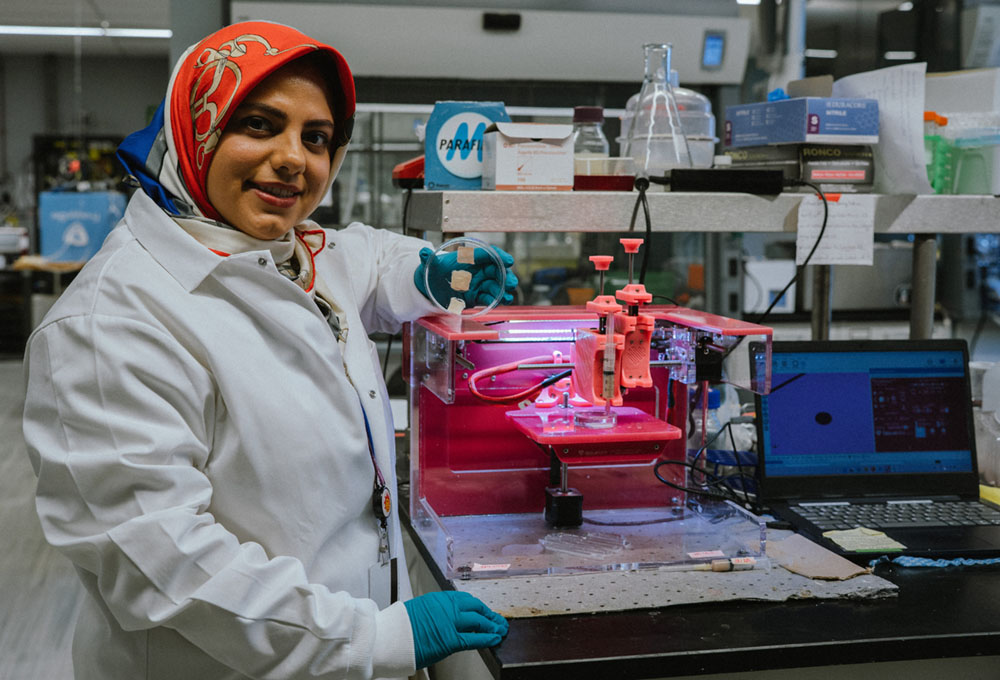
Main photo shows PhD candidate Pegah Saraf, whose research at McMaster University is exploring plant protein scaffolds for growing cultivated meat (Photo: Roxxannia Wang, Faculty of Engineering)
If you liked this, check these out...
• Stanford’s Natalie Larson targets whole-cut cultivated meat with subvoxel 3D bioprinting
• What comes after the cultivated meat hype? Didier Toubia is finding out
• University of Queensland microalgae system could cut cultivated meat media costs by up to 90%

Join Us At One Of Our Upcoming Events

If you have any questions or would like to get in touch with us, please email info@futureofproteinproduction.com