GFI’s comprehensive TEA review calls for digital cell growth models to strengthen cultivated meat economics

A new technical report led by Bert Frohlich of BioFarm Designs and Faraz Harsini and Elliot Swartz of The Good Food Institute has laid the groundwork for more rigorous cell growth modeling in cultivated meat production, arguing that stronger biological inputs are essential before techno-economic projections can meaningfully improve.
• Phase 1a of the Cultivated TEA 2.0 project reviewed existing biological data to strengthen cell growth modeling for cultivated meat.
• The report identified major gaps in publicly available measurements, including dry cell mass, biomass composition, and dynamic growth data.
• The authors called for digital performance models that integrate cell growth, bioreactor conditions, and system-level dynamics.
The report forms the first phase of the multi-stage Cultivated TEA 2.0 initiative, which aims to enhance techno-economic modeling of cultivated meat production. Rather than presenting a new full techno-economic analysis or scenario-based cost modeling, Phase 1a focuses on improving the foundational models used to predict how cells grow under different bioreactor conditions.
The document provides a detailed assessment of existing data relevant to cell growth modeling and identifies priority research areas needed to build more realistic and adaptable predictive frameworks.
At the center of the review is the argument that static assumptions currently limit the usefulness of many techno-economic assessments.
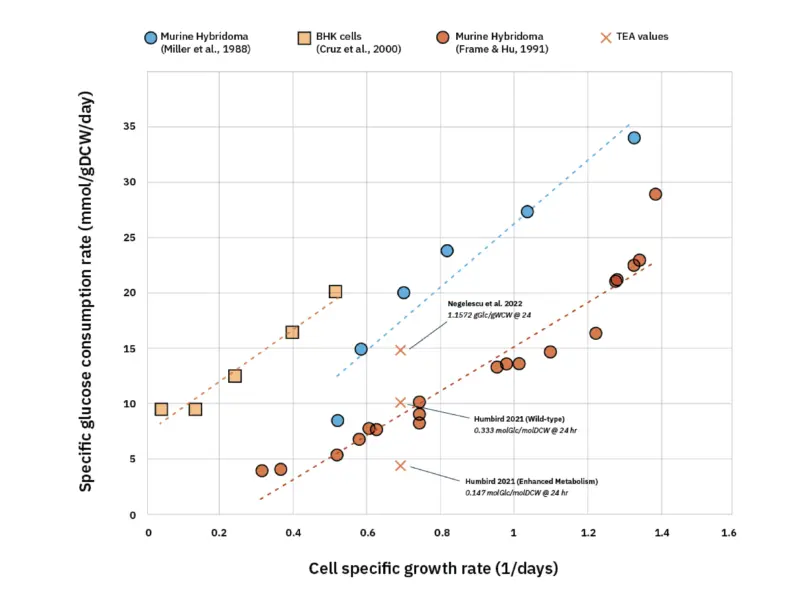
Existing analyses often rely on simplified, steady-state assumptions that do not fully capture how cells behave inside dynamic bioreactor environments. As a result, their ability to test alternative feeding strategies, operating modes, or production scales remains constrained.
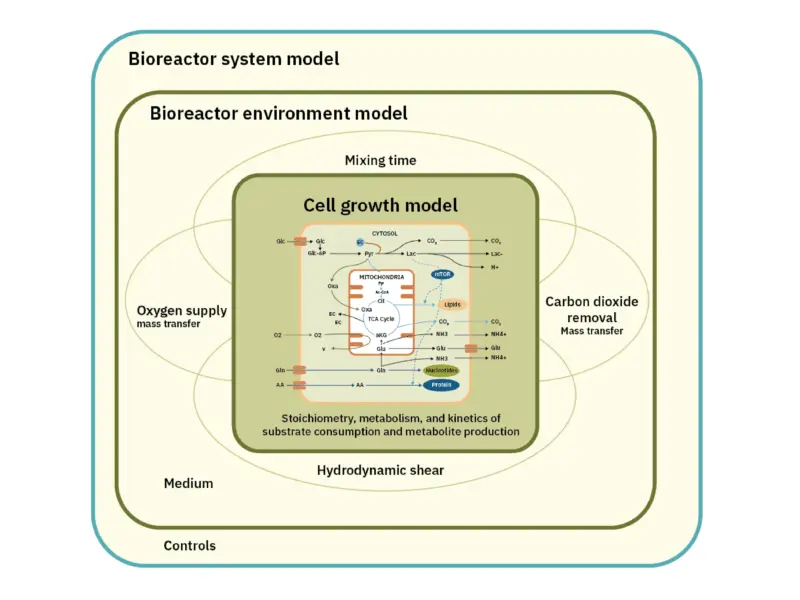
The report proposes a performance-to-cost modeling framework that links cell growth, bioreactor environment, and system-level factors. The goal is to enable future digital models capable of predicting bioreactor productivity, optimizing feeding strategies, evaluating design trade-offs, and assessing the impact of cellular adaptation or genetic modification.
However, the authors stress that data gaps remain the primary bottleneck.
Publicly available datasets frequently lack critical parameters such as dry cell mass, biomass composition, and measurements of how temperature, pH, and osmolality affect cultivated meat-relevant cell lines. Much of the available data are single-point or steady-state averages rather than dynamic time-series measurements, limiting their utility for building predictive models.
Swartz, Senior Principal Scientist for Cultivated Meat at The Good Food Institute, emphasized the importance of direct measurement.
“The dry mass of cells needs to be measured. Relying on proxies from cell diameter or volume is inaccurate, and most cultivated meat LCA/TEA models have likely overestimated the mass of cells by a factor of ~3 when compared to actual measurements of single cell mass,” Swartz wrote.
If cell mass assumptions are inaccurate, yield predictions and downstream economic modeling may require recalibration. Overestimating biomass inflates projected productivity and may distort comparisons across studies.
Swartz also pointed to variability within cell populations.
“Additionally, the biomass composition of cells, which will be important for optimizing end product nutrition, can vary across cell types, cell cycle phases, and culture-level phases. Cell volume and mass can also fluctuate by a factor of ~two throughout typical growth rate ranges.”
Such variability complicates modeling efforts and reinforces the need for standardized measurement and dynamic datasets.
“Measuring and understanding these phenomena will be critical factors in developing accurate models of cultivated meat production and determining optimal harvest timepoints,” Swartz added.
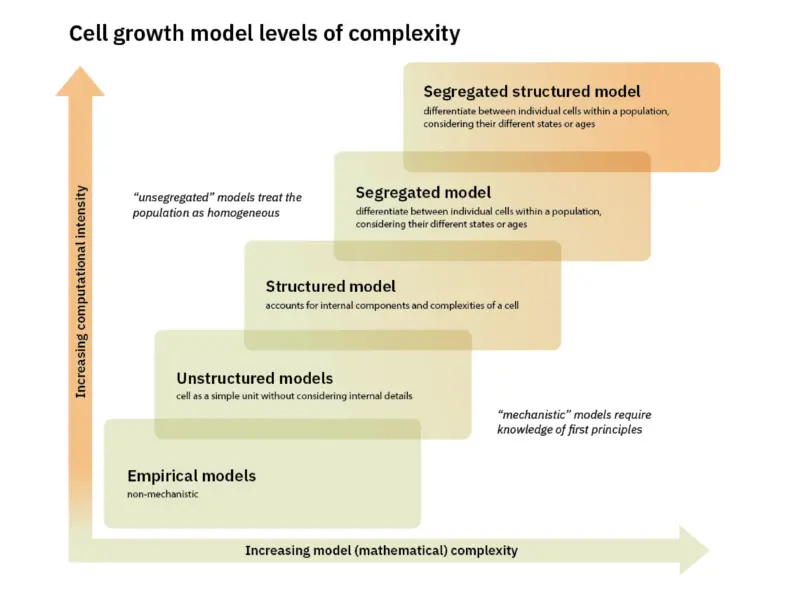
Beyond identifying data gaps, the report highlights energetics-based modeling as a promising direction. Anchoring predictive models in cellular energetics could provide a structured way to capture metabolic flexibility and stress responses, especially when paired with new experimental datasets and AI-driven model development.
Future digital performance models, the authors argue, should be able to predict productivity across heterogeneous bioreactor conditions, optimize feeding and operating modes, and quantify the benefits of adaptation strategies or alternative substrates.
To enable that progress, the report calls on researchers and industry to publish or share key growth parameters, including dry mass, biomass composition, nutrient uptake rates, inhibition constants, metabolite levels, and maintenance metabolism metrics, where possible in formats that protect proprietary information.
The long-term objective of Cultivated TEA 2.0 is to demonstrate the economic feasibility of various facility sizes and designs. But Phase 1a makes clear that robust economic projections depend on biologically accurate inputs.
By strengthening the scientific foundations of cell growth modeling, the project seeks to improve how the sector predicts performance, prioritizes research, and designs scalable processes.
Rather than revising cost curves directly, the report reframes the discussion around methodological rigor.
If cultivated meat is to scale commercially, the authors suggest, the industry must first ensure that the biological assumptions feeding into its models reflect measurable, dynamic reality.

Join Us At One Of Our Upcoming Events

If you have any questions or would like to get in touch with us, please email info@futureofproteinproduction.com