
USDA and Department of War formalize Farm Security Plan, bringing DARPA into food and agtech oversight

The US Department of Agriculture has formally embedded agriculture, biotechnology, and food systems into the country’s national security architecture, signing a Memorandum of Understanding with the US Department of War to implement its National Farm Security Action Plan and launching a DARPA partnership that places agricultural innovation inside the defense innovation ecosystem.
• USDA signed an MOU with the Department of War to implement the National Farm Security Action Plan and launched a DARPA partnership focused on agricultural security vulnerabilities.
• The plan introduced tighter scrutiny of foreign-linked research, farmland ownership, and eligibility for federally funded innovation programs including SBIR, STTR, and BioPreferred.
• USDA created a new Office of Research, Economic, and Science Security to oversee research security across its intramural and extramural research enterprise.
Framed around the assertion that 'farm security is national security', the 12-page Action Plan elevated food and agriculture to what USDA described as a top-echelon national security priority. The department linked agricultural production, supply chains, research infrastructure, and biotechnology development directly to economic sovereignty, defense readiness, and resilience against foreign adversaries.
For companies operating in precision fermentation, cell-cultivated proteins, synthetic biology, agricultural biotech, and biomanufacturing, the shift marked a structural change in how federal engagement may be governed.
USDA stated that agriculture and related industries employ more than one in ten American workers and contribute more than US$1.5 trillion annually to US GDP. The department referenced existing National Security Memoranda designating food and agriculture as critical infrastructure and highlighted exposure to cyberattacks, biological threats, intellectual property theft, and foreign economic influence.
The Action Plan identified risks including malicious cyberoperations targeting food processors, foreign acquisition of farmland, forced technology transfer, agroterrorism tools, and reliance on foreign-controlled agricultural inputs.
The document described foreign ownership structures and supply chain dependencies as strategic vulnerabilities requiring federal response.
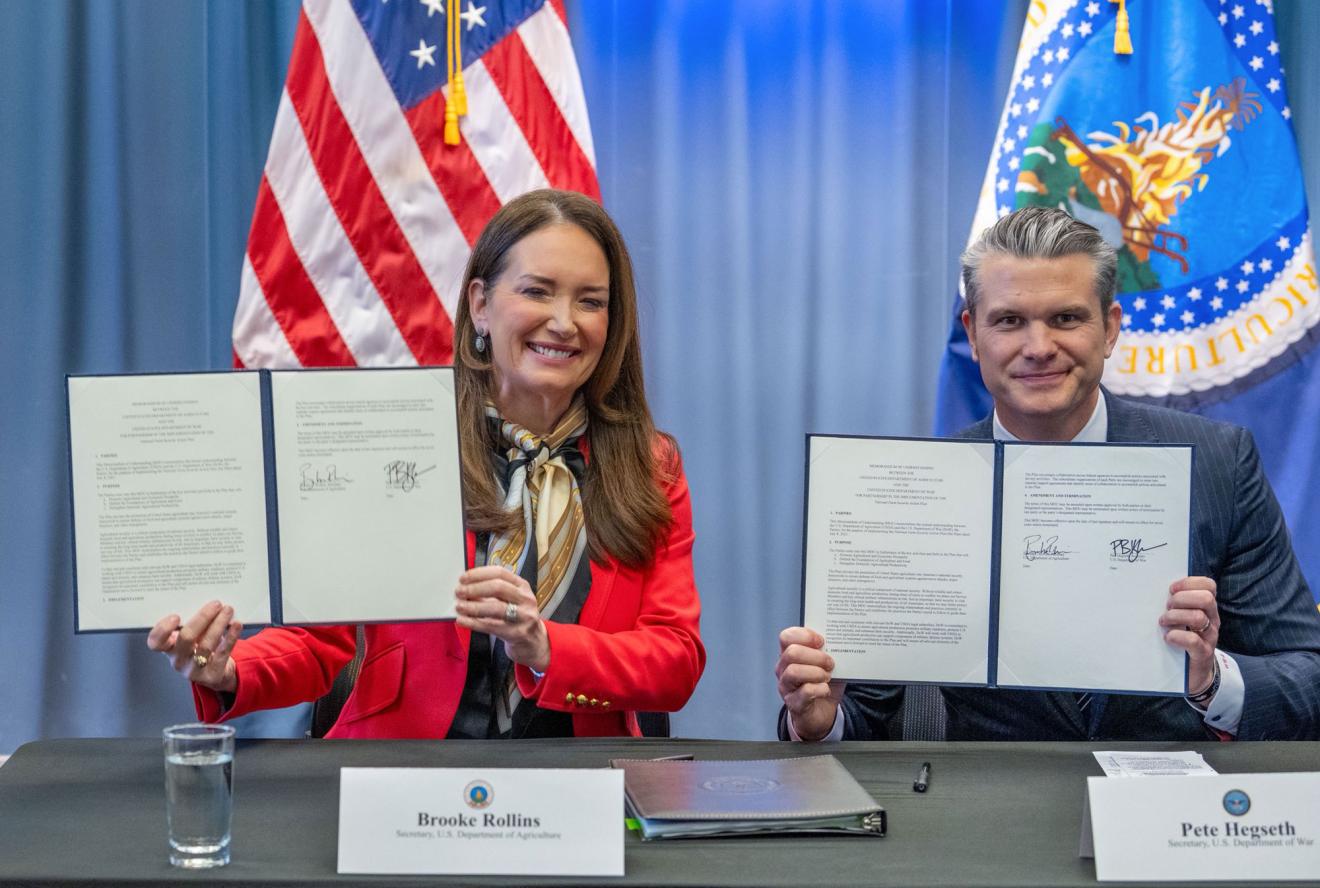
In February 2026, USDA Secretary Brooke L. Rollins and Secretary of War Pete Hegseth signed a Memorandum of Understanding formalizing collaboration between the two departments to implement the Action Plan.
The MOU established a framework for joint coordination to defend food and agricultural systems, strengthen domestic productivity, and address emerging security threats. The first action under the agreement launched a partnership between the Defense Advanced Research Projects Agency and USDA’s Office of the Chief Scientist.
Through this partnership, DARPA and USDA agencies will share information on agricultural security vulnerabilities, co-develop technological solutions to agricultural threats, and exchange personnel to accelerate innovation and protect supply chains.
For food tech and agricultural biotech companies, DARPA’s involvement signals that agricultural innovation is now intersecting directly with defense-backed R&D priorities.
One of the most consequential elements for biotechnology firms lies in research security reforms.
USDA stated it will require certification that recipients of federal research funding are not owned or controlled by foreign adversaries and are not participating in foreign talent recruitment programs that could result in technology transfer.
The department confirmed enhanced due diligence for Small Business Innovation Research and Small Business Technology Transfer applicants and said participation in programs such as BioPreferred will be reviewed. BioPreferred certification may be prohibited for entities located in countries of concern.
Additionally, unless required by statute or approved by leadership, USDA funding will prioritize research conducted in America using American-made technology and biomanufacturing systems.
To oversee implementation, USDA announced the creation of a new Office of Research, Economic, and Science Security within the Office of the Chief Scientist. The office will coordinate research security across USDA’s intramural and extramural research activities and implement federal research security directives including National Security Presidential Memorandum 33.
The department also reported that it terminated contractors and visiting scientists with citizenship from countries of concern and standardized grant and cooperative agreement terms across USDA programs.
For alternative protein and fermentation companies with international investors, cross-border research collaborations, or overseas manufacturing partnerships, eligibility criteria for federal grants may now be more closely tied to ownership structure, data governance practices, and domestic production footprint.
The Action Plan also targeted foreign ownership of US agricultural land.
USDA published an advance notice of proposed rulemaking to modernize reporting requirements under the Agricultural Foreign Investment Disclosure Act. The department developed an online filing system to replace paper submissions and launched a public portal allowing farmers and stakeholders to report suspected false filings or foreign influence in agricultural land transactions.
Civil penalties for late or false filings will increase, and USDA stated it will work with Congress and state partners to pursue action to end direct or indirect purchase or control of American farmland by nationals from countries of concern.
Beyond land ownership, USDA worked with federal partners to designate critical fertilizer inputs as critical minerals and signaled further identification of vulnerable agricultural inputs including chemicals, minerals, vitamins, and materials tied to critical infrastructure.
The department committed to conducting cross-sector crisis simulations and wartime scenario planning exercises to assess risks to food and agricultural systems.
Biosecurity featured prominently in both the Action Plan and the new MOU.
USDA stated that research funding will prioritize development of vaccines, therapeutics, and mitigation strategies for plant and animal diseases including Highly Pathogenic Avian Influenza, African Swine Fever, and Foot and Mouth Disease.
Cybersecurity protections for agricultural companies will be strengthened in collaboration with intelligence and law enforcement agencies to counter ransomware and digital intrusions.
The DARPA partnership expands that posture into advanced technology development. The agencies will collaborate on identifying vulnerabilities in agricultural systems and accelerating innovation to protect domestic productivity.
The involvement of DARPA places agricultural biotechnology, synthetic biology platforms, and biomanufacturing infrastructure within a defense innovation context typically associated with advanced materials, aerospace systems, and semiconductor technologies.
While the Action Plan did not reference alternative protein companies or cultivated meat developers directly, its provisions on research security, funding prioritization, foreign ownership, and domestic biomanufacturing establish a new policy environment for food technology companies.
Federal engagement may increasingly depend on certification of ownership structures, domestic R&D activity, and supply chain transparency. Companies participating in USDA grant programs, SBIR funding, BioPreferred certification, or public-private research partnerships may face expanded compliance requirements.
At the same time, emphasis on domestic manufacturing resilience, bio-based inputs, fermentation platforms, and pathogen mitigation could create new collaboration opportunities within a national security framework.
By formalizing collaboration with the Department of War and DARPA, USDA has placed agricultural innovation alongside sectors such as semiconductors and advanced manufacturing that have recently been drawn into geopolitical competition.
With agriculture now explicitly treated as a national security asset, the boundaries between food production, biotechnology innovation, and defense strategy have narrowed.
(Main photo shows USDA Secretary Brooke L. Rollins and Secretary of War Pete Hegseth)

Join Us At One Of Our Upcoming Events

If you have any questions or would like to get in touch with us, please email info@futureofproteinproduction.com