
The 20-20 test: BioCraft takes palatability to the benchmark

Matching a leading commercial cat treat on first bite took BioCraft Pet Nutrition through a much broader lesson in palatability, processing and formulation. Founder & CEO Dr Shannon Falconer tells PPTI what it learned along the way
BioCraft Pet Nutrition had already spent considerable time on the cost and nutritional performance of its cell-cultured ingredient when attention turned to another question: just how palatable could it make the finished product?
An early in-home feeding trial provided some of the answers, and some new questions. The finished product contained around 40% of BioCraft’s ingredient and had been formulated by a pet food manufacturer.
“Some of the cats didn’t even want to try the product. So it was a case of, okay, what’s going on?” Falconer recalls. That experience became part of a much longer optimization process. The result BioCraft is reporting now provides a rather different benchmark. In an independent feeding trial conducted by German market research company Regionales-Produkt-Panel (RPP), 40 cats were offered BioCraft’s newly developed cell-cultured lickable treat alongside Applaws Chicken Creamy Lickable Treat.
Seventeen ate more of BioCraft’s product. Nineteen ate more of Applaws. Four ate equal amounts. RPP found no statistically significant preference between the two.
On first bite, it was exactly even: 20 cats chose BioCraft and 20 chose Applaws.
“We had done a lot of iterations on the version of the treat before we actually sent it out for final palatability testing,” Falconer says, “so we were hoping that it would be even better. The 20-20 result – we were very, very happy with that, but we felt like we were very well prepared.”
Setting the bar high
BioCraft deliberately chose a difficult comparator. Lickable treats are among the most palatable products in the cat category, and Falconer wanted to know whether its formulation could hold its own against one of the better ones.
“A lickable treat, especially an Applaws chicken-flavored lickable treat, is probably one of the most palatable products you can find for a cat on the market, period. We wanted to go up against that benchmark,” Falconer says, “because if we can compete with that, then we can compete with everything else – dogs in every category, but also all of the other potential products that one could make for cats.”
RPP employees observed the feedings in the cats’ homes, where 30g portions of each product were presented side by side in neutral bowls. Their positions were rotated across households to control for any tendency to favor one side.
A lickable treat, especially an Applaws chicken-flavored lickable treat, is probably one of the most palatable products you can find for a cat on the market, period
The setting for the trial was as important to BioCraft as the way it was conducted.
“As a mission-based founder who started this company with the intention, ultimately, of taking animals out of the supply chain, having an in-home environment versus working, for example, with some kind of kennel where cats would be in cages is something that we wouldn’t do. We wouldn’t engage in that ethically.”
There was a practical advantage too: the cats were eating where they normally eat.
“If you have cats living in cages or kennels, they have different behavior because they’re living under quite a stressful environment. The way they eat and the way they act isn’t necessarily as representative as a cat that’s just living its life – its good life – in a home.”
Falconer does not turn 17 versus 19 into a win for BioCraft. It wasn’t one.
“What we can conclude is simply that there is no difference. Cats as individuals will have individual preferences,” Falconer stresses. “Say, for example, the 17 cats who preferred ours to the Applaws and the 19 that preferred Applaws. You can imagine if you have 17 humans in front of an ice cream stand choosing one product versus 19 choosing another, it doesn’t mean that chocolate is necessarily tastier than peanut butter. It just means that 17 prefer chocolate and 19 prefer peanut butter.”
The 20-20 first-bite result offered another piece of information.
“The first bite tells us that 20 cats thought our product smelled just as good as the other 20 cats who thought the Applaws smelled really good. So the first bite,” Falconer observes, “is really a measure of that initial smell and the initial attraction.”
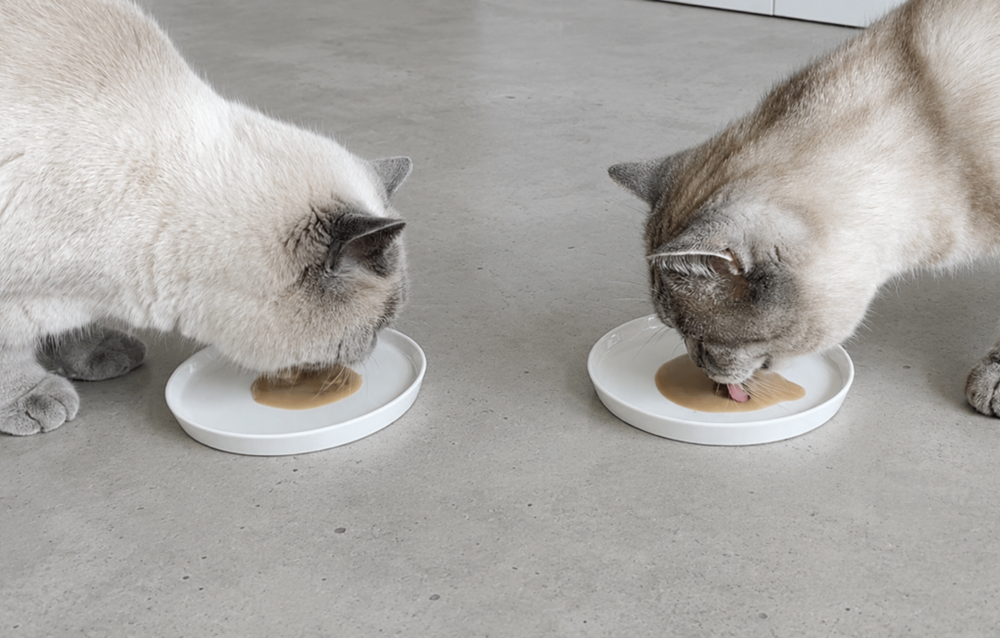
The palatability puzzle
Reaching that result had taken a series of formulation iterations. BioCraft tackled cost and nutritional specifications first. Palatability was deliberately left until later.
“Palatability was kind of the last piece, and as it should be,” Falconer recalls. “That’s the piece that you optimize last. We expected that it would be the last piece to optimize and that it would require some optimization. I think we didn’t know how much optimization it would require.”
The early trial did not immediately tell BioCraft what needed to be optimized.
“It wasn’t immediately obvious to us,” she says. “It may not be that there’s something off-putting necessarily. It could just be that there’s not enough of what’s really interesting present in the product.
“We had to figure out: is there something off-putting, or is there just not something that’s appealing?”
Ultimately, it was a combination of things that we looked to refine individually and then holistically in order to provide an ingredient that today has gotten us to where we are
One option was to bring in an established palatant. BioCraft decided instead to work through the formulation itself.
As a B2B business, some of those palatability companies were themselves potential BioCraft partners or customers. Rather than hand the formulation work to a company that might ultimately become a BioCraft partner or customer, the team decided to solve it internally.
“We’re a team primarily of academics, so we’re curious people and we like to problem-solve. We thought this was an interesting and curious problem for us to solve, so it made a lot more sense for us to do it ourselves.
“And, of course, it’s much cheaper. It’s a lot cheaper for us to do it this way than to buy an expensive palatant that’s already been vetted from another big company.”
There was no single fix. Smell, texture, initial taste and aftertaste all came into play, with different elements of the formulation influencing the cat at different points.
“Ultimately, it was a combination of things that we looked to refine individually and then holistically in order to provide an ingredient that today has gotten us to where we are.
“But it was many things together.”
Beyond the biomass
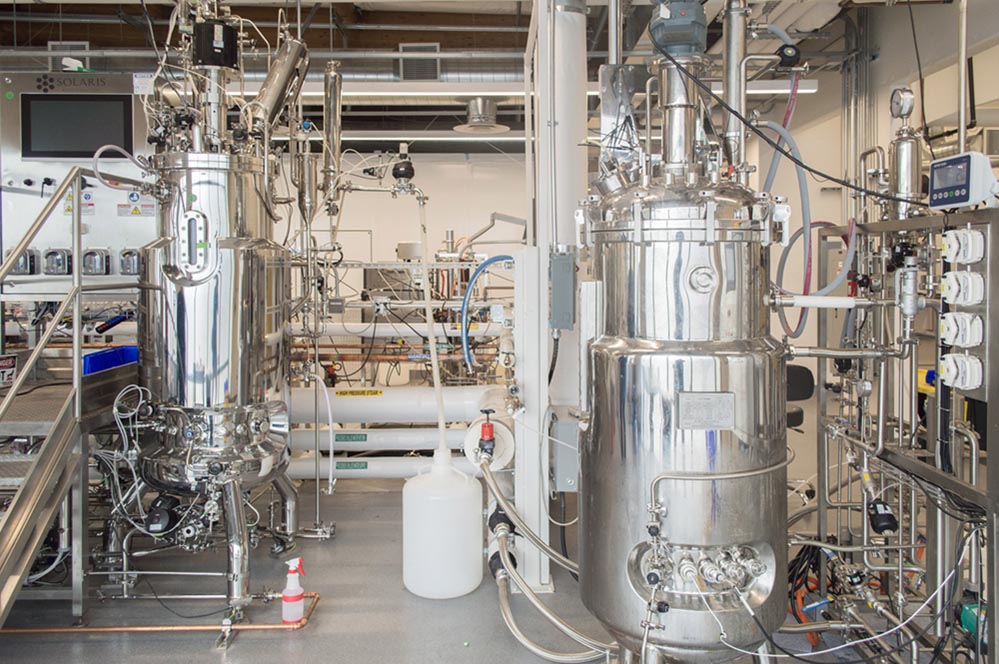
What came out of the bioreactor had changed too. In its earlier work, the company focused on harvesting the cellular biomass. It now harvests everything, including the biomass, the nutrients or small molecules produced by the cells, and nutrients that went into feeding them.
But the bioreactor was only part of the difference. Early testing could be done with freshly produced material. A product intended for sale also has to survive processing and shelf life.
“In the very, very early days, if you just take biomass – and again, in the early days we weren’t doing very sophisticated palatability testing – we could use it fresh straight away. We weren’t accounting for shelf life and then asking cats what they thought.”
Turning that material into a finished product introduced another set of variables.
We don’t know if it’s the ingredient itself that’s delicious or if it’s what we’ve done to it to make it delicious
“That’s a wholly different product from taking the product that we’re making today and combining it with other ingredients to make a final product, where you also have to account for the processing,” Falconer points out. “You have to heat it up because, even though the ingredient itself is sterile, when you combine it with other ingredients, even if they’re not animal-derived, there is still microbial load. So you have to process it or heat it up. That changes the chemistry of the ingredient.”
Feeding a fresh laboratory sample to a cat is therefore not the same test as asking whether a shelf-ready product works.
“The product that somebody just makes in their kitchen or their lab and then turns around and feeds to a cat quickly is a different product from what a consumer would ultimately see coming to their cat’s bowl. You have to account for shelf life, processing and any other ingredients that are going in to make a final product.”
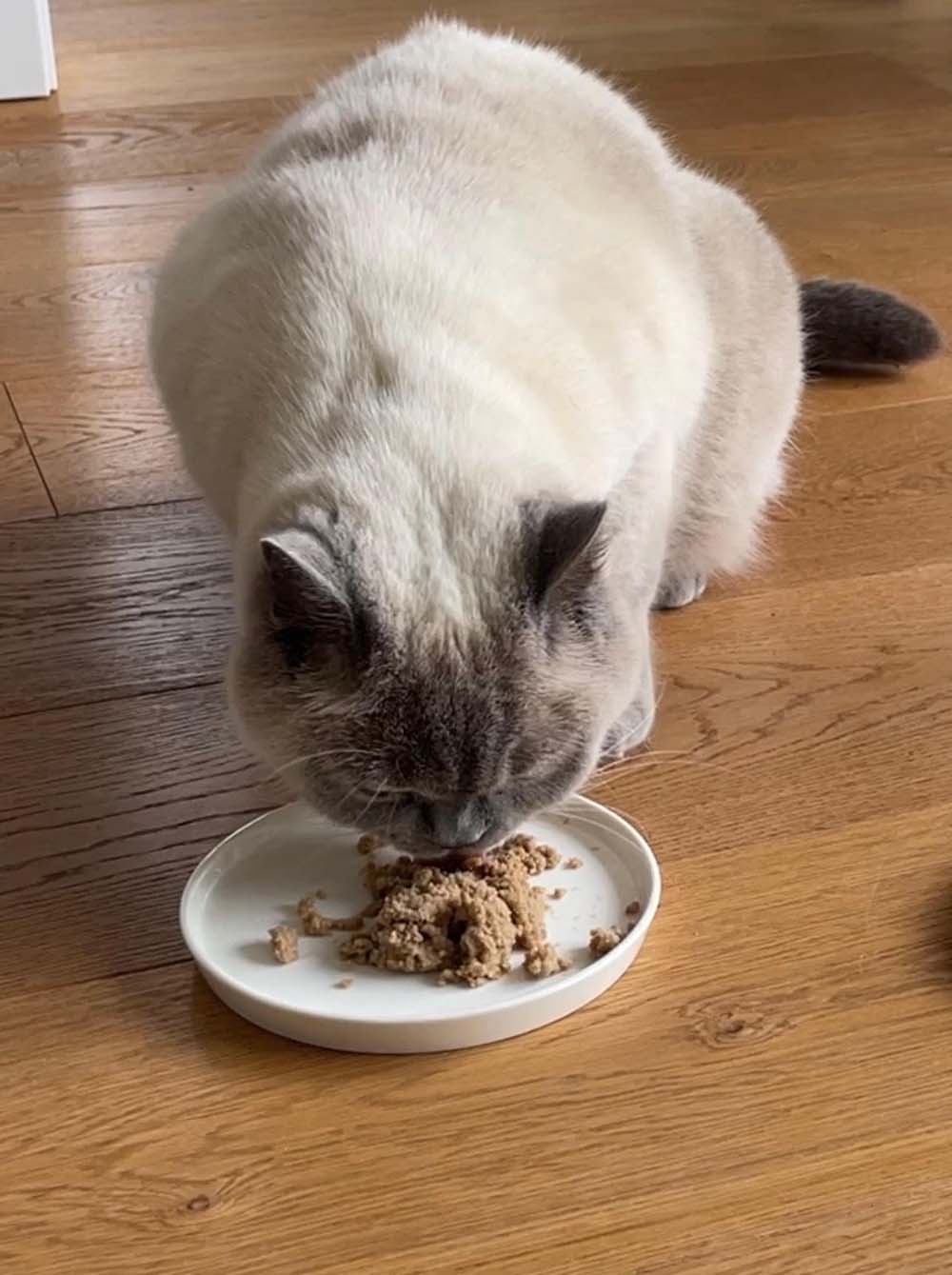
From ingredient to finished product
That helps explain why an ingredient company ended up developing the finished treat.
Falconer is adamant that it is not becoming a pet food brand. The lickable treat instead gives customers the option of starting much further down the development road.
Many smaller and mid-sized pet food businesses do not formulate and manufacture everything themselves. They rely on white-label manufacturers or co-manufacturers, which means an unfamiliar ingredient can pass between supplier, brand and manufacturer before there is even a finished product to evaluate.
“For those potential partners – and that’s a lot of pet food manufacturers – it’s much simpler for us to be able to say, ‘Here’s the final finished product,’ as opposed to sending them the ingredient to sample, because they can’t really do much with it,” Falconer says.
The approach also gives BioCraft much greater control over formulation before a prospective customer becomes involved. Rather than hand over the ingredient and wait to see how somebody else formulates it, the company can establish palatability itself.
“This way, the pet food manufacturer doesn’t have to go through the process of trying to optimize palatability on its end, and we don’t have to have a painful back-and-forth,” she says. “Let’s make sure that we’re confident and secure, and then just offer them the final product.”
There is a question lurking in all this: has the trial shown that cats like BioCraft’s cultured ingredient, or simply that BioCraft has become good at making cat treats?
Falconer says the material coming from the bioreactor accounts for upwards of 80% of the finished product.
“If the majority is the ingredient itself, we can probably relatively safely conclude that at least the ingredient is contributing a lot of the taste, or it’s certainly not contributing anything that is not tasty or is off-putting.”
Falconer is less certain that the two can be neatly separated.
“We don’t know if it’s the ingredient itself that’s delicious or if it’s what we’ve done to it to make it delicious.
“But at the same time, it doesn’t really matter because, at the end of the day, this is what food is for any animal – us or our cats – that is eating in a home environment.”
Falconer points to raw meat as an example. A cat does not necessarily accept a piece of raw chicken simply because meat is its natural food. Animals moved from processed diets to raw diets can show poor acceptance, while the mouse caught and eaten by a cat in the wild is fresh, warm and chemically different from meat that has spent time in a supply chain.
“My argument is that everything you have in your kitchen or that comes from a grocery store is made in some way to be tasty,” she says.
Faster formulation loops
AI has played a part in that formulation work, although Falconer is unusually cautious about what she claims for it.
“The ideal person to answer this question would probably be our computational guy,” Falconer laughs. “But if you think I’m long-winded in my answers, then let’s keep him off the call!”
The joke comes with a candid admission: BioCraft does not know how its approach compares with an experienced specialist.
“Maybe a professional company could already do everything that we’ve done,” Falconer concedes.
BioCraft feeds formulation information and data from analyses including metabolomics into its computational models, alongside observations from early feeding tests. The team records more than whether a cat simply eats or refuses the food: whether it approaches, sniffs, licks and later returns can all provide information.
The fact that we, as a very, very small, scrappy startup with a limited budget, have been able to produce a final product that is on par in terms of palatability and acceptance with one of the world’s leading products in terms of cat preferences means we’re doing something better than most, certainly
“We look to the AI to help guide us around, ‘If you observe this behavior, it might be because of this that was in the formula, or because it’s lacking this,’ whatever the case may be,” Falconer says.
“So we can iterate more quickly and basically keep reformulating until we get something that actually really works. It’s more or less a process of quick iteration and insightful iteration.”
For Falconer, the result is more interesting than the AI label.
“The fact that we, as a very, very small, scrappy startup with a limited budget, have been able to produce a final product that is on par in terms of palatability and acceptance with one of the world’s leading products in terms of cat preferences means we’re doing something better than most, certainly.”
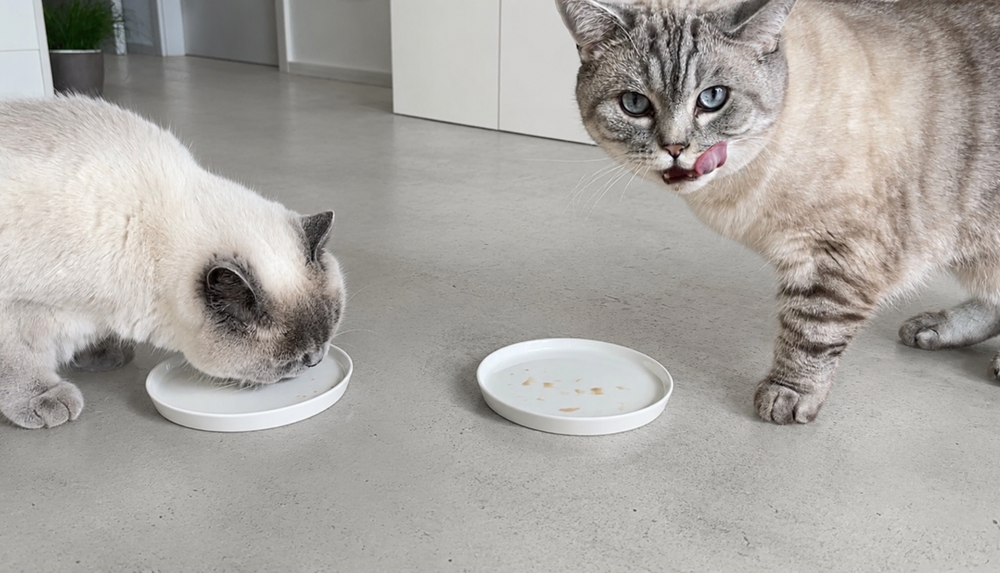
Ready for the purchase order
Asked what remains between the treat and the market, Falconer’s answer is immediate. “Next, you place a PO!”
After that, she says, things become rather more conventional.
“Then it becomes very boring, if you will! It becomes regular pet food manufacturing stuff.
“Let’s look at packaging size, packaging style, processing, how much you need, and we’ll work with you to make sure that all of the shelf-stability testing that we’ve been able to confirm for the specific ingredient we’ve tested also holds through for whatever you’re looking to deliver.”
For a company using the conventional 10-15g lickable-treat format, Falconer expects relatively little additional product development. BioCraft has done the formulation work and a customer could put its own branding on the product before taking it through the applicable local steps and manufacturing process.
Falconer does not believe another experiment stands between this particular product and the market.
The company has established a price point and nutritional specifications. It has also made its scientific dossier publicly available, setting out how the material is produced. Palatability was the piece it still wanted to push further.
“What haven’t we proved yet?” Falconer asks, considering the question. “At least for this product, we’re ready to go.”
Forty cats cannot tell BioCraft how consumers will respond to cell-cultured pet food on a shelf, how many brands will be willing to launch it or how quickly meaningful volumes might follow. Those answers will come from customers, not another bowl test.
The more telling comparison is with BioCraft’s own starting point.
BioCraft's earlier work had shown there was still room to optimize. The team kept working on the ingredient and formulation, then returned to an independent in-home trial with a considerably tougher question. This time, it put Applaws in the other bowl.
Twenty went to BioCraft first. Twenty went to Applaws.
“We’ve proved that the palatability works,” Falconer says. “So we’re happy for people to come back to us with more questions, but from our perspective, at least as far as a lickable treat for cats goes, we’re ready to fly with that one.”
(Main image shows Dr Shannon Falconer, Founder & CEO of BioCraft Pet Nutrition, who says the company is ready to work with customers on bringing its cell-cultured pet food products to market. Also pictured, River, Dr Falconer's furry friend)
If you liked this, check these out...
• Coolty Meat launches 'world’s first' complete dog food made with cultivated meat

Join Us At One Of Our Upcoming Events

If you have any questions or would like to get in touch with us, please email info@futureofproteinproduction.com