

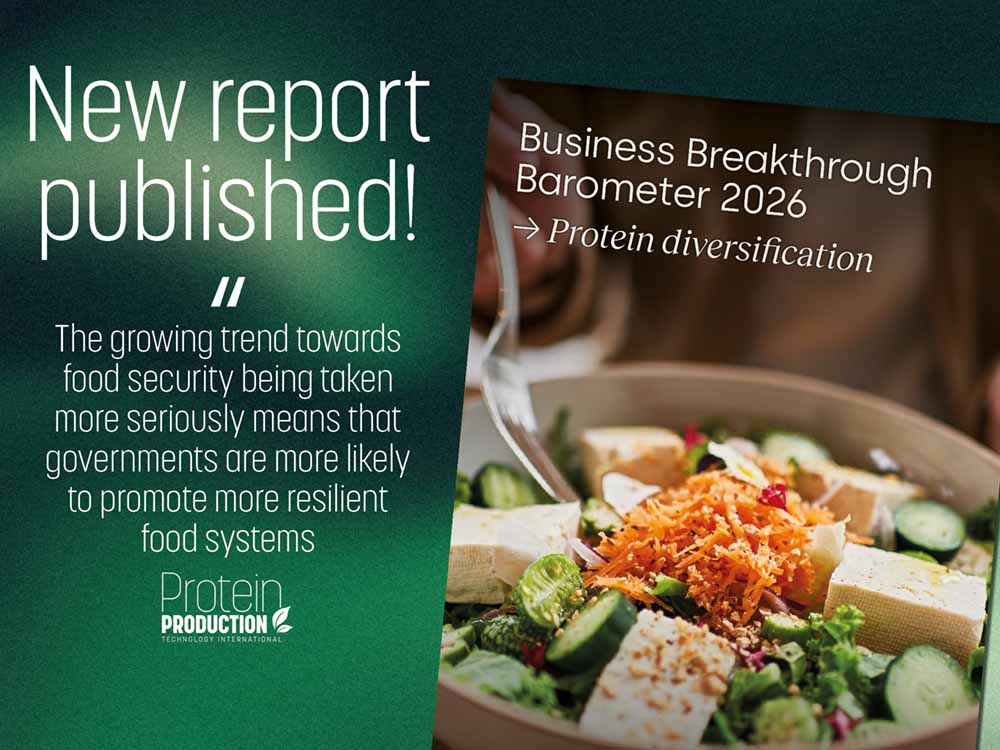
Business confidence returns as protein diversification enters a new phase, report finds

Businesses are becoming more optimistic about the future of protein diversification, with growing confidence that the sector is moving beyond the slowdown seen in the early 2020s and into a new phase centered on affordability, health and scalable production technologies, according to a new Business Breakthrough Barometer 2026 report.
Published by the World Business Council for Sustainable Development (WBCSD) in partnership with Breakthrough Agenda and supported by Bain & Company and the Climate High-Level Champions, the report finds companies believe consumer demand is recovering as interest shifts from highly processed meat analogues toward whole-food plant proteins, hybrid products and fermentation-enabled innovation.
• Businesses reported renewed confidence in protein diversification, citing stronger consumer interest in health, affordability and a wider range of protein sources after a slowdown earlier in the decade.
• Companies identified regulation, policy uncertainty and limited financial incentives as the biggest barriers preventing faster commercialization and investment.
• China emerged as the market viewed as setting the pace for coordinated investment in innovation, processing capacity and protein production infrastructure.
The report suggests the industry's focus has evolved since the rapid expansion of plant-based meat alternatives several years ago. Rather than relying on meat analogue products alone, businesses now see stronger opportunities in minimally processed plant proteins such as tofu, tempeh and legumes, alongside hybrid products that combine animal and plant ingredients. Companies also expect affordability improvements and demand growth in emerging markets to support the next stage of expansion.
Businesses surveyed said several factors are driving additional investment. Consumer demand continues to shift as more people prioritize health and well-being, flexitarian eating patterns and a broader mix of protein sources, while taste and affordability remain decisive purchasing factors. Companies also see commercial opportunities in investing early in research and development, new processing technologies, production capacity and partnerships that can help establish more diverse protein markets. At the same time, protein diversification is increasingly viewed as a way of reducing exposure to climate risks, supply chain disruption and geopolitical uncertainty by expanding crop diversity and reducing dependence on imported raw materials.
The report argues that manufacturers and retailers are playing an increasingly important role in shaping demand by investing in new ingredients, processing technologies and procurement strategies. It highlights examples where retail pricing initiatives have boosted sales of plant-based products, suggesting food environments can strongly influence purchasing decisions.
Businesses also identified several areas where progress has been strongest over the past year. Respondents pointed to improvements in taste, texture and functionality, particularly in plant-based milk products, while governments have continued directing funding toward crop diversification and circular production systems designed to strengthen domestic food security. Companies also reported greater consumer openness to flexitarian diets, with health and wellness trends, including wider use of GLP-1 medications, contributing to changing purchasing habits.
Despite that optimism, respondents said several longstanding challenges remain unresolved.
Affordability continues to be one of the largest barriers to wider adoption, particularly where plant-based alternatives do not benefit from the same subsidies or tax treatment as conventional meat and dairy products. Businesses argued that narrowing the price gap through targeted policy measures could accelerate demand.
Regulatory uncertainty also remains a major concern. While several countries have introduced incentives for growing protein-rich crops such as legumes, businesses said novel food approval pathways remain slow and expensive in some regions, delaying commercialization and encouraging companies to prioritize markets with more predictable regulatory frameworks.
Those concerns are reflected in the report's assessment of business progress. Companies reported improvements in investment conditions, consumer behavior and technology development compared with the previous year, while infrastructure, supply constraints and regulatory certainty showed little change.
The report also identifies notable regional differences in how protein diversification is developing.
China is highlighted as the strongest example of coordinated industrial development, with businesses pointing to close alignment between government policy, investment, innovation, agricultural production and processing capacity. The report notes that China has become one of the world's largest investors in protein diversification and suggests the country is setting a new benchmark for how innovation can be translated into commercial production.
The United States, meanwhile, is described as benefiting from strong consumer demand for high-protein foods, product innovation and a favorable commercialization environment. Businesses also pointed to the country's financing ecosystem as supporting innovation, although the report notes public biotechnology investment in alternative proteins has declined.
Within Europe, businesses viewed support for crop diversification positively but said slower novel food approvals and fragmented policy frameworks continue to weaken investment confidence. The report also notes that the European Union's Common Agricultural Policy remains primarily focused on supporting animal agriculture.
Technology remains another area of optimism.
Businesses said ingredient innovation is improving clean-label products while expanding opportunities to enrich foods such as snacks, chickpea pasta and frozen meals with additional protein. Companies also highlighted continued investment in fermentation-derived proteins, particularly in Silicon Valley and China, where venture capital continues to support technology development.
Alongside ingredient innovation, respondents emphasized the importance of greater coordination throughout the value chain. Examples included retailer incentives encouraging farmers to grow protein-rich crops, collaboration between industry and research organizations, and co-investment in pilot facilities supporting crop processing, biomass fermentation and precision fermentation. Food manufacturers were also seen as playing an important role by providing market intelligence and helping improve production efficiency for companies entering protein diversification.
Looking ahead, businesses identified three policy priorities they believe require the most urgent attention over the next one to three years.
The first is greater financial support for protein-diverse supply chains through transition finance, infrastructure investment and research funding. The second is increased public procurement and updated dietary guidance to encourage more diverse protein consumption. The third is improved policy coherence by integrating protein diversification into national strategies while using science-based metrics and transparent reporting to measure progress.
Among countries highlighted as ones to watch, Denmark was recognized for its national Action Plan for Plant-Based Foods, China for its coordinated investment strategy, and the USA for strong consumer demand and commercialization opportunities.

Join Us At One Of Our Upcoming Events

If you have any questions or would like to get in touch with us, please email info@futureofproteinproduction.com



.jpg)
.jpg)
