

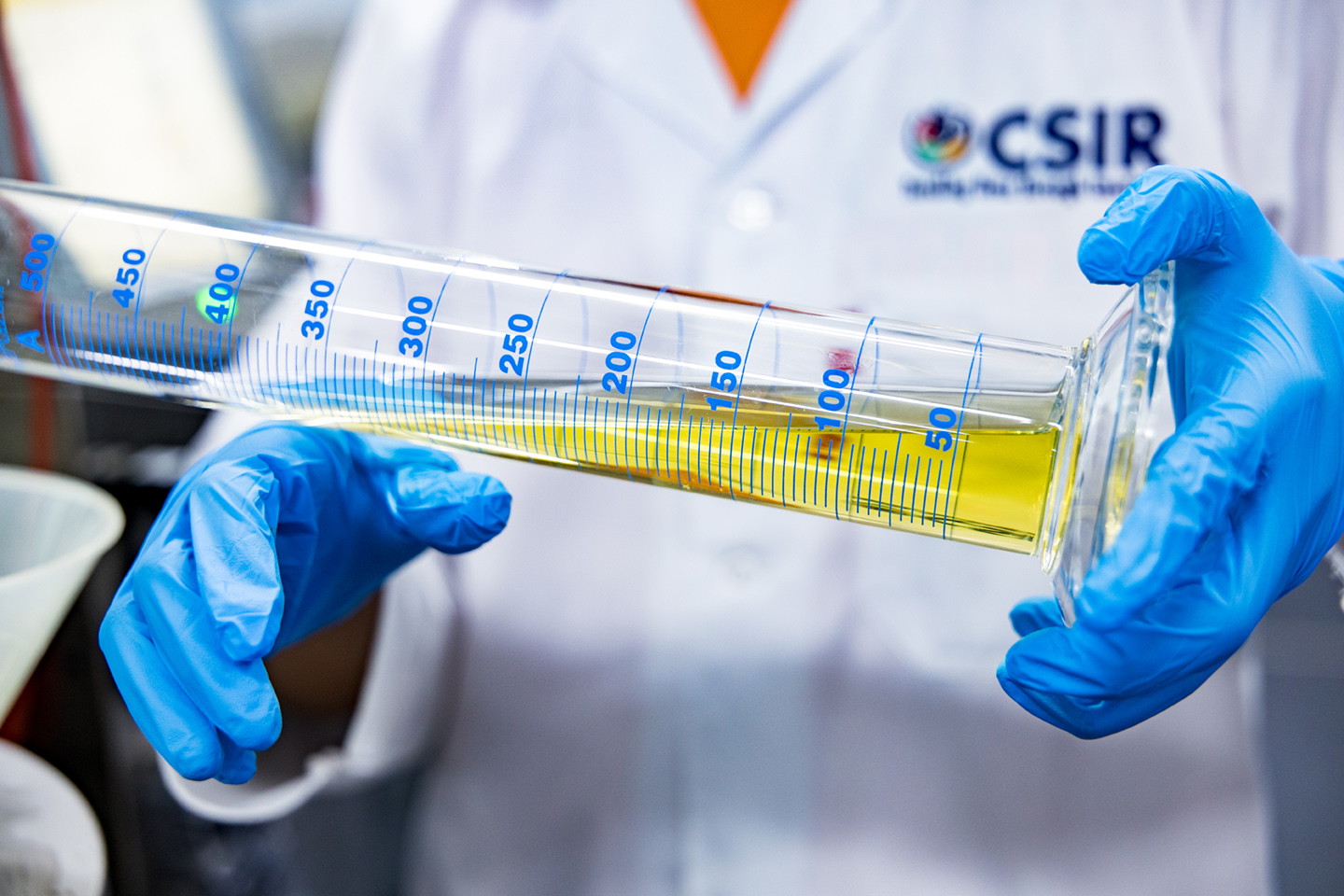
Immobazyme scales South African-made growth factor for cell-cultivated meat with CSIR support

South African biotech start-up Immobazyme has scaled production of a key growth factor used in cell-cultivated meat, marking what it described as a major local manufacturing milestone after working with the Council for Scientific and Industrial Research to run the process in 50-liter bioreactors.
• Immobazyme and the CSIR scaled production of fibroblast growth factor 2, or FGF-2, to a 50-liter bioreactor process in South Africa for use in cell-cultivated meat.
• The project focused on turning a genetically modified E. coli strain into a cost-effective, scalable production system for a molecule that has traditionally been expensive to make.
• The collaboration gave Immobazyme industrial production insight and training while opening the door to wider localization of growth factors and related proteins in South Africa.
The molecule at the center of the project was fibroblast growth factor 2, or FGF-2, a protein used to signal mammalian cells to multiply. That makes it one of the essential inputs in cell culture systems used by companies developing cell-cultivated meat from animal cells.
Immobazyme originally approached the CSIR with a genetically modified bacterial strain designed to produce FGF-2. From there, the work shifted toward a more industrial challenge: whether the process could be scaled efficiently enough to support a market where growth factors have long been a stubborn cost problem.
“Companies specialising in cell-cultivated meat take a cell from a cow or a fish or a chicken,” explained Nick Enslin, chief commercial officer and co-founder of Immobazyme. “They take it to the laboratory and then they make that one cell become many cells - and eventually those many cells become a food product.”
That multiplication process depends on growth factors such as FGF-2, which are added to guide and sustain cell growth. But while the science behind these molecules is well established, their cost has remained a major issue for companies trying to bring cell-cultivated products closer to commercial reality.
Dr Veshara Ramdas, a biotechnology expert at the CSIR, said her team quickly recognized the commercial potential when Immobazyme presented the opportunity around FGF-2 and the wider cultivated meat industry.
“They brought the technology for us to look at development and scalability,” said Ramdas, who added that the CSIR’s role was to develop a cost-effective and efficient production process using precision microbiology and bioreactors.
The workflow began at the smallest scale. Microbiologists first established sterile, stable conditions to make sure only Immobazyme’s genetically modified E. coli strain grew in the culture, along with the protein of interest. The culture started in a petri dish, moved into a nutrient-rich flask, and was then transferred into larger bioreactors where temperature, nutrients, and other conditions could be tightly controlled.
Those bioreactors were used to drive efficient production of FGF-2 at larger scale. Once the fermentation run was complete, the team moved into downstream processing, separating the liquid fraction from the E. coli biomass.
“When we harvest the bioreactor, that whole broth then goes through a separation process,” Ramdas said.
From there, the work became more technically demanding. Because the target product was intracellular, the bacterial cells had to be broken open mechanically to release the protein. Ramdas described the step plainly: “Our product is based intracellularly, so we have to pop those cells open or break them open, in a process of mechanical disruption.”
The disrupted material then went through centrifugation, allowing the heavier cell debris to separate from the clarified liquid containing the target protein. That clarified lysate was then purified further until the final output was a purified FGF-2 protein powder suitable for cell culture applications.

“This clarified lysate goes through a purification process,” Ramdas said.
The significance of the project, she added, lay not only in the molecule itself but in the fact that the process had now been demonstrated at a meaningful pilot scale in South Africa.
“For the first time in South Africa, we were able to demonstrate a process for this growth factor at a 50-litre bioreactor scale,” Ramdas continued. “It is a huge achievement for the CSIR and this opens doors to other novel and unique technologies to localize - particularly fibroblast growth factors and others such as insulin growth factors.”
That localization point may prove especially important. Cell-cultivated meat supply chains still rely heavily on specialized ingredients that are expensive and often produced outside the markets where companies are trying to build manufacturing capacity. A domestic route to producing growth factors could help reduce both cost and supply risk over time, even if much larger volumes will still be needed.
For Immobazyme, the partnership also delivered something less tangible but equally valuable: exposure to industrial-scale bioprocessing and the operational realities that come with it.
Enslin said the company had benefited not only from access to the CSIR’s infrastructure in Pretoria, but from the technical knowledge shared by Ramdas and her colleagues during the collaboration.
“The BIDC is an incredible facility; it is a world-class facility,” he said. “But I would almost say beyond the facility itself, the equipment and the machinery, there was this flow of ideas; it was a collaborative effort.”
That experience is likely to shape the company’s next steps. Enslin said Immobazyme was now looking toward larger-scale manufacturing of FGF-2 as well as other proteins and products in its pipeline. As a smaller company, it plans to continue using the CSIR’s large-scale facilities to strengthen its own production capabilities rather than trying to build everything alone.
For South Africa’s biotech sector, the project offered a concrete example of how start-ups and public research infrastructure can work together to move specialist biomanufacturing technologies beyond the bench. For Immobazyme, it marked a step from proof of concept toward something more industrial: a locally demonstrated process for making one of the sector’s critical molecules.

Join Us At One Of Our Upcoming Events

If you have any questions or would like to get in touch with us, please email info@futureofproteinproduction.com

.jpg)
.jpg)
