LIKE-A-PRO reports lower protein production costs as partners reach industrial scale

Partners in the European LIKE-A-PRO project have reported advances in alternative protein production, including a 50% reduction in microbial protein production costs at Calidris Bio and profitable industrial-scale production of pea and fava bean proteins at Sanygran.
• Sanygran reported profitable industrial-scale production of pea and fava bean protein ingredients, reaching protein contents of up to 55% through air classification under the European LIKE-A-PRO project.
• Calidris Bio doubled microbial protein production yield and reduced production costs by 50%, while other partners addressed extraction efficiency, unwanted flavors, mouthfeel and fungal production automation.
• Celabor coordinated ingredient development alongside nutritional, functional and safety assessments, with partners examining how production improvements translate into ingredients suitable for commercial food manufacturing and use.
The project brought together ingredient producers and research organizations to improve processes across seven protein categories, covering pulses, rapeseed, microorganisms, mealworms, krill, mushroom stems and fermented fungal protein. Work addressed both manufacturing economics and the characteristics that determine whether food companies can use an ingredient successfully.
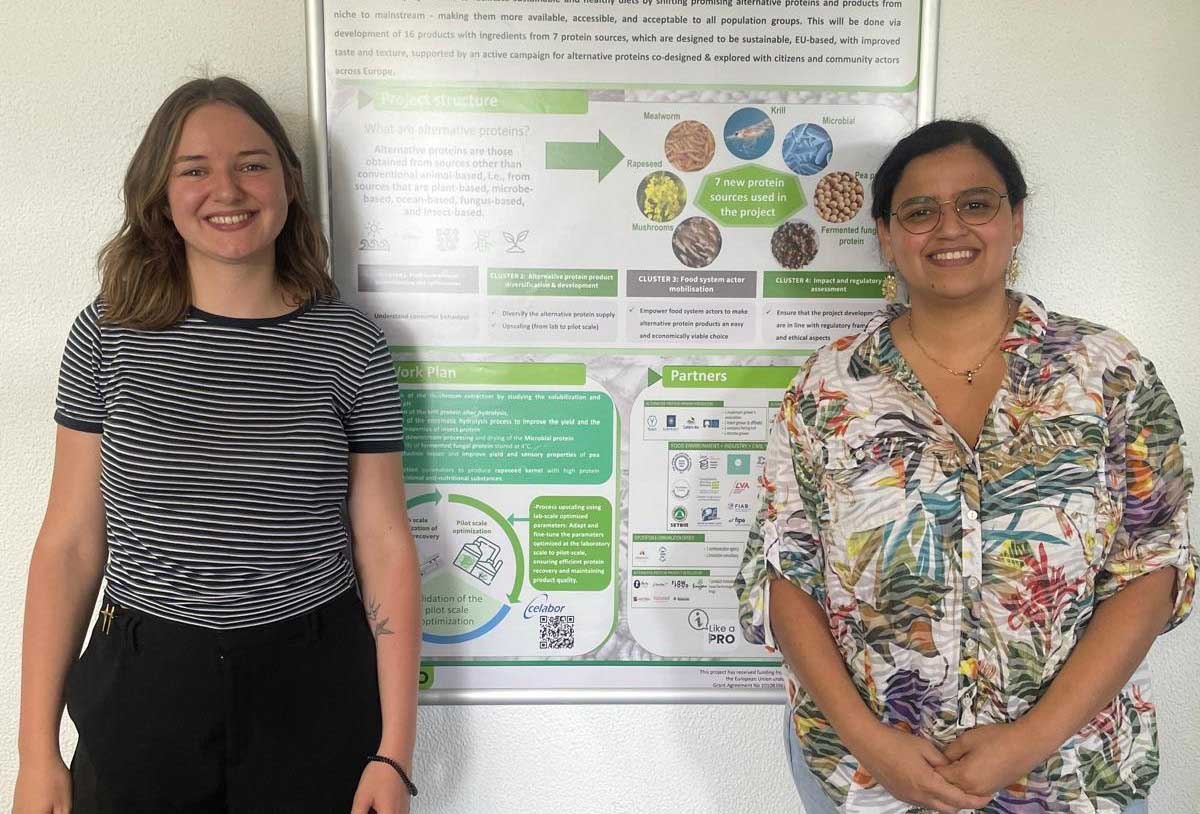
At Belgian research center Celabor, R&D project managers Soukaina Hilali and Camille Malterre supported and coordinated ingredient development. They identify the gap between laboratory performance and commercially viable production as a central challenge.
“Many alternative protein production processes are still complex and costly. Scaling them up often requires significant investment in equipment and processing technologies. Our goal has been to help ingredient producers improve their processes, increase efficiency and enhance the quality of the final ingredients,” they explain.
The priorities varied between producers. Some needed to recover more protein from their raw materials or simplify processing. Others concentrated on taste, color and texture, addressing characteristics that could limit an ingredient’s suitability for food applications.
Spanish ingredient producer Sanygran established industrial-scale production of pea and fava bean proteins using air classification, which separates protein-rich fractions from other components of the raw material.
According to the project, Sanygran achieved protein contents of up to 55% and established production capacity of 3,000-3,600kg of protein per hour. The company reported that the process was operating profitably.
Hilali and Malterre highlight the result as an example of technical development progressing alongside economic feasibility. For ingredient manufacturers, the work addressed the need to supply sufficient volumes while keeping production commercially workable.
Calidris Bio, meanwhile, optimized its microbial protein production parameters, doubling production yield and reducing production costs by 50%. The reported improvements addressed two linked obstacles to commercialization: the amount of ingredient a process can deliver and the cost of producing it.
Fraunhofer developed and scaled up a rapeseed extraction process that enables the simultaneous recovery of oil and protein. The approach uses solvents described by the project as more environmentally friendly, avoiding conventional petroleum-based solvents such as hexane.
Its work also targeted protein quality and unwanted flavors, with the aim of making the resulting ingredient more suitable for food formulation.
For Rimfrost, purification was a priority. The company scaled up a process to reduce unwanted odors and improve the sensory quality of krill protein. It developed an ingredient containing more than 70% protein with a complete essential amino acid profile.
Other partners addressed different processing and sensory problems. Ÿnsect improved the properties of mealworm protein, including reducing a sandy mouthfeel, and carried out semi-industrial scale-up.
CTICH developed a protein ingredient from stems remaining after the cultivation of white button, oyster and shiitake mushrooms, providing a route to use material left over from mushroom production.
Kinoko introduced automation strategies to improve production efficiency and support the scale-up of fermented fungal protein.
Alongside these developments, project partners assessed whether the ingredients met nutritional, safety and functional requirements. Greater output or lower manufacturing costs would not, on their own, establish suitability for commercial food use.
CNTA analyzed ingredients at different stages of development, monitoring techno-functional properties that influence how they behave when incorporated into food products. This work accompanied process development so that improvements in production could be evaluated alongside ingredient performance.
GAIKER monitored safety and quality, including nutritional profiles, digestibility, potential contaminants and antinutritional factors. Ingredient producers also worked under food-grade conditions to minimize contamination risks.
“The development of alternative proteins requires a holistic approach. Improving production yields and reducing costs must go hand in hand with ensuring nutritional quality, food safety and the functional properties that food manufacturers need,” Hilali and Malterre explain.
The project identified production costs, industrial scalability, regulatory requirements and consumer acceptance as continuing obstacles to market entry. Its partners’ results cover different stages of development, from semi-industrial processing to Sanygran’s reported profitable industrial operation.
LIKE-A-PRO has published seven ingredient factsheets detailing the work across its protein sources, including process improvements, ingredient characteristics and progress toward larger-scale production.
If you liked this, check these out...
• LIKE-A-PRO pilots reveal what helps alternative proteins win repeat consumers
• Duynie targets fermentation feedstocks in PROSCALE microbial protein project
• PROSCALE secures €7 million EU backing to scale single-cell proteins from food industry sidestreams

Join Us At One Of Our Upcoming Events

If you have any questions or would like to get in touch with us, please email info@futureofproteinproduction.com