Superbrewed Food launches Thryvia postbiotic for digestive and immune health formulations

Superbrewed CEO Bryan Tracy talks PPTI through the science behind Thryvia, how its biological activity is measured and what the platform could yield next
Superbrewed Food has commercially launched Thryvia, a shelf-stable, protein-derived postbiotic produced from non-viable Clostridium tyrobutyricum, taking the company's fermentation platform into low-dose functional ingredients for digestive and immune health support.
• Superbrewed Food launched Thryvia, a postbiotic derived from heat-killed Clostridium tyrobutyricum strain ASM19, for food, beverage, supplement and pet nutrition applications.
• Third-party assays found activation of TLR2, TLR5 and NOD2, while Superbrewed developed methods to measure the ingredient's biological activity batch-to-batch.
• Thryvia is manufactured commercially through Superbrewed Food's partnership with Döhler and is typically formulated at approximately 200mg per serving.
Thryvia follows Superbrewed's SB1 Postbiotic Cultured Protein, drawing on the same core fermentation platform but developed for a different commercial purpose.
“SB1 and Thryvia come from the same core fermentation platform and are closely related, but they’re developed, specified and commercialized for very different uses,” Bryan Tracy, Co-Founder & CEO of Superbrewed Food, said. “SB1 is positioned as a high-protein nutritional ingredient at gram-level inclusion, while Thryvia is developed and standardized around its postbiotic activity at much lower inclusion levels.

“So Thryvia isn’t simply a new name or positioning exercise for SB1. It’s a distinct commercial product built around a different intended use, specification and evidence package.”
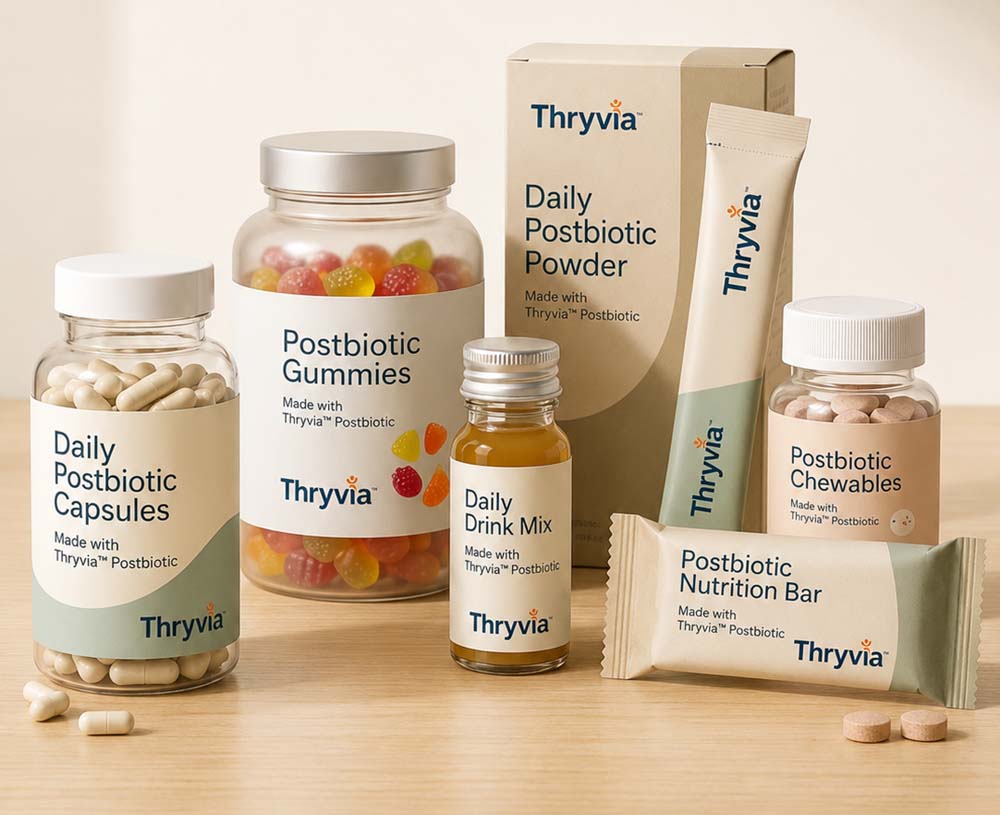
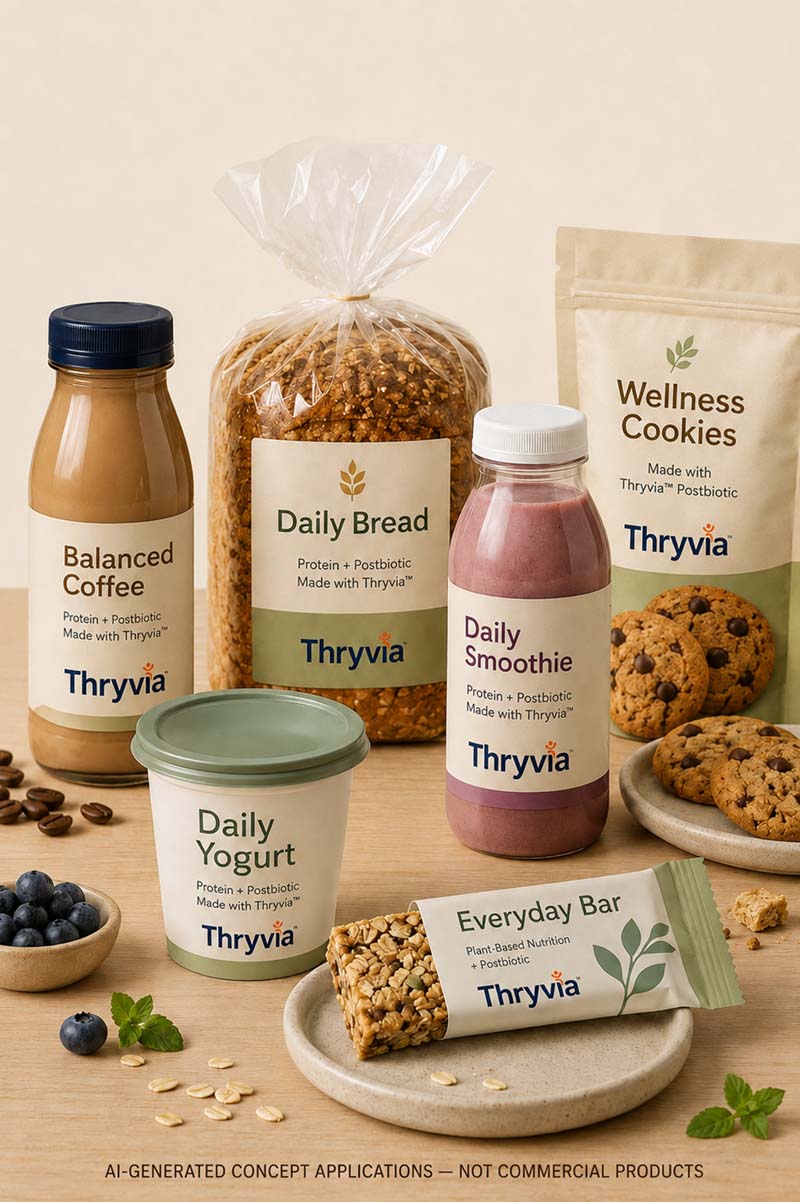
Produced from heat-killed C. tyrobutyricum strain ASM19, Thryvia is non-viable and shelf-stable at room temperature. Superbrewed has developed it for use across capsules, powders, gummies, bars, foods and beverages, including shelf-stable and UHT-processed formats, as well as pet nutrition.
Commercial supply is available through the company's manufacturing partnership. The ingredient has also received a ‘No Questions’ letter from the US Food and Drug Administration under GRAS Notice GRN 1129.
“Consumers understand digestive comfort and immune health, but brand owners need differentiated ingredients backed by science that also work in real-world products,” Tracy said. “Thryvia brings science, differentiated positioning and practical formulation together, giving our customers a clear path to products that stand out.”

Because the organism is no longer viable in the finished ingredient, Superbrewed's scientific work has focused on the components of the microbial biomass and their interaction with the host rather than the survival of the microorganism itself.
Exactly which components account for Thryvia's activity remains under investigation.
“We have strong indications of which cellular structures are contributing to the postbiotic activity and are continuing to characterize them,” Tracy said. “We expect to share considerably more on that work in the near future.”
The company's current evidence includes third-party preclinical assays examining pattern-recognition receptors involved in host recognition of microbial structures.
“The activation pattern actually confirmed our hypothesis based on the composition of the microbial biomass we manufacture as a precision postbiotic,” Tracy said. “Thryvia activated TLR2, TLR5 and NOD2 in our assays, while we did not observe activation of other receptors tested, including TLR4 and NOD1. That selectivity was consistent with our hypothesis based on the biomass composition and suggests we’re seeing something more specific than indiscriminate recognition of bacterial material.
“The biology associated with that profile is also compelling. TLR2, TLR5 and NOD2 are implicated in intestinal barrier function, mucosal defense and host-microbe signaling, providing a plausible mechanistic hypothesis for how specific components of Thryvia may interact with the gut.
“We’re careful not to claim that receptor data alone establishes the mechanism in humans. But the alignment between composition, predicted receptor activity and our broader preclinical and translational findings gives us a strong mechanistic foundation that we’re continuing to investigate.”
Those findings also raised the question of whether similar results could be expected from another strain of C. tyrobutyricum.
“The prevalence and presentation of the bioactive components in the final biomass are physiology-dependent - influenced by the specific strain, its growth state and fermentation conditions, as well as the downstream processing used to purify, stabilize and prepare the finished ingredient,” Tracy said.
“So the differentiation really sits in the combination: ASM19 plus fermentation physiology plus downstream processing plus resulting composition. We would not assume that another C. tyrobutyricum strain, even processed similarly and administered at the same dose, would produce an equivalent biological response without actually demonstrating it.”
The same specificity applies to the regulatory basis established for the ingredient.
“There’s also an important regulatory dimension: the safety and regulatory basis supporting ASM19 and our specific preparation cannot simply be assumed to extend to another related strain,” Tracy said. “That combination of biological specificity, manufacturing control and regulatory substantiation is an important part of what we’ve built around Thryvia.”
Processing presents a different challenge. Killing the microorganism removes the need to maintain viability, but the cellular components responsible for biological activity still have to withstand manufacturing conditions.
“The postbiotic attributes we’re targeting are actually quite heat tolerant, which gives us considerable processing flexibility,” Tracy said. “Importantly, we can operate at elevated temperatures while retaining the functionality we care about, which also helps us maintain a very high standard of manufacturing hygiene.
“Of course, time and temperature still matter, and our process is controlled accordingly. But the inherent thermal stability of the relevant biomass components is one of the advantages of Thryvia - both in manufacturing and ultimately in food applications that would be challenging for live microorganisms.”
Superbrewed has tested Thryvia through extended pasteurization, high-pressure homogenization and standard UHT processing conditions.
For manufacturers, verifying what remains after that processing requires a different approach from the viable cell counts commonly used for probiotics.
“We’re not limited to measuring whether a compound is still present after processing - we can directly assay its in vitro biological activity using cell-based pattern-recognition receptor assays available through independent third-party laboratories,” Tracy said.
“That’s an important distinction. Probiotics are typically verified by viable cell count, while many postbiotics are characterized by the presence or concentration of particular components. With Thryvia, we can go a step further and test whether the processed ingredient - and potentially the finished food itself - retains the specific in vitro biological activity we expect.”
Those assays measure both the expected pattern of receptor activation and its magnitude, giving Superbrewed the ability to establish potency specifications and verify biological activity between commercial batches.
The approach could also be applied to finished products after Thryvia has undergone a customer's manufacturing process.
“That ability to measure function, not simply presence or concentration, is unusual in the postbiotic category and potentially a major advantage for brand owners – and ultimately consumers – who want confidence that the functionality intended at formulation is actually present in the product they consume,” Tracy said.
The commercial inclusion level is approximately 200mg per serving, giving formulators scope to use Thryvia in products where gram-level additions would be difficult to accommodate. “The ~200mg inclusion level emerged from a combination of our compositional, mechanistic, preclinical, translational and formulation work,” Tracy said. “One of the advantages of Thryvia is that we observe the in vitro biological activity we’re targeting at relatively low concentrations, so we don’t need gram-level inclusion to formulate it into foods.”
Superbrewed has also characterized concentration-response relationships in its PRR assays. “I’d distinguish that from saying we’ve established a pharmacological dose-response curve in humans – that’s not how we’re positioning the ingredient,” Tracy said. “For commercial use, 200 mg is the inclusion level around which we’ve built our current evidence base and formulation strategy.”
The scientific program has also extended into animal and human research. Controlled animal studies have provided translational evidence of intestinal and host-response activity, according to Superbrewed. A four-week consumer perception study has also been completed, with Superbrewed planning to release detailed results separately. Additional human studies are ongoing.
Thyrvia grew out of Superbrewed's broader work with ASM19 and its fermentation platform rather than a separate organism-discovery program.
“It was really both discovery and design,” Tracy said. “You’ll notice that we’ve always called SB1 Postbiotic Cultured Protein – the postbiotic biology was part of the platform from the beginning. With SB1, however, our primary focus was delivering core nutrition and protein benefits at gram-level inclusion.
“As we learned more about ASM19 and its biology, we recognized a second opportunity at much lower inclusion levels. With Thryvia, we’ve deliberately developed and optimized the product around a specific profile of postbiotic biological activity relevant to digestive and immune function.”
Commercial interest in functional ingredients helped push that work further. “The market has also caught up with the science,” Tracy said. “There’s tremendous pull for natural, shelf-stable functional ingredients that are easy to formulate into everyday foods, which accelerated our decision to dig much deeper into this low-inclusion postbiotic opportunity.”
Superbrewed is supporting prospective customers with samples, formulation guidance and claims substantiation as they evaluate Thryvia across food, beverage, supplement and animal nutrition applications.
The company has also appointed microbiome industry veteran Michael Bush as Co-Chairman of its board. Bush previously served as President & CEO of Ganeden, where he helped build and commercialize a branded probiotic platform. “As someone who has spent years in the microbiome space, I know exactly what it takes to bring a category-defining ingredient to market – and Thryvia has that potential,” Bush said. “I’m thrilled to work alongside this team to bring fermented ingredients to market that meet real, unmet needs across the food, beverage, supplement, and animal health industries.”
The work on Thryvia has also opened another avenue for Superbrewed's fermentation platform. “What we’re learning about the relationships among microbial physiology, composition, processing and biological activity is giving us a much more deliberate framework for identifying and developing other postbiotic functionality,” Tracy said. “That’s a very exciting longer-term opportunity for the platform.”
If you liked this, check these out...
• Babybel rolls out protein and probiotic snack cheese with launch of Babybel PRO
• NUS team turns Kombu into banana- and pear-scented probiotic superfood
• SUSU scientists ferment a new path for dairy-free probiotics

Join Us At One Of Our Upcoming Events

If you have any questions or would like to get in touch with us, please email info@futureofproteinproduction.com

More News