Your process works. Your factory might not.

Alternative protein companies have spent years proving their science. Commercialization is forcing them to learn what it takes to become manufacturers
A process can work in the lab. It can work at pilot scale. It can produce exactly the protein, ingredient or product its developers intended. And it can still be nowhere near ready for a factory. That is the uncomfortable gap now confronting parts of the alternative protein sector as companies move from scientific development into commercial production.
.png)
David Ziskind put it succinctly in his latest column for Protein Production Technology International: “A process that works in the lab, even one that works at pilot scale, is not automatically ready for commercial manufacturing.”
His point goes further than the familiar warning that scale-up is difficult. Changing scale will often require the process itself to be redesigned for manufacturing, followed by revalidation before millions are committed to a facility built around it.
That requires companies to start thinking differently about what they are.
For much of the past decade, alternative protein rewarded scientific novelty. Companies were created around strains, processes, ingredients and technologies that could do something new. Venture funding allowed teams to prove the science, develop intellectual property and demonstrate what might eventually be possible at much greater scale.
Commercialization demands another skill set. As Ziskind argues, the work now includes capital project planning, site selection, contracting, procurement and facility startup. The company that began life as a food-tech startup has to learn how to become a food manufacturer.
That change can expose decisions made years earlier. During a PPTI webinar in July, NIZO's Robyn Eijlander warned that scale-up problems frequently have their origins in laboratory choices around biology, media, process engineering and manufacturability.

A strain that performs brilliantly in tightly controlled conditions can become less attractive if it requires expensive feedstocks at industrial volumes. A seemingly minor downstream step can become a serious cost once thousands of tons are moving through it. Mixing, heat removal and oxygen transfer behave differently as vessels get larger. Cleaning, sterility, water, utilities and waste suddenly become part of the process economics.
Even the building can become a problem. Facilities are expensive, but Ziskind warns that startups can focus too heavily on the obvious process equipment. Utilities and building services can derail a project through poor sizing and cost overruns just as effectively as a badly specified fermenter or dryer.
The people making those decisions matter, too. Ziskind argues that technically strong founders need to be complemented by experienced capital-project leaders, ideally people with traditional food-industry experience who have built large facilities before.
Perhaps more unusually, he recommends looking for somebody who has experienced failure. A project leader who has dealt with scope creep, missed schedules, cost overruns or other major problems knows what those failures look like before they happen again. For a startup spending a large proportion of its remaining capital on manufacturing, that experience can be considerably more useful than an immaculate project history.
Some companies are deciding that the answer is not to build at all. Nutrition from Water (NXW) has partnered with Jiangsu Jiangshan Pharmaceutical to scale production of its Marine Whey microalgae-derived protein using existing industrial fermentation infrastructure in China.
Rather than developing a greenfield facility, NXW gains access to fermentation capacity alongside downstream manufacturing and distribution capabilities. The company said the arrangement brought its expected path to profitable scale forward from late 2028 to early 2027.
It is a reminder that industrialization does not necessarily mean constructing a factory. The manufacturing question is partly about understanding which parts of a process a company genuinely needs to own, where its competitive advantage sits and which capabilities can be supplied more effectively by somebody else.
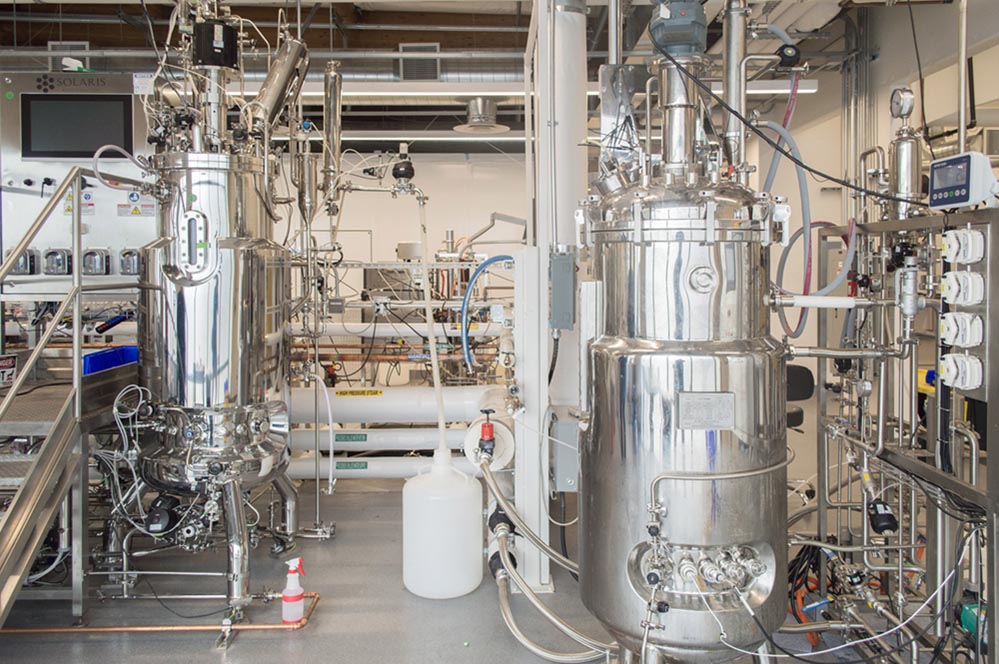
For companies that do build, the learning does not stop when the factory opens. Solar Foods provides a rare example. Factory 01 in Vantaa took Solein production from pilot to industrial scale through a 100-fold increase. By October 2025, the facility had reached its full annual design capacity of 160 tons, using a 20,000L bioreactor for a gas fermentation process based on carbon dioxide, hydrogen and electricity.

Yet the company's pilot facility subsequently achieved productivity of 1.6g/L/h, compared with 1g/L/h when Factory 01 reached design capacity.
Solar Foods therefore continued transferring improvements demonstrated at pilot scale into its commercial operation, with higher productivity and energy efficiency expected to increase Factory 01's annual design capacity to 230 tons.
Even after a successful 100-fold scale-up, there was more industrial learning to do.
The decisions become larger again with Factory 02, Solar Foods' proposed 6,400-ton facility in Lappeenranta. Electricity availability and the opportunity to integrate with the city's district heating network were among the considerations behind the site selection.
Those are not questions that dominate work at laboratory scale. At thousands of tons a year, they can have a direct bearing on whether the economics work.
Elsewhere, companies and technology providers are creating intermediate steps to reduce the size of the jump. Pow.Bio and Bühler have taken continuous precision fermentation through a 3,000L demonstration as they work toward commercial deployment. Pilot and shared infrastructure providers are increasingly offering companies access to progressively larger equipment before they commit to their own production assets.
All of this points to a change in what determines success. The sector still needs better strains, processes, ingredients and products. But a technically impressive process is only useful commercially if somebody can manufacture it reliably, repeatedly and at a cost the market will bear.
As Ziskind wrote in his Q3 2026 column, “The companies that make it through this phase will not be the ones with the most exciting processes. They will be the ones that treated manufacturing like the discipline it is, not an afterthought to the science.”
That is also where Industrialisation: What Startups Still Don’t Know About Manufacturing begins at The Future of Protein Production Amsterdam.
Jean-Charles Motte, Head of Innovation at Soufflet Malt, brings experience from an established industrial manufacturer. Federico Duarte, CEO of Nutrition from Water, is taking NXW toward industrial production through existing manufacturing infrastructure. David Ziskind, Managing Partner at Mach Global Advisors, has spent years working on the engineering and capital decisions that startups encounter as they scale.
Godert Zijlstra, Chief Commercial Officer at Solar Foods, brings another perspective: what companies learn after they have actually made the leap into industrial production.
That should allow the discussion to get into the decisions that are considerably harder to put on a startup pitch deck.
When should a process stop being optimized for the laboratory and start being designed for manufacturing? What should a company build itself? What should it outsource? Who needs to be around the table before equipment is ordered? And which apparently small decisions can become very expensive once concrete has been poured?
For startups approaching commercial scale, there is an even simpler question. Before you build the factory, do you really know how to manufacture?
Industrialisation: What Startups Still Don’t Know About Manufacturing takes place at The Future of Protein Production Amsterdam from 12:30-1:00pm on Wednesday, November 4, 2026, at RAI Amsterdam. Click here to book your conference pass or to register for the free-to-attend exhibition ticket

Join Us At One Of Our Upcoming Events

If you have any questions or would like to get in touch with us, please email info@futureofproteinproduction.com